

Get in the KNOW
on LA Startups & Tech
XWhat Are LA’s Hottest Startups of 2022? See Who VCs Picked in dot.LA’s Annual Survey
Harri is dot.LA's senior finance reporter. She previously worked for Gizmodo, Fast Company, VentureBeat and Flipboard. Find her on Twitter and send tips on L.A. startups and venture capital to harrison@dot.la.
In Los Angeles—like the startup environment at large—venture funding and valuations skyrocketed in 2021, even as the coronavirus pandemic continued to surge and supply chain issues rattled the economy. The result was a startup ecosystem that continued to build on its momentum, with no shortage of companies raising private capital at billion-dollar-plus unicorn valuations.
In order to gauge the local startup scene and who’s leading the proverbial pack, we asked more than 30 leading L.A.-based investors for their take on the hottest firms in the region. They responded with more than two dozen venture-backed companies; three startups, in particular, rose above the rest as repeat nominees, while we've organized the rest by their amount of capital raised as of January, according to data from PitchBook. (We also asked VCs not to pick any of their own portfolio companies, and vetted the list to ensure they stuck to that rule.)
Without further ado, here are the 26 L.A. startups that VCs have their eyes on in 2022.
1. Whatnot ($225.4 million raised)
Whatnot was the name most often on the minds of L.A. venture investors—understandably, given its prolific fundraising year. Whatnot raised some $220 million across three separate funding rounds in 2021, on the way to a $1.5 billion valuation.
The Marina del Rey-based livestream shopping platform was founded by former GOAT product manager Logan Head and ex-Googler Grant LaFontaine. The startup made its name by providing a live auction platform for buying and selling collectables like rare Pokémon cards, and has since expanded into sports memorabilia, sneakers and apparel.
2. Boulevard ($40.3 million raised)
Boulevard’s backers include Santa Monica-based early-stage VC firm Bonfire Ventures, which focuses on B2B software startups. The Downtown-based company fits nicely within that thesis; Boulevard builds booking and payment software for salons and spas. The firm has worked with prominent brands such as Toni & Guy and HeyDay.

3. GOAT ($492.7 million)
GOAT launched in 2015 as a marketplace to help sneakerheads authenticate used Air Jordans and other collectible shoes. It has since grown at a prolific rate, expanding into apparel and accessories and exceeding $2 billion in merchandise sales in 2020. The startup sealed a $195 million funding round last summer that more than doubled its valuation, to $3.7 billion.
The Best of the Rest
VideoAmp ($578.6 raised)
Nielsen competitor VideoAmp gathers data on who's watching what across streaming services, traditional TV and social apps like YouTube. The company positions itself as an alternative to so-called "legacy" systems like Nielsen, which it says are "fragmented, riddled with complexity and inaccurate." In addition to venture funding, its total funding figure includes more than $165 million in debt financing.
Mythical Games ($269.4 million raised)
Seizing on the NFT craze, Mythical Games is building a platform that powers the growing realm of “play-to-earn games.” Backed by NBA legend Michael Jordan and Andreessen Horowitz, the Sherman Oaks-based startup’s partners include game publishers Abstraction, Creative Mobile and CCG Lab.

FloQast ($202 million raised)
FloQast founder Michael Whitmire says he got a “no” from more than 100 investors in the process of raising a seed round. Today, the accounting software company is considered a unicorn.

Nacelle ($70.8 million raised)
Nacelle produces docuseries, books, comedy albums and podcasts. The media company’s efforts include the Netflix travel series “Down To Earth with Zac Efron.”
Wave ($66 million raised)
A platform for virtual concerts, Wave has hosted performances by artists including Justin Bieber, Tinashe and The Weeknd. The company says it has raised $66 million to date from the likes of Warner Music and Tencent.
Papaya ($65.2 million raised)
Sherman Oaks-based Papaya looks to make it easier to pay “any” bill—from hospital bills to parking tickets—via its mobile app.
LeaseLock ($63.2 million raised)
Based in Marina del Rey, LeaseLock says it’s on a mission to eliminate security deposits for apartment renters.
Emotive ($58.1 million raised)
Emotive sells text message-focused marketing tools to ecommerce firms like underwear brand Parade and men's grooming company Beardbrand.
Dray Alliance ($55 million raised)
Based in Long Beach, Dray says its mission is to “modernize the logistics and trucking industry.” Its partners include Danish shipping company Maersk and toy maker Mattel.

Coco ($43 million raised)
Coco makes small pink robots on wheels (you may have seen them around town) that deliver food via a remote pilot. Its investors include Y Combinator and Silicon Valley Bank.

HiveWatch ($25 million raised)
HiveWatch develops physical security software. Its investors include former Twitter executive Dick Costollo and NBA star Steph Curry’s Penny Jar Capital.

Popshop ($24.5 million raised)
Whatnot competitor Popshop is betting that live-shopping is the future of ecommerce. The West Hollywood-based firm focuses on collectables such as trading cards and anime merchandise.
First Resonance ($19.4 million raised)
Founded by former SpaceX engineer Karan Talati, First Resonance runs a software platform for makers of electric cars and aerospace technology. Its clients include Santa Cruz-based air taxi company Joby Aviation and Alameda-based rocket company Astra.
Open Raven ($19 million raised)
Founded by Crowdstrike and Microsoft alums, Open Raven aims to protect user data. The cybersecurity firm’s investors include Kleiner Perkins and Upfront Ventures.

Fourthwall ($17 million raised)
When an actor faces the camera and speaks directly to the audience, it’s known as “breaking the fourth wall.” Named after the trope, Venice-based Fourthwall offers a website builder that’s designed for content creators.

The Non Fungible Token Company ($15 million raised)
The Non Fungible Token Company creates NFTs for musicians under the name Unblocked. Its investors include Jay Z’s Marcy Venture Partners and Shawn Mendez.
Safe Health Systems ($15 million raised)
Backed by Mayo Clinic Ventures, Safe Health develops telehealth software and offers tools for enterprises to launch their own health care apps.

Intro ($11.6 million raised)
Intro’s app lets you book video calls with experts—from celebrity stylists, to astrologists, to investors.

DASH Systems ($8.5 million raised)
With the tagline “Land the package, not the plane,” DASH Systems is a Hawthorne-based shipping company that builds hardware and software for automated airdrops.

Ettitude ($3.5 million raised)
With a focus on sustainability, Ettitude is a direct-to-consumer brand that sells bedding, bathroom textiles and sleepwear.

Afterparty ($3 million raised)
Along similar lines as Unblocked, Afterparty creates NFTs for artists and content creators such as Clay Perry and Tropix.

Heart to Heart ($0.75 million raised)
Heart to Heart is an audio-focused dating app that “lets you listen to the story behind the pictures in a profile.” Precursor Ventures led the pre-seed funding round.
Frigg (undisclosed)
Frigg makes hair and beauty products that contain cannabinoids such as CBD. The Valley Village-based company raised an undisclosed seed round in August.
- The Early-Stage Startups in LA Set to Take Off in 2021 - dot.LA ›
- Los Angeles Startups Closed a Record Number of Deals in Q3 - dot.LA ›
- dot.LA's Map of Startups in Los Angeles - dot.LA ›
- The Hottest LA Startups of 2020 - dot.LA ›
- Los Angeles Cleantech Incubator Launches Green Loan Fund - dot.LA ›
- dot.LA's Guide on L.A. Flight Startups Overair, Archer Aviation - dot.LA ›
- Here Are LA’s Hottest Startups for 2023 - dot.LA ›
- Nobody Studios Plans to Build 100 Startups in Five Years - dot.LA ›
- From GameTree to Sota — Ukrainian Founders Call LA Home - dot.LA ›
Harri is dot.LA's senior finance reporter. She previously worked for Gizmodo, Fast Company, VentureBeat and Flipboard. Find her on Twitter and send tips on L.A. startups and venture capital to harrison@dot.la.
The $100M Plan to Deliver Sunlight After Dark
🔦 Spotlight
Hello, LA.
Most companies built around solar energy are trying to capture more sunlight.
Reflect Orbital wants to move it.
The Hawthorne-based startup is developing satellites equipped with large reflectors that could redirect sunlight from orbit to specific locations on Earth after sunset. The idea sounds borrowed from science fiction, but Reflect Orbital is getting closer to testing whether it can work at commercial scale.
This week, the company announced $73.5M in new funding, bringing its total raised to more than $100M. Existing investors Sequoia Capital, Lux Capital and Starship Ventures participated alongside new backers including Buckley Ventures, Convective Capital, The Uncommon Group and Salesforce Ventures.
The funding will support Reflect Orbital’s first satellite launches, continued development of its reflector technology and new commercial partnerships across the energy and lighting industries.
The company’s premise begins with a familiar limitation: Solar panels stop producing energy when the sun disappears below the horizon, often just as electricity demand is rising.
Reflect Orbital wants to extend that window.
Its planned satellites would remain in sunlight while orbiting Earth, then angle their reflectors toward selected areas on the ground. Solar farms could potentially generate electricity beyond daylight hours without acquiring more land or replacing their existing infrastructure.
The same technology could eventually illuminate disaster zones for search-and-rescue teams, help construction crews work more safely at night and provide light in places without reliable electrical infrastructure.
That is a considerable expansion from where the company stood two years ago.
Reflect Orbital raised a $6.5M seed round in 2024 to develop its production vehicles and grow its Hawthorne team. It followed that with a $20M Series A led by Lux Capital in May 2025.
Now, the company is preparing to leave the warehouse and test its technology where it was designed to operate.
Reflect Orbital has received Federal Communications Commission approval for its first demonstration mission, Eärendil-1, which is expected to launch in the second quarter of 2027. The satellite will allow the company to study how its reflector deploys and performs in low Earth orbit while gathering data that could shape future versions of the system. Reflect Orbital has also secured additional launch opportunities for 2027, including two dedicated missions with Skyroot Aerospace.
Building the satellites presents its own unusual manufacturing challenge. According to the company, its team produces reflector material 28 times thinner than a human hair, folds individual sections into packages roughly the size of a shoebox and assembles satellites containing approximately 12,000 parts.
In other words, delivering sunlight after dark requires some very careful folding.
The concept has naturally prompted questions from astronomers and dark-sky advocates about light pollution and potential interference with scientific observations. Reflect Orbital says it is designing the service around predictability, transparency and control, including limiting reflections to defined locations and short periods, publishing satellite positions in advance and avoiding observatories and other protected sites.
The demonstration mission is expected to produce illumination comparable to a full moon for no more than five minutes during the two hours following local sunset. Reflect Orbital has also said it will collect data, invite outside evaluation and use the results to refine both its technology and safeguards before attempting to scale.
That process will matter because Reflect Orbital is not simply building another satellite. It is proposing a new kind of infrastructure, one that could change when and where sunlight becomes available.
The company still has significant technical and regulatory work ahead. But it has already moved from an unconventional idea to more than $100M in funding, an approved demonstration mission and multiple launch opportunities.
The next step is proving that its technology can deliver light precisely, reliably and responsibly from hundreds of miles above Earth.
If it succeeds, the sun may no longer disappear from the energy grid when it drops below the horizon.
More from this week’s LA startup and venture scene below.
🤝 Venture Deals
LA Companies
- Helix raised $6.2M in a round led by Chicago Ventures, with participation from BAM Ventures, Aglaé Ventures, Corazon Capital and others. The startup is developing on-device voice technology that verifies whether users are human and estimates their age without collecting traditional identity documents, offering a privacy-focused alternative to CAPTCHA and photo verification. - learn more
- Opdo raised a $2.3M pre-seed round led by Angular Ventures, with participation from Inflection and Tiny.vc. The company uses AI agents alongside established optical-design software to help engineers develop and manufacture complex components faster, and will use the funding to expand its engineering capabilities, improve its AI tools and support more customer projects. - learn more
- Athlete To Athlete raised an $8M Series A led by Rally Ventures, with participation from Newbound VC, Scrum Ventures and UpHonest Capital. The platform pairs young athletes with college-athlete mentors for virtual one-on-one guidance and will use the funding to expand youth sports partnerships, strengthen participant safeguards and reach more families nationwide. - learn more
- Kindo raised $30M in a round co-led by Crosspoint Capital and Forgepoint Capital, bringing its total funding to $57.6M. The company provides a centralized platform for enterprises to monitor and control AI agents, including their data access, activity and costs, and will use the capital to expand sales and further develop its AI management and security products. - learn more
- Trousdale Ventures made a follow-on investment in Databento’s $100M Series C, which was led by Fifth Down Capital and valued the market-data company at $1.1B. Databento plans to accelerate its global infrastructure expansion and build a larger historical market-data archive as demand grows from financial institutions and AI companies. - learn more
- Upfront Ventures led General Translation’s seed round, while Andreessen Horowitz led its Series A, bringing the AI localization startup’s combined funding across the two rounds to $27M. The company is building full-stack infrastructure that helps businesses translate and continuously update apps, websites, documents and videos across languages. - learn more
- Alpha Edison participated in Q-CTRL’s $290M Series C, which was led by Salesforce Ventures. The quantum infrastructure company will use the funding to expand its AI-powered software for improving the performance and reliability of quantum computers and sensors while accelerating commercial adoption. - learn more
- KittyHawk Frontier participated in Twin1 AI’s $5M seed extension, which was led by Curql and brought the company’s total seed financing to $25M. Twin1 develops privacy-focused AI “digital twins” that preserve professionals’ knowledge and working context, and will use the capital to expand across credit unions, law firms and financial institutions while growing its teams and enterprise governance tools. - learn more
- Bonfire Ventures co-led Axle’s $9M funding round alongside Eniac, with participation from Teamworthy Ventures. Axle provides investment banks with a unified platform for managing conferences, corporate access, roadshows and expert engagements, and will use the capital to expand its AI capabilities and bring the product to more financial institutions. - learn more
- TenOneTen Ventures participated in Tristar AI’s $12.4M Series A, which was led by Isogon Ventures. The Cambridge-based company uses AI-powered visual inspection to identify manufacturing defects in real time and will use the funding to improve its vision and edge-computing platform, enter additional industries and support larger deployments across customer facilities. - learn more
- Clearlake Capital Group co-led Mirendil’s $1B Series A alongside Kleiner Perkins, with M13 participating among the company’s other new and existing investors. Mirendil is developing AI agents and tools that allow smaller teams to conduct advanced AI research and will use the funding to make frontier-level R&D more accessible to scientists and engineers. - learn more
- CommonKind VC participated in Akara’s $5.5M funding round, which was led by Locke Health and brought the healthcare technology company’s total funding to $12.3M. Akara combines privacy-preserving sensors, AI agents and robotics to give hospitals real-time visibility into clinical operations, and will use the capital to expand its teams, grow adoption across U.S. hospitals and further develop its physical AI platform. - learn more
- March Capital co-led Rox’s $100M Series B alongside General Catalyst, valuing the AI sales startup at $1.3B. Rox helps large enterprises automate pipeline generation, deal execution and upselling, and will use the funding to advance its AI models and expand across industries including healthcare, energy, financial services and manufacturing. - learn more
- Clocktower Technology Ventures participated in Palomma’s $10M Series A, which was led by Cometa and brought the Colombian fintech’s total funding to $14M. Palomma combines AI leasing software, rent payments and financial products for landlords and tenants, and will use the capital to expand in Colombia, develop additional services and prepare for entry into new markets. - learn more
- Alpha Edison led Agent F’s $4M pre-seed round, with participation from United Founders, Tiny Supercomputer Investment Company and several technology executives and founders. The Berlin startup is building AI-powered enterprise software that automates accounting, financial planning and compliance tasks for fast-growing companies while keeping finance professionals responsible for final approval. - learn more
- Bail Capital participated in Delix Therapeutics’ oversubscribed $100M Series C, which was co-led by Johnson & Johnson Innovation and SV Health Investors’ Dementia Discovery Fund. The neuroscience company will use the funding to advance its non-hallucinogenic depression treatment Zalsupindole into Phase II development and expand its broader pipeline of therapies for psychiatric and neurodegenerative conditions. - learn more
- M13 participated in Nominal’s $240M Series C, which was led by Lightspeed Venture Partners and co-led by Insight Partners at a $3B valuation. The hardware intelligence company will use the funding to expand its AI-powered engineering platform, develop new tools across the hardware lifecycle and enter additional industries and markets. - learn more
- MANTIS Venture Capital participated in Project Omega’s $80M Series A, which was led by B Capital. The nuclear technology company will use the funding to begin building a domestic fuel-recycling facility and advance long-duration power systems that transform materials recovered from used nuclear fuel into energy, reactor feedstock and strategic isotopes. - learn more
- Critical Frontier participated in Mavria’s latest funding round, which was led by Paradigm and valued the infrastructure startup at $1B. Mavria has raised $130M across its pre-seed and seed rounds to scale manufacturing, secure supply chains and build factory-produced data centers designed to bring AI computing capacity online faster and at lower cost. - learn more
Fashion Tech Works Opens New Coworking Space for Emerging Designers
For Cindy Keefer, CEO of Fashion Tech Works, sustainability has always been a way of life. The woman behind Downtown Los Angeles’ new coworking incubator for designers and artists grew up a far cry from Hollywood, on an organic farm in Wisconsin.
“I've been an environmentalist since I was born,” said Keefer, a vegetarian since childhood. “So for me, I never had a breakthrough moment.”
Sustainability is at the heart of Fashion Tech Works’ mission: The incubator is particularly interested in giving a home to designers and technologies “that improve the sustainability of apparel design and production,” according to its website.
“The passion is just so alive that I could actually change the trajectory of apparel manufacturing, to be sustainable and clean,” Keefer told dot.LA. “I want to be that hub for these young designers who want to make a difference,” Keefer said.
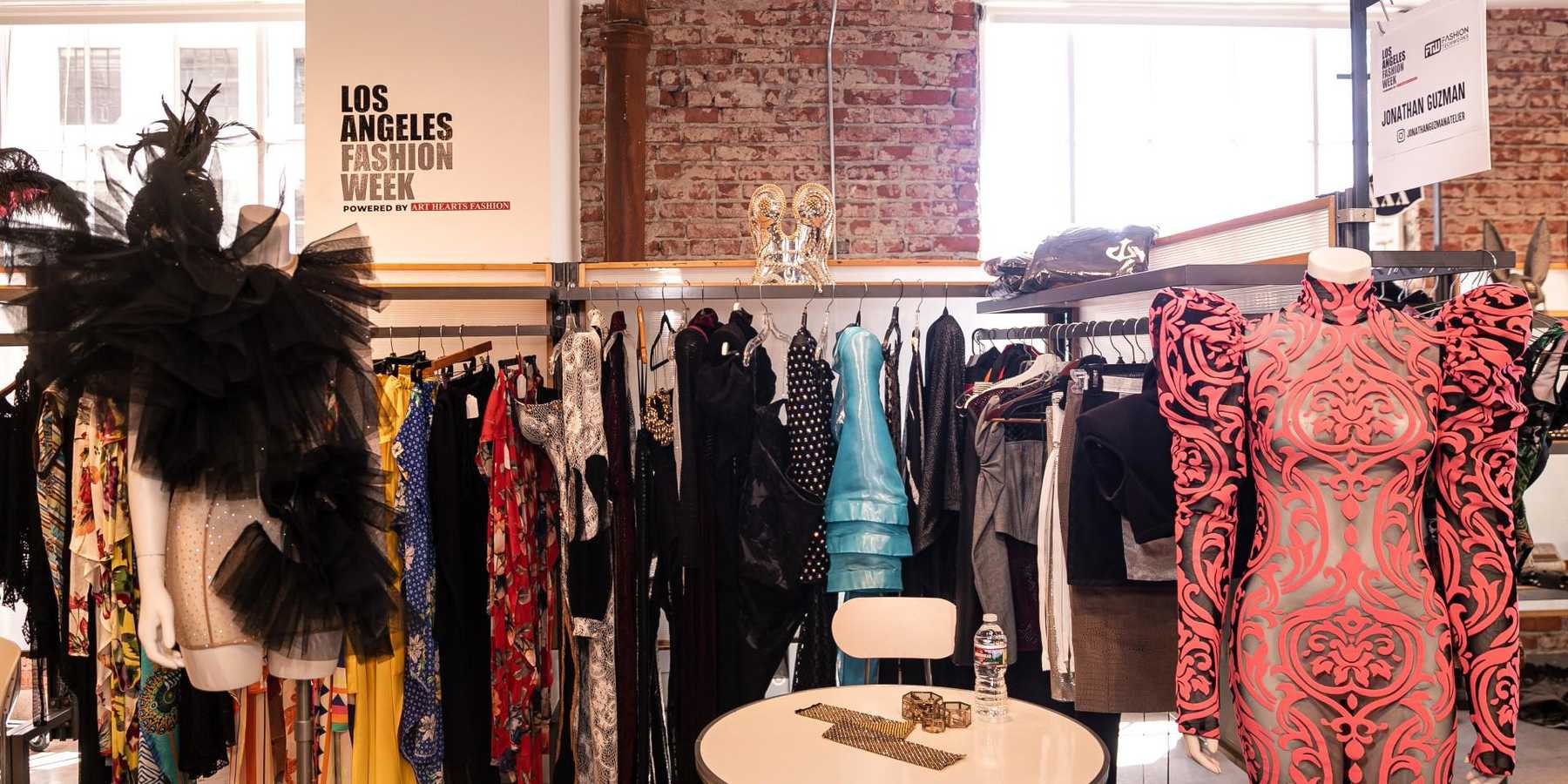
Earlier this month, the third floor of The New Mart in Downtown L.A. was bustling with designers and models preparing for Art Hearts Fashion, an annual Los Angeles Fashion Week event for local designers. Keefer partnered with Art Hearts to host a “fashion hub” that gave young talents the opportunity to network with brands like Doc Martens and Bellaria, as well as industry veterans like Condé Nast Latin America senior editor José Forteza.

“There's a void in the fashion program in Los Angeles, especially,” Art Hearts founder Erik Rosete said. A designer and long-time attendee of fashion weeks in Milan and Paris, Rosete noticed L.A. Fashion Week’s lack of a space for people to meet designers and get a hands-on experience of the clothing being showcased on the runway.
“It was very natural and synergistic that the partnership happened, because it created the opportunity to fill the void in L.A. Fashion Week,” he told dot.LA.
In 2015, Keefer and her husband Tom hosted Melange, a fashion tech conference held at The New Mart. The panelists included Liz Heller of TOMS shoes, Ashley Crowder of VNTANA and Kristine Upsuleja of Madison Innovative Materials, whom Keefer considers innovators in the fashion space.
During the first five years after the Melange conference, Keefer and her husband laid the groundwork for their business and created strong relationships with founders of other fashion incubators like Arizona-based FABRIC. Keefer used the pandemic as an opportunity, accepting a small business grant from the government which she used to launch Fashion Tech Works.
What was once storage space for The New Mart is now Fashion Tech Works’ incubator and coworking space, equipped with a content creation studio, events spaces and private offices.
Among the designers who showcased their work at the Art Hearts Fashion Hub was Symone Carter, designer of Le Mo’ney and a member of Fashion Tech Works.
“I just needed to be somewhere where I can get creative and meet other creatives,” Carter said. “I stumbled upon Fashion Tech Works on Instagram, set up an appointment to do a walkthrough and fell in love with it that first day.”

Each designer is required to have a fashion degree to become a member. There are three different tiers: silver ($60 per month), which is a remote membership that has access to the space two days out of the week; gold ($95), which includes daily access to the building; and premium ($750), which provides the designer with a private office space, access to the content creation studio for six hours a month and an opportunity to showcase their line on the runway.
Designers who become Fashion Tech Works members will receive the support of both FABRIC and garment producer Lefty Production Co. and access to the ORB360 machine, a 3D photographic technology that offers a 360-degree view on models. Keefer said Fashion Tech Works is also collaborating with other companies that focus on photographic printing, digital layouts, and cutting; she did not name those companies but said partnerships will be announced soon as negotiations are being finalized.
- GTLA Aims to Make LA Manufacturing More Equitable - dot.LA ›
- DressX's Filters Lets Users Dress in Couture Fashion - dot.LA ›
- Fashion Tech - dot.LA ›
- MarqVision Raises $20M to Stop Online Counterfeiters - dot.LA ›
- LA-Based Fashion Tech Companies Are Changing Online Shopping - dot.LA ›
- An Inside Look Into FCTRY LAb’s Shoe Making Tech - dot.LA ›
Decerry Donato is a reporter at dot.LA. Prior to that, she was an editorial fellow at the company. Decerry received her bachelor's degree in literary journalism from the University of California, Irvine. She continues to write stories to inform the community about issues or events that take place in the L.A. area. On the weekends, she can be found hiking in the Angeles National forest or sifting through racks at your local thrift store.