



Intersect Summit Updates: Snap Inc’s AR Play; How SportsTech is Remaking the Game

Sarah Favot

Favot is an award-winning journalist and adjunct instructor at USC's Annenberg School for Communication and Journalism. She previously was an investigative and data reporter at national education news site The 74 and local news site LA School Report. She's also worked at the Los Angeles Daily News. She was a Livingston Award finalist in 2011 and holds a Master's degree in journalism from Boston University and BA from the University of Windsor in Ontario, Canada.

Intersect Summit Updates: Snap Inc’s AR Play; How SportsTech is Remaking the Game
Photo by izayah ramos on Unsplash

Intersect event

From NFTs to augmented reality and streaming services, a new frontier reshaping entertainment and technology has exploded in Los Angeles. It's ripe with media talent and fueled by venture capital.

Dot.LA will explore that intersection of media and tech during our inaugural Intersect summit. We'll be talking to Los Angeles executives, entrepreneurs and investors at the forefront about trends moving the industry.

The event kicks off Wednesday with a keynote address from the CEO of Kevin Hart's Laugh Out Loud Productions and concludes with a pitch competition featuring three SoCal startups. Join the live event by applying to attend at the Intersect site. Follow us here for coverage.


The Live Events Industry Braces For a New Normal, and a 'Roaring' Return to In-Person

As more people get vaccinated, venues and stadiums are opening up, leaving a looming question: what will events look like in the future?

Leaders in the entertainment and event space said events in the near term will be hybrid, with organizers ensuring attendees feel and are safe. The industry is hoping that those watching at home will see others experiencing the in-person event, and become more comfortable with the idea of returning in person.

While some companies have found success in remote events, panelists said, it isn't equivalent to standing shoulder-to-shoulder with friends and strangers on the concert hall floor as they're experiencing their favorite artists.

"I'm looking forward for live to come back," said Robert Ellin, founder, CEO and chairman of LiveXLive.

LiveXLive will be testing the waters for its return to live events in June with an in-person matchup in Miami called "Social Gloves," which will pit YouTubers against TikTokers in the boxing ring. It will also be livestreamed.

VidCon will return as a live event in October in Anaheim. It's also selling digital tickets for remote access.

"I know they're going to enjoy the experience so much they're going to want to go to a VidCon somewhere else around the world when it comes near them in '22 or '23," Jim Louderback, GM and senior vice president of VidCon at Viacom, said of at-home viewers.

Ellin said he feels like we are moving into the Roaring 20s based on his experience of the excitement in Miami.

"We're all in the digital space right now," he said. "No matter what we do, the live experience is nothing like it. You're actually interacting with people and so there's going to be audiences."

In Los Angeles, SoFi stadium will host Vaxx Live on May 8, a charity concert featuring Selena Gomez. Organizers said it will host thousands of fully vaccinated frontline health care and essential workers.

Even as things return, more or less, to normal, industry insiders say the future live events will use more technology than it once did, including touchless purchasing at the ticket booth and concession stand, as well as more virtual and augmented reality experiences.

Louderback said at VidCon they're thinking of ways to incorporate those technologies, maybe a scavenger hunt or secret party through AR.

"I think there's really creative unique ways to integrate them," he said. "I think we all have to be thinking about those and those special ways to make it more interesting," he said.

Ellin said Social Gloves will feature NFTs in the form of a digital card, but also a physical card.

"As you can touch it and feel it, you're going to want to really have a responsibility of protecting those assets long term," he said.

When it comes to touchless technology at venues or processes like mobile ordering and individual packaging, Wroan said it might seem cumbersome and costly upfront, but it will put more people in seats.

"I think, once they're up and running, we're actually going to be more efficient — probably in the long run, better," she said. "Part of it, too, is just people feeling confident and safe to get off the couch and come experience a live event."

Snap Inc’s AR Play
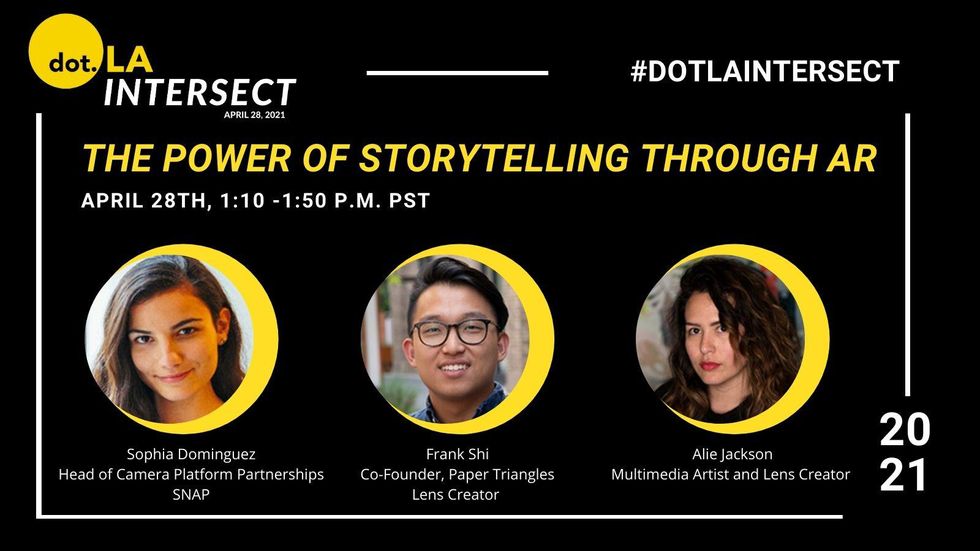
Snap Inc. is placing big bets on AR technology.

Last year, it announced a $3.5 million fund for augmented reality (AR) creators building their own lenses for the app.


The fund will help the Santa Monica-based company keep products fresh for its 280 million users and potentially reel in big revenue for developers and artists like Frank Shi, who co-founded a boutique AR studio called Paper Triangles.

But perhaps most importantly, it feeds Snap's advertising deals as brands look for new ways to sell products.

Shi remembers the first time he showed Crocs how to use Snap's AR try-on feature, which lets users step into shoes and clothes virtually.

"That experience to us was magical," Shi said. "I think when it comes to brands, they're a little hesitant at first, but once they see the magic...how easy it is to use AR, their eyes kind of twinkle."

As advertising remains a key component of Snap's business model, AR represents a natural avenue for companies scouting new customers. Fashion-oriented AR is a promising market given how shopping habits have moved online since the pandemic. Last month, Snap acquired FitAnalytics to help shoppers find the right clothing sizes.

"Before, it was a question of who's using AR," said Sophia Dominguez, who heads camera platform partnerships for Snap. "Brands have seen the value."

During its first quarter Q1 earnings call last week, Snap focused on two of its software development kits — Camera Kit and Lens Studio — and its community of "lens creators" like Shi who get early access to AR tools, training and support.

"Those who want to build AR on Snap," Dominquez said, "we hear you and we're looking for more ways to create streamlined sources of monetization."

How SportsTech is Remaking the Game

Intersect sport-tech panel

Athletes are moving from the court or the playing field into boardrooms. Increasingly they are shunning traditional endorsements for a stake in startups and other companies. It comes amid rapid-fire changes in sports tech and is altering the landscape for both investors and founders.


"What makes [athletes] really, really interesting partners is not only their ability to command an audience with their social following or their conversations on the court and in interviews and whatnot, but also their ability to support business development," said Amanda Groves, a partner at Plus Capital. The Marina del Rey-based venture advisory firm helps celebrities across entertainment and sports facilitate investments and equity-based partnerships.

Groves said athletes are particularly good storytellers and team players who are passionate about their underlying investments and can tell a complicated story in a way that's approachable and interesting for the consumer.

"It's not just a service day to go do this photoshoot to support a product line. It's like, 'this is my baby and I want to help grow it and so I'm going to give it to all my friends and I'm going to to talk about it every chance I get'," she said.

DeMarcus Williams, a partner at Silicon Valley Bank, which supports early stage entrepreneurs and VC firms, said athletes are cultural influencers, using NBA legend Michael Jordan as an example.

"I would say for startups that are pursuing athletes, it's really important that you really sit down and understand what they're passionate about and appeal to that passion point," Williams said.

Athletes' journeys through training from a young age to achieving success at a professional level is similar to the growth startups face, Groves said.

These changes are unfolding as the technology people use to interact with sports is changing.

For instance, the panelists think bite-sized highlight clips will be key to delivering sports that air on traditional regional networks.

Williams said he thinks these networks will still be around for the next 20 to 30 years, but he used the example of his 8-year-old son to highlight how younger audiences want to engage with sports.

"Can he sit down and watch a game for its entirety for three hours? No, for an hour, no, for 30 minutes, maybe, 15, maybe," he said. "A lot of these sports leaders and sports leagues, they're going to have to meet their audience where they are."

Kyle Laughlin, CEO of Surfline Wavetrak, Inc., a Huntington Beach-based company that specializes in surf forecasting and surf reports, said the World Surf League has demonstrated how to use digital platforms.

"I think there's a real range from a league perspective, from the little niche league to the mass, that is embracing technology to engage ether fans in new and interesting ways from both an athlete and a technology perspective," he said.

But it's not only in professional sports that tech is altering viewership. Pasadena-based BallerTV live streams and shows replays of youth basketball and volleyball, mainly targeting the audience of parents who can't make it to their kid's games. Since being founded in 2016, it has broadcasted more than 500,000 games, typically showing 10,000 games each weekend.

It is looking to expand into different vertices with the launch of youth soccer this summer.

"In this industry, we like to say that we're sort of first to market or category definers with respect to video at scale in this market," said Sandeep Hingorani, EVP, Founding Team at BallerTV.

PlayVS CEO Delane Parnell Has Ambitions Beyond HS, College Esports

Keynote with Delane Parnell

Founder and CEO of PlayVS Delane Parnell was living in Detroit and developing the idea for his company, when he had a chance meeting at South by Southwest with Peter Pham, co-founder of Santa Monica venture fund Science Inc.

Darnell recounted that Pham encouraged him to come to L.A., saying 'You can be a millionaire in Detroit or a billionaire in L.A., but don't waste my time.'

The startup has been on a remarkable ascendency since.

PlayVS has raised $107 million since it entered the esports marketplace for high school teams in 2018 and now 43% of all high schools in the country have an esports team, playing Fortnite, SMITE, League of Legends and other games using the PlayVS platform.

It expanded into the college market last year and now has 30% of colleges in the country on the platform.

"We wanted to build an environment to actually reengage and reactivate that community," he said.

While there are only 1,000 professional gamers in North America, there are 2.8 billion gamers globally, many of whom don't have aspirations to become professional. Parnell wanted to tap into that market starting with high schoolers, who sometimes are prevented from playing because they are under 18.

He said the beauty of amateur esports is "there's more gamers who care about actionality and don't necessarily care or have aspirations of going pro, and so they just want to play their favorite game at the time with their friends and teammates."

Eventually he'd like to expand, building PlayVS digital playground beyond school sports.

"I still want to build the digital playground in which every gamer can compete whether they're high school-aged or college-aged or in their 40s in any sort of context of competition," he said.

But, Parnell said, the company relies on partnerships with game publishers, who drive the content.

"We don't just add any game to our platform," he said. "We're really thoughtful in which titles we decide to partner with and integrate with."

NFTs Are 'No Get Quick Rich Scheme'

NFT Panel

The underpinning of the hottest new trend, NFTs or "non-fungible tokens," is blockchain and it's here to stay.

At least in the eyes of Zach Katz, CEO of the music-tech investment firm Raised in Space.

"Blockchain is finally finding its footing in supporting something that fans and artists have wanted to do for a long time," Katz said.

As the pandemic reshaped how businesses and creatives made money, NFTs have boomed as a new market for digital commerce. Artists and musicians can now build new and profitable relationships with fans — ones that do away with "traditional financing" they once relied upon, he said.

NFT sales have spiked in the first three months of the year. And artists and creators are looking at new ways to use the tokens to provide fans exclusive, paid experiences.

"Graphic artists and 3D designers now have a way to monetize their creativity and monetize the art that had been previously really, really hard to sell," added Shara Senderoff, president and partner at Raised in Space.

But in the world of NFTs, "there's no get quick rich scheme," Senderoff said. "This is about being able to show your loyalty and follow the people you admire and respect."

And the environmental consequences are looming.

"When you're putting in that level of energy and using that level of computing power at scale, it's absolutely doing something," Senderoff said about the climate change risks of blockchain technology. "Entrepreneurs need to be accountable and responsible for what the products they create are doing."

​'It's About Reading The Room': How Kevin Hart's LOL Connects with Audiences

Panel with LOL Productions

Created by comic Kevin Hart, the four-year-old startup Laugh Out Loud, or LOL, is quickly becoming a force, carving out its own space for comedy across multiple platforms.

The company, which originally began as a joint venture between Hart and Lionsgate, now has a deal with NBCUniversal and estimates it reaches over 100 million people on streaming and audio platforms with original scripted and unscripted series, stand-up specials, live broadcasts and other events.

Last year, it inked a deal with Snapchat for "Coach Kev," a show in which the comedian doles out wisdom and advice. The move pushed LOL's content further across media channels having already been on Roku Channel, ViacomCBS's PlutoTV, SiriusXM and YouTube. It has also given an expansive platform to comedians of color.

"An entertainment media company, you have to be involved with tech," said CEO Jeff Clanagan. "You have to embrace tech because the worldwide consumer accesses content through technology."

That's become key as demographic shifts have been playing out in media. Gen Z, for instance, would rather scroll through social media, play video games and stream music than watch TV or catch a film.

"Comedy is about keeping your finger on the pulse," said Candice Wilson Cherry, the company's head of development and production. "It's about reading the room, reading the cultures, seeing what's changing and it's changing so quickly."

NFTs: What They Are and What's Coming Next

Sam Blake

NFTs, or non-fungible tokens, have exploded in popularity in 2021, but what's hype, and what's here to stay? That's the main question dot.LA will be exploring with a panel of experts during one session of our inaugural Intersect conference this Wednesday.

NFTs have helped create scarcity among digital assets. Consider a photo, GIF, video or any other type of online item: previously these could be endlessly copied, with limited ability to reliably distinguish the copies from the original. Using blockchain, an NFT injects scarcity by serving as a unique, traceable certificate of ownership of that digital asset.

Read more >>

Impulse Space Just Raised $308M to Build the Roads in Orbit
Impulse Space

🔦 Spotlight

Happy Friday, Los Angeles.

Space may not have roads, but it still has a transportation problem.

Rockets have become remarkably good at carrying satellites beyond Earth. Once those satellites reach space, however, getting them from one orbit to another can still be slow, expensive or impossible.

Redondo Beach-based Impulse Space wants to change that, and investors are giving it considerably more fuel for the journey.

The company raised a $308M extension to its Series D, bringing the round’s total to $808M. The new financing comes just over three months after Impulse announced the initial $500M raise and pushes its total capital raised above $1.3B.

Existing investors 137 Ventures, BANNER VC, DFJ Growth, Linse Capital, Lux Capital and Valor Equity Partners participated in the extension. Impulse did not disclose a valuation, but convincing existing backers to commit another $308M so soon after an already substantial round is a strong signal of confidence in both the company and the market it is pursuing.

Founded by former SpaceX propulsion executive Tom Mueller, Impulse is building vehicles designed to move satellites and payloads after they have already reached space. If rockets are responsible for getting cargo off the ground, Impulse wants to handle what happens after delivery.

Impulse Space

Its Mira spacecraft is built for precise maneuvering, payload deployment and proximity operations in orbit. Helios, scheduled for its first flight in 2027, is a high-energy kick stage designed to move payloads from low Earth orbit to destinations such as geostationary orbit in less than a day. The company has also introduced an electric propulsion system called Electra and a rideshare service aimed at making higher-energy orbits more accessible.

Together, those products represent something larger than a collection of spacecraft. Impulse is attempting to build a transportation network for an economy that increasingly needs one.

That need is becoming harder to ignore. More satellites are reaching orbit, governments are prioritizing responsive space capabilities and commercial operators want greater flexibility after launch. A satellite that can change position, reach a different orbit or respond quickly to a new mission is significantly more useful than one permanently tied to its original destination.

The U.S. government is already putting Impulse’s thesis to work. Helios was selected for the U.S. Space Force’s National Security Space Launch Phase 3 Lane 1 program, making it the first upper-stage prime awarded a position in the program. Impulse also received a $28M contract extension to provide two Mira spacecraft for additional Space Systems Command missions.

The company says its headcount has more than doubled over the past year as it expanded its facilities in Redondo Beach, Mojave, Boulder and Washington, D.C. The new capital will support further hiring, product development and facility growth as Impulse works to serve commercial, civil and defense customers.

It also recently appointed its first chief financial officer, Adam Townsend, who previously helped guide Vizio through an IPO and its eventual sale to Walmart. The hire is another sign that Impulse is preparing for a more complex chapter, one defined not only by engineering milestones but also by a growing capital base, government contracts and large-scale operations.

That is where this announcement becomes more interesting than its considerable price tag.

Impulse has already shown that Mira can operate in space. Now it must prove that it can turn several ambitious vehicles into dependable infrastructure. The difference between a promising spacecraft company and a transportation network is repetition: more missions, more customers and systems that work reliably enough to become part of how the space economy operates.

An $808M round gives Impulse the resources to pursue that vision. It also raises the expectations attached to it.

For Southern California, the financing reinforces the region’s role in the new space economy. Los Angeles helped build the original aerospace industry, and a new generation of companies is now developing the vehicles, factories and infrastructure intended to support life beyond the launchpad.

Impulse Space is tackling what may be the next big bottleneck. Getting to space is only the beginning.

Someone still has to get you where you are going.

More from this week’s LA startup and venture scene below.

🤝 Venture Deals

    LA Venture Funds

    • Riot Ventures co-led EnduroSat’s $205M funding round alongside Atreides Management, with participation from GV, Founders Fund, Lux Capital, the European Innovation Council and other investors. The Bulgarian space company will use the capital to open a high-volume satellite factory in the U.S., build a major European space and defense hub and scale production of its standardized spacecraft. - learn more
    • Upfront Ventures and M13 participated in Ayble Health’s $16M Series A, led by Neon and joined by Unum Ventures, Cleveland Clinic Ventures, DigiTx and Accomplice. The virtual-care company will use the funding to expand its AI-enabled clinic for chronic digestive and autoimmune conditions across national health plans, major employers and benefits platforms, bringing its total capital raised to more than $27M. - learn more
    • Blue Heron Ventures participated in Voxela’s Series A, led by Delight Ventures and joined by SOMPO Growth Partners, Happiness Capital, Archetype Ventures and ALL STAR SAAS FUND, bringing the eldercare technology company’s total funding to approximately $13.2M. Voxela will use the capital to expand hiring and develop new AI capabilities for its VCare platform, which helps care facilities monitor residents, prevent incidents and automate administrative work such as documentation and reporting. - learn more
    • Clocktower Technology Ventures participated in Mainstay’s more than $18M growth round alongside new investors Parker89, Stackpoint, Alpaca VC and FJ Labs, as well as returning backers Khosla Ventures and Era Ventures. Mainstay also acquired AI-powered listing platform Truelist and will use the funding to bring its real estate data, pricing and automation infrastructure to more brokerages, agents and smaller investors. - learn more
    • Amboy Street Ventures participated in Evvy’s $40M Series B, led by Catalio Capital Management and joined by new and returning investors including Rethink Impact, Muse Capital, Labcorp Venture Fund and General Catalyst. Evvy will use the funding to expand its AI-powered women’s health diagnostics and care platform, beginning with fertility, while growing distribution through physicians and strategic partners. - learn more
    • Second Sight Ventures participated in Fin.com’s $20M seed round, led by Expa and Uber co-founder Garrett Camp, with backing from Coinbase Ventures and other investors. The payments infrastructure startup will use the funding to expand its cross-border network through additional acquisitions and plans to acquire a bank within six months. - learn more
    • Clearlake Capital, Mantis Venture Capital and Sound Ventures participated in Factory’s $200M funding round, which valued the AI software development company at $5B and brought its total funding above $400M. Factory will use the capital to accelerate research, product development and global expansion for its platform, which enables enterprises to build, manage and improve software using autonomous AI agents. - learn more
    • Navitas Capital led Scaffold’s $15M seed round, with participation from D.R. Horton, Pulte Homes, Builders FirstSource and other construction-industry investors. The Austin startup will use the funding to expand its engineering team and broaden its AI-powered platform, which connects homebuilders, contractors and suppliers to automate scheduling, purchase orders and other coordination work. - learn more
    • Halogen Ventures led it’s electric’s oversubscribed bridge round, joined by Wisdom Ventures, Future Communities, E8 Angels and other new and returning investors, bringing the curbside EV-charging startup’s total funding to $15M. The financing will support its rapid expansion, including a New York City contract to install hundreds of locally manufactured chargers across all five boroughs over the next three years. - learn more
    • Matter Venture Partners participated in Delos Data’s more than $100M funding round alongside Matrix, Playground Global, Socratic Partners, Capricorn’s Technology Impact Fund and IAG. The Palo Alto startup will use the capital to expand its engineering teams and accelerate development and sales of its Nonstop AI infrastructure, designed to reduce network bottlenecks and improve the speed and efficiency of AI inference. - learn more
    • Mantis Venture Capital and Gold House participated in A Vinyl Bar in Shibuya’s $5.5M pre-seed round alongside SV Angel, BoxGroup, Quiet Capital and other investors. Founded by Spotify’s former head of innovation, the startup is developing playful music apps that let users remix, manipulate and collaboratively create sounds rather than simply stream or generate songs. - learn more

    LA Exits

    • Headspace has agreed to be acquired by AI healthcare company Sword in a deal expected to close by the beginning of Q4 2026; financial terms were not disclosed. The acquisition will combine Headspace’s mental health brand, global consumer base and network of more than 15,000 providers with Sword’s AI-powered clinical platform to offer more personalized and continuous care. - learn more
    • Nasty Gal was acquired by WSG Brands for an undisclosed amount, adding the women’s fashion label to a portfolio that also includes Von Dutch and Allbirds. WSG plans to expand Nasty Gal internationally and into categories such as footwear, beauty, activewear and accessories while growing its direct-to-consumer, wholesale and licensing businesses. - learn more
    • Converse Health was acquired by healthcare AI company Hello Patient for an undisclosed amount, bringing its back-office automation technology into the buyer’s platform. The combination will allow medical practices to use one system for patient communications and administrative work such as referral processing, chart follow-ups, authorization paperwork and medical records. - learn more

      Download the dot.LA App

      From Breaking Tech News to Backing It
      Image Source: Sources

      🔦 Spotlight

      Hey there, Los Angeles.

      For the past decade, Alex Heath has made a career out of figuring out what the technology industry is doing before everyone else.

      Now, he is going to invest in it.

      Heath announced this week that he is joining Los Angeles-based Sound Ventures as a partner on its investing team. The veteran technology journalist will continue independently operating Sources, the newsletter and podcast business he launched after leaving The Verge last year.

      It is an unusual career move, but perhaps not as unusual as it initially appears.

      Journalists and venture capitalists spend much of their time doing surprisingly similar work. Both look for signals before they become obvious, build relationships with people who know what is coming next and attempt to distinguish a lasting shift from a convincing story.

      The crucial difference is what happens after they find one.

      A journalist publishes. An investor writes a check.

      Heath has spent years reporting on some of the technology industry’s most powerful companies and executives. At The Verge, where he served as deputy editor, his work focused on the internal decisions shaping companies such as Meta. More recently, Sources has taken readers inside the AI race through reporting and interviews with executives including Sam Altman and Mark Zuckerberg.

      That experience gives Sound something venture firms increasingly want: someone who already understands the founders, companies and narratives competing to define the next era of technology.

      Sound Ventures is not exactly starting from scratch. Led in Los Angeles by Guy Oseary and Effie Epstein, the firm manages nearly $2B and has backed companies including OpenAI, Anthropic, World Labs, Brex, Affirm and GitLab. According to The Wall Street Journal, Sound deployed more than $800M into early positions in OpenAI, Anthropic and World Labs as it intensified its focus on artificial intelligence.

      Heath is joining during an important transition for the firm. Ashton Kutcher, who co-founded Sound with Oseary in 2015, departed earlier this year to launch a new venture firm. Oseary and Epstein are continuing to lead Sound while raising its fifth flagship fund and sharpening its strategy around companies with the potential to reach meaningful commercial scale.

      Adding Heath suggests that Sound’s next phase will not be defined by capital alone.

      As AI makes it faster and less expensive to build software, technical capability may become less effective as a differentiator. More startups will be able to create credible products, and more of them will compete for the same finite supply of customers, talent and attention.

      In that environment, knowing how to identify a compelling founder is only part of the job. Venture firms also need to understand how companies earn trust, communicate what makes them different and remain culturally relevant in an increasingly crowded market.

      That is familiar territory for Sound. Oseary built his career managing artists including Madonna and the Red Hot Chili Peppers, where recognizing talent was inseparable from helping that talent connect with an audience. Heath brings a different version of the same instinct, developed through finding important stories and understanding why people should pay attention to them.

      Heath will continue owning and operating Sources independently while expanding its podcast and interviewing prominent voices across the technology industry. That means he is not abandoning the platform or audience he built. He is adding a new vantage point.

      The combination could prove especially valuable to Sound. Heath brings the instincts of a reporter, the reach of an independent media founder and years of relationships with the people shaping technology. Now, he can apply that experience to finding and supporting the next generation of founders.

      It is a fitting evolution for someone who has spent his career identifying important technology stories early.

      This time, he will have the opportunity to help write what happens next.

      Venture firms once competed primarily through capital, networks and operating expertise. Now, access to attention is becoming an asset of its own. Founders need help reaching customers and shaping public understanding, while investors want better ways to recognize which people and ideas will command that attention next.

      Sound Ventures hired someone who has spent a decade doing exactly that.

      Heath used to decide which technology stories were worth following.

      Now, he will help decide which ones get funded.

      More from this week’s LA startup and venture scene below.

      🤝 Venture Deals

        LA Companies

        • Maven Robotics emerged from stealth with a $100M Series A and humanoid robots already operating in warehouse deployments. The company says its robots can work for 16 hours a day with 99% uptime and is positioning itself as a reliable alternative for businesses whose existing robotics providers fail to meet deployment targets. - learn more

        LA Venture Funds
        • Bedrock Capital participated in Mach Industries’ $600M Series C extension alongside Ribbit Capital, Infinite Capital and Sequoia, bringing the round’s total to $900M and doubling the defense startup’s valuation to $3.7B in three months. The Huntington Beach company manufactures lower-cost unmanned aircraft, strike weapons and counter-drone systems, while expanding into solid rocket motors and jet-engine production to address critical defense supply-chain bottlenecks. - learn more
        • U First Capital participated in Positron AI’s $875M funding round, which was co-led by NEA, Atreides Management, Valor Equity Partners, Andra Capital, SemiAnalysis Capital and Jim Clark, valuing the AI chip startup at $5B. Positron will use the capital to bring its memory-focused Asimov processor and Titan server system to market, offering an energy-efficient alternative to GPUs for running AI models. - learn more
        • WndrCo participated in Harvey’s $550M funding round, co-led by Diffusion and Lightspeed Venture Partners, valuing the legal AI company at $15.5B. Harvey will use the capital to expand its team and advance its AI platform, which helps law firms, in-house legal departments and professional-services organizations build and manage proprietary legal intelligence. - learn more
        • Nolan Capital participated in Encoded Therapeutics’ $275M Series F, which was co-led by GV and another healthcare-focused fund and included several new and returning investors. The biotech will use the capital to advance its lead gene therapy for Dravet syndrome through pivotal studies, expand its manufacturing capabilities and prepare another treatment for post-amputation nerve pain for clinical testing in 2027. - learn more
        • UP Partners led Overroute’s $5.5M seed round to expand its AI-powered freight execution platform for large trucking fleets and logistics operators. The company’s AI agents automate load monitoring, exception management and freight coordination, helping fleets respond to disruptions and keep shipments moving with less manual work. - learn more
        • Patron Fund participated in System’s $20M funding round alongside Will Ventures, Vine, Courtside, Daybreak, SV Angel and RiverPark Ventures. The San Francisco company will use the capital to expand its vertically integrated peptide platform, which connects patients with licensed clinicians and personalized treatments from U.S. compounding pharmacies while emphasizing testing, traceability and regulatory compliance. - learn more
        • Alpha Edison led Onix’s $5M pre-seed round, with participation from Garage Capital, Ride Home Fund and strategic investors including UTA co-founder Jeremy Zimmer and Real Ventures co-founder JS Cournoyer. The Montreal startup will use the funding to develop its private AI platform, onboard more specialists and prepare for a public launch, offering personalized guidance built exclusively from licensed expert knowledge rather than information scraped from the internet. - learn more
        • Rebel Fund participated in VideoGen’s $3.3M seed round alongside Y Combinator, Lobster Capital, Stretford End Capital, Mento VC, Pioneer Fund and Decacorn VC. The San Francisco startup, which has reached more than 5M users across 190 countries, will use the funding to expand its team and grow its AI platform for producing editable, copyright-free videos. - learn more

          Download the dot.LA App

          Who Gave the AI Access?

          🔦 Spotlight

          Happy Friday, Los Angeles.

          The newest employee in the office does not need a desk, a salary or a coffee order. But it may have access to your company’s emails, financial records, customer data and software systems.

          That raises a fairly important question: Who decides what an AI agent is allowed to do?

          El Segundo-based cybersecurity company Saviynt is building its next chapter around the answer.

          Carrick Capital Partners announced this week that it closed a $600M continuation vehicle for Saviynt, including a new $255M investment in the company. The transaction allowed Carrick’s existing investors to either take liquidity or remain invested, while also providing liquidity to Saviynt employees through a tender offer.

          Continuation vehicles are not exactly known for making gripping Friday reading. The company behind this one is considerably more interesting.

          Saviynt develops identity security software that helps businesses determine who can access their applications, data and infrastructure. Increasingly, however, “who” does not refer exclusively to a person.

          Companies are deploying AI agents that can retrieve information, write code, communicate with customers and complete multistep tasks with limited supervision. These digital workers need access to company systems to be useful, but every new permission also creates another opportunity for sensitive information to be exposed or an unintended action to be taken.

          In other words, AI agents may be tireless employees. They are not necessarily trustworthy ones.

          Saviynt is addressing that problem through Zuma, its platform for discovering, securing and governing AI agents, large language models and other nonhuman identities alongside a company’s human workforce. The goal is to give businesses one place to determine what every identity can access, whether it belongs to an employee, a contractor, a software application or an autonomous agent operating at machine speed.

          The opportunity appears to be growing quickly. Saviynt has surpassed $300M in annual recurring revenue, up from approximately $10M when Carrick first invested. The company says bookings have increased by more than 80% this year while customer retention remains at 96%.

          The new investment was completed as part of the final close of Saviynt’s previously announced $700M Series B, which valued the company at approximately $3B. Carrick’s continuation vehicle was led by Coller Capital and co-led by HSBC Asset Management, giving the investment firm more time and capital to remain behind one of its strongest-performing companies.

          For Saviynt, the funding will support further development of its identity platform, deeper integrations with major cloud and software providers and its push to become a central security layer for the agentic workplace.

          That ambition reflects a broader change taking place inside companies. The first wave of enterprise AI focused largely on what the technology could generate. The next phase is about what it can actually do, and whether businesses can maintain control once AI moves from answering questions to taking action.

          Saviynt is betting that identity will become the gatekeeper.

          AI agents are gaining access to the digital workplace, whether corporate security teams are ready for them or not.

          Someone still has to hold the keys.

          More from this week’s LA startup and venture scene below.

          🤝 Venture Deals

            LA Venture Funds

            • Fulcrum Ventures participated in Critical Materials Group’s $10.3M seed round, led by Overmatch Ventures and joined by Victory Six Advisors. The Austin-based defense manufacturer will use the funding to develop and commission modular, automation-ready production systems designed to expand domestic manufacturing capacity for munitions and advanced energetic materials. - learn more
            • Fusion VC participated in Newlight’s $9M seed round alongside lomarlabs, BIRD Energy, Undeterred Capital and CiRi Ventures. The San Francisco-based maritime technology company recently demonstrated its hydrogen-hybrid retrofit on an 8,500-nautical-mile commercial voyage, reducing fuel consumption by 24% and carbon dioxide emissions by 28%. - learn more
            • Rebel Fund participated in Metal’s $4.5M seed round alongside a16z, Y Combinator, Gaingels, Indus Valley Capital, Phaze Ventures and Pioneer Fund. Metal will use the funding to build an AI-native operating system that helps founders identify relevant investors, manage outreach and automate other parts of the venture fundraising process. - learn more
            • UP.Partners participated in Reframe Systems’ $40M funding round, led by Energy Impact Partners and joined by Counterpart Ventures, E12 Ventures, Global Brain, Thin Line Capital and LACI Impact Fund. The homebuilding startup will use the capital to expand its network of robotics-powered microfactories, which it says can construct homes three times faster and at 35% lower cost than traditional methods. - learn more
            • Clocktower Technology Ventures participated in Sharpi’s $4M seed round, co-led by NXTP and ONEVC and joined by MAYA Capital. The Brazilian startup will use the funding to expand its team and develop autonomous AI agents that connect WhatsApp conversations with enterprise systems to automate B2B sales tasks such as order processing, customer follow-ups and demand generation. - learn more

            LA Exits

            • Extensiv, a California-based provider of warehouse management and fulfillment software, has been acquired by Descartes Systems Group for approximately $120M in cash. The acquisition adds Extensiv’s AI-enabled inventory, order, billing and omnichannel fulfillment tools to Descartes’ logistics network, strengthening its offerings for third-party logistics providers and ecommerce brands. - learn more
            • DocSolutionUSA has been acquired by Stewart Information Services alongside ProTitleUSA, adding mortgage document generation and automation capabilities to Stewart’s title services platform. The companies provide title, document and due diligence services for mortgage servicers, investors and capital markets clients; financial terms were not disclosed. - learn more
            • Fysh Foods, the Los Angeles-based plant-based seafood brand founded by creator and entrepreneur Zoya Biglary, has been acquired by City Roots Hospitality in an all-cash deal with undisclosed terms. City Roots plans to introduce Fysh Foods’ raw fish alternatives across its New York City restaurants and potentially expand the brand beyond the city as its restaurant portfolio grows - learn more

              Download the dot.LA App

              RELATEDEDITOR'S PICKS
              Trending