
George Floyd Protests: Music Industry Vows 'Blackout Tuesday'; Snap CEO Calls for Reparation Commission; Cities Impose Midday Curfews

George Floyd Protests: Music Industry Vows 'Blackout Tuesday'; Snap CEO Calls for Reparation Commission; Cities Impose Midday Curfews
Eric Zassenhaus, dot.LA

Here are the latest headlines regarding how the protests around the killing of George Floyd are impacting the Los Angeles startup and tech communities. Sign up for our newsletter and follow dot.LA on Twitter for the latest update.

Today:

  • TikTok addresses 'tough but fair questions' about treatment of black creators
  • L.A. VC's react
  • L.A.'s top health official: racism fuels health inequities
  • L.A.'s music industry will shut down for 'Black Out Tuesday'
  • Hollywood, streaming services nod to Black Lives Matter
  • Snap and Twitter reportedly used by ill-intentioned protesters to organize theft
  • Snap CEO talks reparations and heartbreak
  • Airmap's Santa Monica headquarters destroyed by looters
  • Santa Monica, Beverly Hills announce 1 pm curfews for business districts

TikTok addresses 'tough but fair questions' about opportunities for black creators on the platform

TikTok sent a message out to "our black community" on Monday addressing what the company called "tough but fair questions" about whether the platform allows all creators the opportunity to have their content viewed.

In a message to its black community, Vanessa Pappas, TikTok's U.S. general manager and Kudzi Chikumbu, director of creator community, said "we hear you and we care about your experienced on TikTok.

"We acknowledge and apologize to our Black creators and community who have felt unsafe, unsupported, or suppressed. We don't ever want anyone to feel that way."

The company, which is owned by ByteDance, a Beijing-based internet technology company, said that on May 19 black creators and their allies changed their profile pictures and connected on the platform to speak out against how they felt marginalized on TikTok. Then, last week, "a technical glitch made it temporarily appear as if posts uploaded using #BlackLivesMatter and #GeorgeFloyd would receive 0 views."

TikTok said that the company understands that many assumed the bug to be an intentional act to suppress the black community's experiences and invalidate their emotions. It's unclear why TikTok wrote about the glitch Monday, or if had intended to do so before recent demonstrations in the aftermath of George Floyd’s death. A Minneapolis police officer pressed his knee into Floyd’s neck while he pleaded for his mother and to breathe.

The company, which has its U.S. headquarters in Culver City, said it is donating $3 million in honor of black creators to nonprofits that help the black community, which has been disproportionately affected by the effects of the COVID-19 pandemic. TikTok also said it is committing $1 million to fighting racial injustice and inequality.

TikTok said it will standing in solidarity on Tuesday by participating in Blackout Tuesday, turning off all playlists and campaigns on its "Sounds" page to observe a moment of reflection and action. The company said it is also investing in technology. and better moderation strategies with a more user-friendly appeals process. It's also establishing a creator diversity council and developing a creator portal to expand communication and opportunities.

"We know we have work to do to regain and repair that trust," the post said.

-- Tami Abdollah

Los Angeles VC's react

Women in tech Art by Candace Navi

It has been notoriously difficult for people of color to break into the insular world of venture capital, where who you know and previous success are are highly prized. Just 2% of investment professionals are black, which in turn makes it hard for black founders to get funded. Here is a sampling of some of the reaction from the Los Angeles VC community, many of whom have offices in Santa Monica near protests and looting:

-Ben Bergman

LA County public health director calls police violence "a public health issue"

Los Angeles County top public health official Barbara Ferrer linked the unrest that has rocked the region to the deep health disparities that black Americans experience. Ferrer, who has been providing somber daily updates on coronavirus deaths and its spread, called police brutality a public health issue that must be addressed.

"It's important to comment on the connection between these two concerns the death of a black man at the hands of police and the experience of COVID-19 in L.A. County," she said in starting her briefing. "We know that black Americans fare worse than other groups on virtually every measure of health status. And it has become all too common to blame this on individual behaviors, when in fact the science is clear, the root cause of health inequities is racism and discrimination."

"Science also tells us that lifetime stress associated with experiences of daily acts of discrimination and oppression, play a major role," she said. "It starts at birth with higher rates of black infant mortality and shockingly higher rates of maternal mortality among black women and extends to adulthood, when we see black residents in L.A. County experiencing earlier onset of heart disease, hypertension and diabetes and earlier deaths."

"When I report each week that we have seen elevated numbers of black deaths in this county due to COVID-19, I am reporting on the consequences of these long standing inequities. And it's not just the direct victim of violence, the person who's beaten, or shot or asphyxiated who pays the price for brutality. It is an entire community that lives with the fear that the next time, it could be them or their son or daughter neighbor or friend. It is a consequence of that fear that we are seeing when we report instance after instance of inequality and health outcomes," she said.

"As the department responsible for public health in L.A. County and in acknowledgement of our national association, the American Public Health Association, declaring that addressing law enforcement violence is a public health issue, this rush to justice has to be part of our prescription, as well.

Los Angeles county and city declared a 6 p.m. curfew on Monday.

-Rachel Uranga

L.A.'s music industry will shut down for 'Black Out Tuesday'
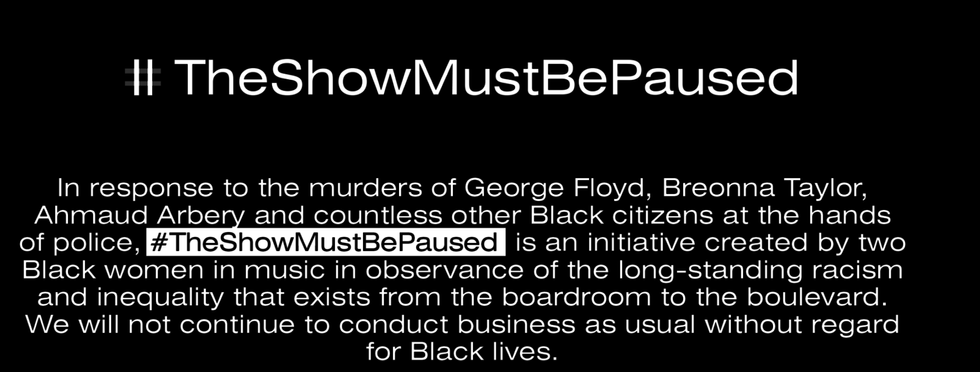
Many organizations in the music industry are pledging to close on Tuesday as part of a 'Black Out Tuesday' campaign. Participants include the three major labels: Warner Music Group, Sony Music and Universal Music Group, along with many of their associated sub-labels.

The initiative started with a pop-up webpage calling for the music industry to shut down on Tuesday, published by Jamila Thomas, a marketing executive at Atlantic Records (owned by Warner Music Group), and Brianna Agyemang, an artist campaign manager at Platoon (owned by Apple).

"It is a day to take a beat for an honest, reflective and productive conversation about what actions we need to collectively take to support the black community," the post said. "The music industry is a multi-billion dollar industry. An industry that has profited predominantly from Black art. Our mission is to hold the industry at large, including major corporations + their partners who benefit from the efforts, struggles and successes of Black people accountable… This is not just a 24-hour initiative. We are and will be in this fight for the long haul. A plan of action will be announced."

The post includes a list of links for suggested actions to take on Tuesday.

#TheShowMustBePaused has traveled widely through the music industry's social media. Santa Monica-based Interscope (owned by Universal Music) pledged to delay releasing new music this week.

Other organizations have been posting messages of solidarity to their social media accounts including Sony Music, Columbia Records (owned by Sony), Universal Music, and Atlantic Records (owned by Warner).

Spotify and Apple Music have also issued brief statements on their social channels.

— Sam Blake

Hollywood, streaming services nod to Black Lives Matter

Over the weekend, several streaming companies took to social media to show support for the peaceful protests.

Some streaming platforms have changed their social media profile names and descriptions to express solidarity, including HBO Max and Quibi. Other organizations with similar messages on their social media pages include NBCUniversal, Disney, and Hulu.

On Sunday, various Hollywood union leaders weighed in as well.

SAG-AFTRA leaders Gabrielle Carteris and David P. White issued a statement. "The murder of George Floyd is deeply emblematic of a corrosive inequality and injustice at the heart of America," it began. "It's not enough to demand change. We must recognize that racism lives in our culture and only we can change that."

WGA West President David Goodman said: "As demonstrations continue today across America, our union stands with those who peacefully protest the racist, extrajudicial murders of George Floyd and other Black people...National outrage about bigotry, discrimination, and injustice is the only way we will ever see real change."

ViacomCBS announced on Monday that several of its networks, including Nickelodeon, BET and CBS Sports Network, would go dark for 8 minutes and 46 seconds in tribute to George Floyd and "other victims of racial violence."

— Sam Blake

L.A.'s gaming companies express support for BLM

live.staticflickr.com

Several Los Angeles gaming companies have weighed in to express solidarity and sympathy with social activists.

Culver City-based Jam City, a mobile game developer founded in 2010, took to social media to stand with Black Lives Matter. Santa Monica's Activision Blizzard and West LA's Riot Games also posted on social media, as has startup Esports One.

Gaming and lifestyle company FaZe Clan, based in Hollywood, published an "honest message" to its fans:

FaZe Clan is donating all profits from a retail campaign to a Memorial Fund created in George Floyd's name.

— Sam Blake

Snap and Twitter reportedly used by ill-intentioned protesters to organize theft; Snap CEO talks reparations and heartbreak 

Photo by Tami Abdollah

Twitter has long been the social media platform of choice for people protesting an abuse of power -- during the Arab Spring uprisings it proved crucially useful as a way to get around and deal with internet blackouts.

So too has it been used this past week, by groups organizing mostly peaceful efforts to express their anger at George Floyd's death. But as Twitter has upped its efforts to counter violence on its platform, notably by placing a warning label on a tweet by President Trump for glorifying violence, those with less peaceful intentions have also taken their messages to Snapchat to urge their contacts and the broader public to engage in violence, theft and property damage.

A Snap spokesperson said the company's Community Guidelines "prohibit content that incites or glorifies violence, hate speech and discrimination of any kind. We have in-app reporting tools that Snapchatters can use to quickly report any content that may be in violation of our guidelines to our Trust and Safety team, who then reviews the reports and takes appropriate action."

On Sunday evening, Snap CEO Evan Spiegel sent a letter to staff in which he said "we simply cannot promote accounts in America that are linked to people who incite racial violence, whether they do so on or off our platform.

"Our Discover content platform is a curated platform, where we decide what we promote. We have spoken time and again about working hard to make a positive impact, and we will walk the talk with the content we promote on Snapchat. We may continue to allow divisive people to maintain an account on Snapchat, as long as the content that is published on Snapchat is consistent with our community guidelines, but we will not promote that account or content in any way."

The self-described camera company is currently protected from financial liability for such messages by Section 230 of the Communications Decency Act that that has been broadly interpreted by the courts over the years as shielding internet sites and apps from being financially liable for what user tweets, posts or generally publishes on their platforms.

Last week, Trump signed an executive order that may change all of that by enabling federal regulators to punish social media companies for how they moderate content on their sites. Lawmakers and internet freedom advocates called the action illegal and improper under the First Amendment.

Such a change could have far-reaching impacts on Santa Monica-based Snap and smaller companies with an online presence that lack the budgets to moderate every single message or post on their apps.

Spiegel said he is "heartbroken and enraged by the treatment of black people and people of color in America." He called for the establishment of a diverse, nonpartisan "Commission on Truth, Reconciliation, and Reparations" to investigate the criminal justice system and take action on reconciliation and reparations.

— Tami Abdollah

Airmap's Santa Monica headquarters destroyed by looters
Greg McNeal/Twitter

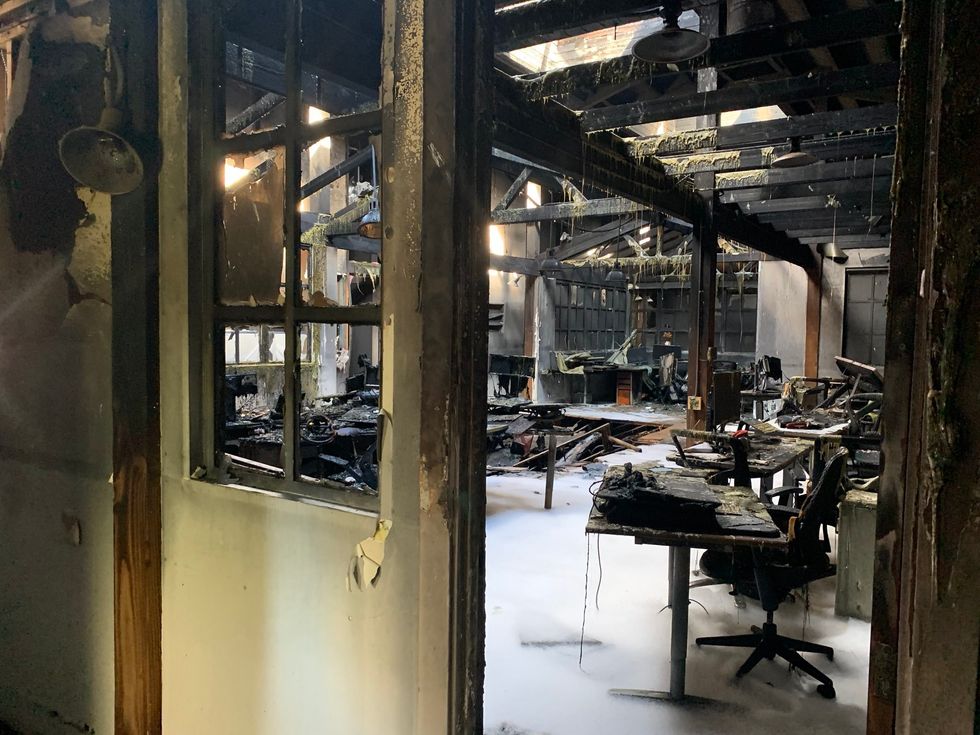
Airmap's headquarters on Santa Monica boulevard near the Third Street Promenade was destroyed by looters Sunday night, according to co-founder Greg McNeal, who recounted the damage in a series of Twitter posts. The company, founded in 2015, is the world's leading airspace services platform for unmanned aircraft.

AirMap co-founder and chairman Ben Marcus added this on Twitter: "Last night, the AirMap office in Santa Monica was consumed by fire. Thankfully, nobody was hurt. What hurts is the unending racism & injustice in America. We all must work harder to make our union more perfect. We're all brothers and sisters. Let's treat each other with love, respect, & dignity, and create opportunity for all who choose to make a positive impact."

— Ben Bergman

Santa Monica, Beverly Hills announce 1 pm curfews for business districts
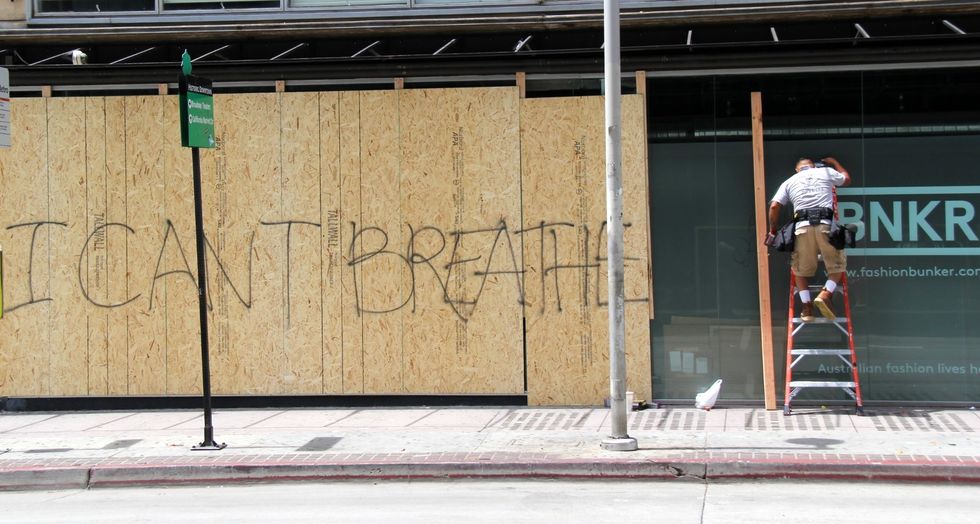
Santa Monica and Beverly Hills announced 1 p.m. curfews for their business districts on Monday, as shop owners and residents began sweeping the glass off the street and assessing the damage after a night of peaceful protests turned into fires, looting and vandalism over the death of George Floyd, who was killed by a police officer in Minneapolis. Citywide curfews will go into effect at 4 p.m. The chaos went to the heart of Silicon Beach, home to tech companies like Snap Inc and venture capitalists like Upfront Ventures, whose office overlooks the Pacific Ocean.

Long Beach issued a similar curfew.

"Sunday was one of the most distressing days in Santa Monica history," said Santa Monica Mayor Kevin McKeown in a statement. "We know better than to let the looters obscure the message of the protesters, who have indeed been heard."

Downtown L.A., Beverly Hills, Fairfax District and the Grove shopping center all got hit by looters over the weekend as police cars were set ablaze and the national guard was called in. News outlets reported that some chanted "eat the rich" as they marched along Rodeo Drive, one of the most expensive slices of commercial real estate in the region.

Floyd's death caused anguish in communities that have seen a number of black men die or be hurt by police officers who often suffer few consequences. Meanwhile, blacks and Latinos have higher arrest and incarceration rates. The deep disparity extends beyond the criminal justice system to education, housing and other areas.

And the frustration over it played out during the protests. Unlike the 1992 civil unrest after the release of Los Angeles police officers who beat Rodney King, demonstrations hit some of the wealthiest parts of the city. In 1992, looting and fires devastated South Central, further impoverishing an already economically disadvantaged area.

"Pretty wild to see the epicentre of this chaos at my office," Laurent Grill, an investor at Santa Monica based Luma Launch wrote on Twitter Sunday. "Quite a divide... on one side we had massive peaceful protests and 3 blocks away, people are looting & burning stores in my community. Makes me extremely sad."

— Rachel Uranga

From Breaking Tech News to Backing It
Image Source: Sources

🔦 Spotlight

Hey there, Los Angeles.

For the past decade, Alex Heath has made a career out of figuring out what the technology industry is doing before everyone else.

Now, he is going to invest in it.

Heath announced this week that he is joining Los Angeles-based Sound Ventures as a partner on its investing team. The veteran technology journalist will continue independently operating Sources, the newsletter and podcast business he launched after leaving The Verge last year.

It is an unusual career move, but perhaps not as unusual as it initially appears.

Journalists and venture capitalists spend much of their time doing surprisingly similar work. Both look for signals before they become obvious, build relationships with people who know what is coming next and attempt to distinguish a lasting shift from a convincing story.

The crucial difference is what happens after they find one.

A journalist publishes. An investor writes a check.

Heath has spent years reporting on some of the technology industry’s most powerful companies and executives. At The Verge, where he served as deputy editor, his work focused on the internal decisions shaping companies such as Meta. More recently, Sources has taken readers inside the AI race through reporting and interviews with executives including Sam Altman and Mark Zuckerberg.

That experience gives Sound something venture firms increasingly want: someone who already understands the founders, companies and narratives competing to define the next era of technology.

Sound Ventures is not exactly starting from scratch. Led in Los Angeles by Guy Oseary and Effie Epstein, the firm manages nearly $2B and has backed companies including OpenAI, Anthropic, World Labs, Brex, Affirm and GitLab. According to The Wall Street Journal, Sound deployed more than $800M into early positions in OpenAI, Anthropic and World Labs as it intensified its focus on artificial intelligence.

Heath is joining during an important transition for the firm. Ashton Kutcher, who co-founded Sound with Oseary in 2015, departed earlier this year to launch a new venture firm. Oseary and Epstein are continuing to lead Sound while raising its fifth flagship fund and sharpening its strategy around companies with the potential to reach meaningful commercial scale.

Adding Heath suggests that Sound’s next phase will not be defined by capital alone.

As AI makes it faster and less expensive to build software, technical capability may become less effective as a differentiator. More startups will be able to create credible products, and more of them will compete for the same finite supply of customers, talent and attention.

In that environment, knowing how to identify a compelling founder is only part of the job. Venture firms also need to understand how companies earn trust, communicate what makes them different and remain culturally relevant in an increasingly crowded market.

That is familiar territory for Sound. Oseary built his career managing artists including Madonna and the Red Hot Chili Peppers, where recognizing talent was inseparable from helping that talent connect with an audience. Heath brings a different version of the same instinct, developed through finding important stories and understanding why people should pay attention to them.

Heath will continue owning and operating Sources independently while expanding its podcast and interviewing prominent voices across the technology industry. That means he is not abandoning the platform or audience he built. He is adding a new vantage point.

The combination could prove especially valuable to Sound. Heath brings the instincts of a reporter, the reach of an independent media founder and years of relationships with the people shaping technology. Now, he can apply that experience to finding and supporting the next generation of founders.

It is a fitting evolution for someone who has spent his career identifying important technology stories early.

This time, he will have the opportunity to help write what happens next.

Venture firms once competed primarily through capital, networks and operating expertise. Now, access to attention is becoming an asset of its own. Founders need help reaching customers and shaping public understanding, while investors want better ways to recognize which people and ideas will command that attention next.

Sound Ventures hired someone who has spent a decade doing exactly that.

Heath used to decide which technology stories were worth following.

Now, he will help decide which ones get funded.

More from this week’s LA startup and venture scene below.

🤝 Venture Deals

    LA Companies

    • Maven Robotics emerged from stealth with a $100M Series A and humanoid robots already operating in warehouse deployments. The company says its robots can work for 16 hours a day with 99% uptime and is positioning itself as a reliable alternative for businesses whose existing robotics providers fail to meet deployment targets. - learn more

    LA Venture Funds
    • Bedrock Capital participated in Mach Industries’ $600M Series C extension alongside Ribbit Capital, Infinite Capital and Sequoia, bringing the round’s total to $900M and doubling the defense startup’s valuation to $3.7B in three months. The Huntington Beach company manufactures lower-cost unmanned aircraft, strike weapons and counter-drone systems, while expanding into solid rocket motors and jet-engine production to address critical defense supply-chain bottlenecks. - learn more
    • U First Capital participated in Positron AI’s $875M funding round, which was co-led by NEA, Atreides Management, Valor Equity Partners, Andra Capital, SemiAnalysis Capital and Jim Clark, valuing the AI chip startup at $5B. Positron will use the capital to bring its memory-focused Asimov processor and Titan server system to market, offering an energy-efficient alternative to GPUs for running AI models. - learn more
    • WndrCo participated in Harvey’s $550M funding round, co-led by Diffusion and Lightspeed Venture Partners, valuing the legal AI company at $15.5B. Harvey will use the capital to expand its team and advance its AI platform, which helps law firms, in-house legal departments and professional-services organizations build and manage proprietary legal intelligence. - learn more
    • Nolan Capital participated in Encoded Therapeutics’ $275M Series F, which was co-led by GV and another healthcare-focused fund and included several new and returning investors. The biotech will use the capital to advance its lead gene therapy for Dravet syndrome through pivotal studies, expand its manufacturing capabilities and prepare another treatment for post-amputation nerve pain for clinical testing in 2027. - learn more
    • UP Partners led Overroute’s $5.5M seed round to expand its AI-powered freight execution platform for large trucking fleets and logistics operators. The company’s AI agents automate load monitoring, exception management and freight coordination, helping fleets respond to disruptions and keep shipments moving with less manual work. - learn more
    • Patron Fund participated in System’s $20M funding round alongside Will Ventures, Vine, Courtside, Daybreak, SV Angel and RiverPark Ventures. The San Francisco company will use the capital to expand its vertically integrated peptide platform, which connects patients with licensed clinicians and personalized treatments from U.S. compounding pharmacies while emphasizing testing, traceability and regulatory compliance. - learn more
    • Alpha Edison led Onix’s $5M pre-seed round, with participation from Garage Capital, Ride Home Fund and strategic investors including UTA co-founder Jeremy Zimmer and Real Ventures co-founder JS Cournoyer. The Montreal startup will use the funding to develop its private AI platform, onboard more specialists and prepare for a public launch, offering personalized guidance built exclusively from licensed expert knowledge rather than information scraped from the internet. - learn more
    • Rebel Fund participated in VideoGen’s $3.3M seed round alongside Y Combinator, Lobster Capital, Stretford End Capital, Mento VC, Pioneer Fund and Decacorn VC. The San Francisco startup, which has reached more than 5M users across 190 countries, will use the funding to expand its team and grow its AI platform for producing editable, copyright-free videos. - learn more

      Download the dot.LA App

      Who Gave the AI Access?

      🔦 Spotlight

      Happy Friday, Los Angeles.

      The newest employee in the office does not need a desk, a salary or a coffee order. But it may have access to your company’s emails, financial records, customer data and software systems.

      That raises a fairly important question: Who decides what an AI agent is allowed to do?

      El Segundo-based cybersecurity company Saviynt is building its next chapter around the answer.

      Carrick Capital Partners announced this week that it closed a $600M continuation vehicle for Saviynt, including a new $255M investment in the company. The transaction allowed Carrick’s existing investors to either take liquidity or remain invested, while also providing liquidity to Saviynt employees through a tender offer.

      Continuation vehicles are not exactly known for making gripping Friday reading. The company behind this one is considerably more interesting.

      Saviynt develops identity security software that helps businesses determine who can access their applications, data and infrastructure. Increasingly, however, “who” does not refer exclusively to a person.

      Companies are deploying AI agents that can retrieve information, write code, communicate with customers and complete multistep tasks with limited supervision. These digital workers need access to company systems to be useful, but every new permission also creates another opportunity for sensitive information to be exposed or an unintended action to be taken.

      In other words, AI agents may be tireless employees. They are not necessarily trustworthy ones.

      Saviynt is addressing that problem through Zuma, its platform for discovering, securing and governing AI agents, large language models and other nonhuman identities alongside a company’s human workforce. The goal is to give businesses one place to determine what every identity can access, whether it belongs to an employee, a contractor, a software application or an autonomous agent operating at machine speed.

      The opportunity appears to be growing quickly. Saviynt has surpassed $300M in annual recurring revenue, up from approximately $10M when Carrick first invested. The company says bookings have increased by more than 80% this year while customer retention remains at 96%.

      The new investment was completed as part of the final close of Saviynt’s previously announced $700M Series B, which valued the company at approximately $3B. Carrick’s continuation vehicle was led by Coller Capital and co-led by HSBC Asset Management, giving the investment firm more time and capital to remain behind one of its strongest-performing companies.

      For Saviynt, the funding will support further development of its identity platform, deeper integrations with major cloud and software providers and its push to become a central security layer for the agentic workplace.

      That ambition reflects a broader change taking place inside companies. The first wave of enterprise AI focused largely on what the technology could generate. The next phase is about what it can actually do, and whether businesses can maintain control once AI moves from answering questions to taking action.

      Saviynt is betting that identity will become the gatekeeper.

      AI agents are gaining access to the digital workplace, whether corporate security teams are ready for them or not.

      Someone still has to hold the keys.

      More from this week’s LA startup and venture scene below.

      🤝 Venture Deals

        LA Venture Funds

        • Fulcrum Ventures participated in Critical Materials Group’s $10.3M seed round, led by Overmatch Ventures and joined by Victory Six Advisors. The Austin-based defense manufacturer will use the funding to develop and commission modular, automation-ready production systems designed to expand domestic manufacturing capacity for munitions and advanced energetic materials. - learn more
        • Fusion VC participated in Newlight’s $9M seed round alongside lomarlabs, BIRD Energy, Undeterred Capital and CiRi Ventures. The San Francisco-based maritime technology company recently demonstrated its hydrogen-hybrid retrofit on an 8,500-nautical-mile commercial voyage, reducing fuel consumption by 24% and carbon dioxide emissions by 28%. - learn more
        • Rebel Fund participated in Metal’s $4.5M seed round alongside a16z, Y Combinator, Gaingels, Indus Valley Capital, Phaze Ventures and Pioneer Fund. Metal will use the funding to build an AI-native operating system that helps founders identify relevant investors, manage outreach and automate other parts of the venture fundraising process. - learn more
        • UP.Partners participated in Reframe Systems’ $40M funding round, led by Energy Impact Partners and joined by Counterpart Ventures, E12 Ventures, Global Brain, Thin Line Capital and LACI Impact Fund. The homebuilding startup will use the capital to expand its network of robotics-powered microfactories, which it says can construct homes three times faster and at 35% lower cost than traditional methods. - learn more
        • Clocktower Technology Ventures participated in Sharpi’s $4M seed round, co-led by NXTP and ONEVC and joined by MAYA Capital. The Brazilian startup will use the funding to expand its team and develop autonomous AI agents that connect WhatsApp conversations with enterprise systems to automate B2B sales tasks such as order processing, customer follow-ups and demand generation. - learn more

        LA Exits

        • Extensiv, a California-based provider of warehouse management and fulfillment software, has been acquired by Descartes Systems Group for approximately $120M in cash. The acquisition adds Extensiv’s AI-enabled inventory, order, billing and omnichannel fulfillment tools to Descartes’ logistics network, strengthening its offerings for third-party logistics providers and ecommerce brands. - learn more
        • DocSolutionUSA has been acquired by Stewart Information Services alongside ProTitleUSA, adding mortgage document generation and automation capabilities to Stewart’s title services platform. The companies provide title, document and due diligence services for mortgage servicers, investors and capital markets clients; financial terms were not disclosed. - learn more
        • Fysh Foods, the Los Angeles-based plant-based seafood brand founded by creator and entrepreneur Zoya Biglary, has been acquired by City Roots Hospitality in an all-cash deal with undisclosed terms. City Roots plans to introduce Fysh Foods’ raw fish alternatives across its New York City restaurants and potentially expand the brand beyond the city as its restaurant portfolio grows - learn more

          Download the dot.LA App

          An LA AI Company Just Won Entertainment’s Backing

          🔦 Spotlight

          Hello LA.

          The entertainment industry has spent the past several years debating what generative AI could take from creators.

          This week, some of its biggest companies put money behind an AI startup promising to build something for them instead.

          Los Angeles-based Stability AI raised $76M in Series B funding from an investor group that includes Electronic Arts, Sony Music Group, Universal Music Group and Warner Music Group. AMD Ventures and Pacific Alliance Ventures also joined the round, while LA-based MANTIS Capital and Sound Ventures are among the company’s existing backers.

          The financing brings Stability AI’s total funding under CEO Prem Akkaraju to $232M, including two equity rounds and convertible notes. The company plans to use the new capital to expand its creative production tools, applied research and professional services across music, gaming and entertainment.

          The amount is notable. The names attached to it are the bigger story.

          Generative AI’s arrival in entertainment has been anything but quiet. Artists have questioned whether their work was used to train models without permission. Studios have faced pressure over how the technology could affect jobs. Record labels have pursued AI companies in court while simultaneously exploring how the same technology might fit into their businesses.

          Now, several of the world’s largest entertainment companies are investing directly in one.

          That does not mean the industry has resolved its concerns about AI. It means some of its biggest players would rather help shape the technology than wait to see what it becomes.

          Stability AI is positioning itself for that opening. Rather than focusing solely on general-purpose models, the company is building tools specifically for professional creatives. Its recently launched Stable Audio 3.0 was trained on fully licensed music and lets artists generate, edit and arrange audio through a web platform or directly inside digital audio workstations.

          Image Source: Stability AI

          That licensed-data approach is central to the pitch. The next phase of creative AI will not be decided only by which company produces the most impressive model. It will also depend on which companies can earn the trust of the artists, studios and rights holders whose work gives those models value.

          For its new strategic investors, the round offers more than financial upside. It creates a closer view into how generative AI may change production, a voice in how the tools develop and an opportunity to establish rules before those rules are established for them.

          For Stability AI, the backing provides something equally important: credibility inside industries that have every reason to scrutinize what it is building.

          The company now has capital and access to some of the largest catalogs, franchises and creative workforces in entertainment. What it does with that access will determine whether this becomes a meaningful alliance or simply an impressive collection of logos.

          Either way, the industry is no longer watching from a safe distance.

          It has entered the room.

          LA’s Air-Taxi Plans Are Coming Downtown

          While Stability AI is trying to change how entertainment gets made, Archer Aviation wants to change how people get to it.

          AEG and Archer announced plans to develop downtown Los Angeles’ first vertiport at L.A. LIVE, creating a potential new stop in Archer’s proposed electric air-taxi network ahead of the 2028 Olympic and Paralympic Games.

          Image Source: Archer

          The planned site would sit beside Crypto.com Arena and allow passengers to travel to and from the entertainment district aboard Archer’s Midnight aircraft. The company says its network could turn drives that take an hour or longer into electric flights lasting approximately 10 to 20 minutes.

          Archer has already identified SoFi Stadium, USC and Hollywood Burbank Airport as possible locations, with its recently acquired Hawthorne Airport expected to serve as the network’s central operating hub. As the official air-taxi provider of LA28 and Team USA, Archer has an unusually visible deadline for turning those plans into something tangible.

          AEG and Archer have completed an initial feasibility study of the L.A. LIVE site, including reviews of land use, airspace, power availability and community impact. The next phase will examine operations and the passenger experience.

          There is still a substantial distance between a proposed vertiport and a functioning air-taxi network. The infrastructure must be built, regulatory approvals must be secured and passengers must be persuaded that flying across the city is safer and more practical than staying on the ground.

          Still, few locations could make that future feel more real than L.A. LIVE. Millions of people already pass through the district for concerts, games and major events. Placing a vertiport there would bring urban air mobility out of the concept stage and directly into public view.

          Together, this week’s announcements show Los Angeles becoming a testing ground for two technologies still moving from promise toward everyday use.

          One could reshape how entertainment is created. The other could reshape how Angelenos reach it.

          In a city famous for both its creative industries and its traffic, that feels appropriately on brand.

          More from this week’s LA startup and venture scene below.

          🤝 Venture Deals

            LA Companies

            • Atorie raised a $9.5M seed round from investors including a16z speedrun, Night Capital and Lightspeed Venture Partners’ Jeremy Liew. The AI-powered fashion startup connects consumers directly with luxury manufacturers to offer high-quality goods without traditional designer markups, and will use the funding to expand logistics, production and its AI shopping tools. - learn more
            • Long Beach-based Maglut Heavy Industries emerged from stealth with $3.1M in pre-seed funding from Wave Function, Nova Threshold and Julian Capital. The startup is developing a chromatography-based system to process and refine rare earth elements domestically, with pilot tests producing materials at more than 99.9% purity. - learn more

            LA Venture Funds
            • MANTIS Venture Capital participated in Voya Energy’s $35M Series A, led by Energy Impact Partners and joined by John Doerr, StepStone, Founders Fund, Overmatch and Seven Stars. The Hayward-based startup will use the funding to commercialize its aluminum-fueled generators, which provide clean, off-grid power for data centers and other energy-intensive operations without combustion or local air emissions. - learn more
            • Regeneration.VC participated in eComID’s $17M seed round, led by Systemiq Capital and joined by Course Corrected, Stadium and returning investor CapitalT. The Stockholm-based startup will use the funding to expand internationally and scale its AI-powered Shopping Passport, which helps retailers personalize sizing and product discovery while reducing returns. - learn more
            • Clocktower Technology Ventures participated in Helcim’s $53M Series C, led by BDC Capital’s Growth Venture Fund and joined by new investors Curql Collective and LA-based Gold House Ventures. The Calgary payments company will use the funding to expand its platform, develop additional financial services and serve more small and midsize businesses across North America. - learn more

            LA Exits

            • Altruist agreed to be acquired by Vanguard, giving the Los Angeles-based wealth technology and custody platform greater resources to expand its tools for independent financial advisors. Altruist will continue operating as a standalone business under its existing leadership and brand after the deal closes, which is expected later this year pending regulatory approval; financial terms were not disclosed. - learn more
            • Personality AI has been acquired by WildBrain for approximately $11M in cash and 1M WildBrain shares upfront, with additional payments tied to future performance. The startup develops kid-safe conversational AI experiences for entertainment characters, including “Hey Peppa Pig,” and will help WildBrain expand its franchises into interactive products across toys, apps and digital platforms. - learn more

              Download the dot.LA App

              RELATEDEDITOR'S PICKS
              Trending