
A New LA Company Aims to Give Fans a Way to Invest, Literally, in the Musicians They Love

Sam Blake

Sam primarily covers entertainment and media for dot.LA. Previously he was Marjorie Deane Fellow at The Economist, where he wrote for the business and finance sections of the print edition. He has also worked at the XPRIZE Foundation, U.S. Government Accountability Office, KCRW, and MLB Advanced Media (now Disney Streaming Services). He holds an MBA from UCLA Anderson, an MPP from UCLA Luskin and a BA in History from University of Michigan. Email him at samblake@dot.LA and find him on Twitter @hisamblake

A New LA Company Aims to Give Fans a Way to Invest, Literally, in the Musicians They Love
  • AmplifyX launches next week to offer shares in musicians' future royalty income
  • Its first tranche is two Detroit-based musicians, each of whom are offering 20% of future royalties for $10,000 at an effective $25 share price
  • In the future, Amplify plans to build out a secondary trading market and hopes to expand beyond music and into the broader creator economy

Rising Detroit rapper and singer Rocky Badd has always been about the street, but soon she and her manager Curtis McKinnon will be going public.

Next week, they'll be selling shares worth 20% of Rocky's future royalty income for $10,000. In doing so, they're also hoping to gain a legion of super fans financially and emotionally invested in her success.


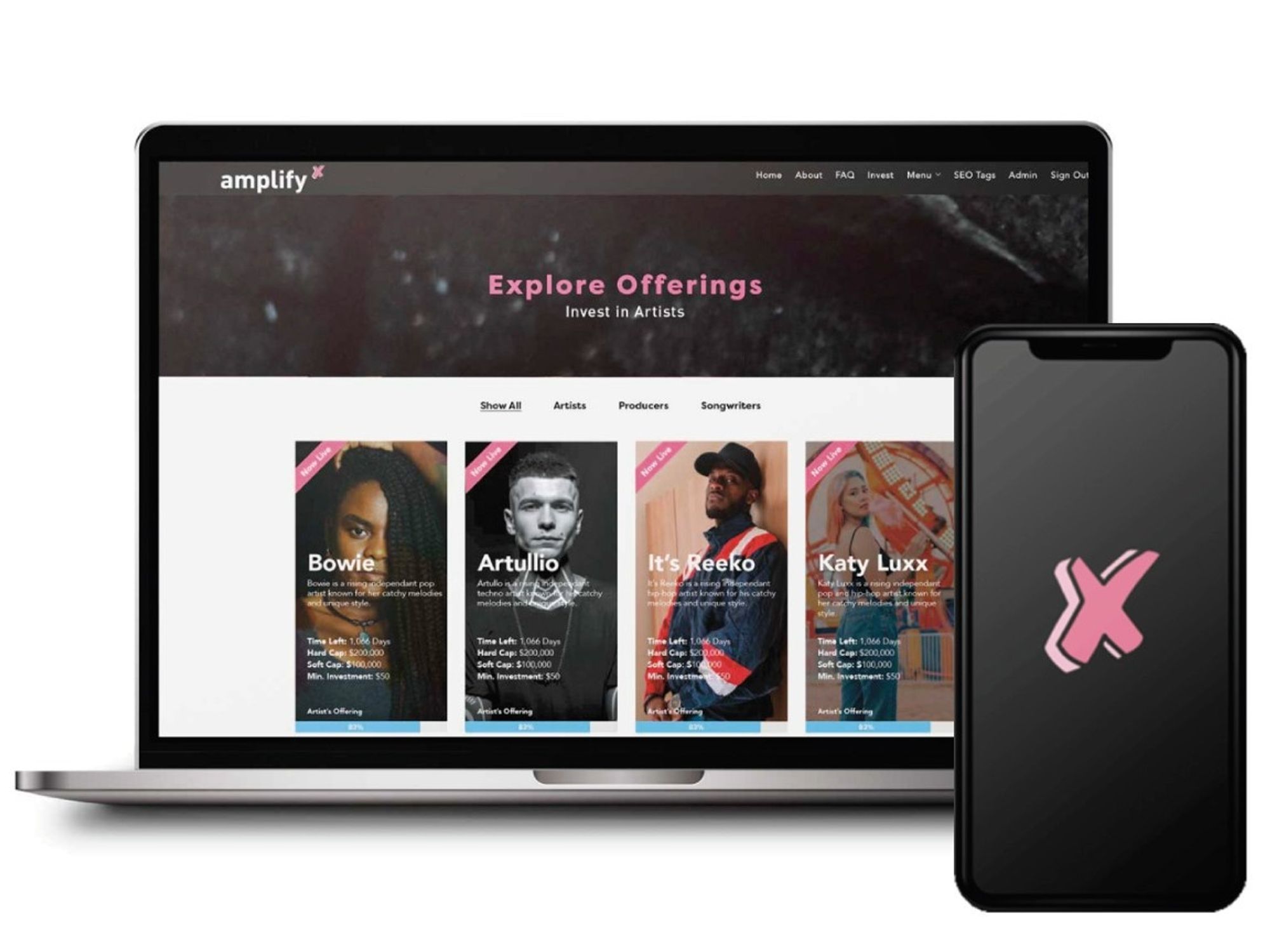
The exchange will be powered by L.A.-based AmplifyX, one of a growing number of online investment platforms made possible by 2015 regulatory changes around crowdfunding. An extension of President Obama's 2012 JOBS Act, the new rules eased restrictions on fundraising and investing, enabling the budding democratization of fractional ownership. Non-accredited investors can now add to their portfolios shares of vintage cars, collectibles like sneakers and trading cards, famous artworks and more.

"Music hasn't really changed from a financing perspective in decades," said Adam Cowherd, Amplify's co-founder and chief executive. His platform aims to address that.

Detroit rapper and singer Rocky Badd, aka September Briyonna-Michelle.

Badd, whose real name is September Briyonna-Michelle, is using Amplify to offer 400 shares tied to her upcoming album, "Respect the Writer 2," for $25 each. Each share is effectively a claim on 0.25% of the streaming and digital download royalties generated by the new release and a few additional songs. Jay Vinchi, another musician from Detroit, is also putting up shares for his upcoming album as part of Amplify's first tranche of offerings.

In L.A., Cowherd has been hard at work. A former physicist turned investment banker, he and his small team had built the infrastructure to run a securities exchange by the end of last year. They waited, though, to complete what would be an 8-month gauntlet to gain regulatory authorization from FINRA, a private financial regulator, and the SEC, its public sector counterpart. The company finished that process in August, and is now awaiting final approval to open its first offering, which Cowherd expects to arrive early next week.

He thinks the wait for that regulatory compliance will pay off by helping Amplify to compete with other platforms that offer similar services, such as Royalty Exchange and Vezt, which also allow fans to buy shares of artist royalty streams.

This first fundraise will be open for 60 days and royalty payments will be distributed to shareholders annually; eventually that could shift to quarterly, Cowherd said.

For artists like Rocky Badd and Jay Vinchi, one obvious appeal to selling shares in their future royalties is earning instant cash – not exactly easy to come by for a musician today.

Rocky Badd's deep connection to her fanbase gives her manager McKinnon and Cowherd confidence she'll have no trouble raising the $10,000. In May, she hosted a livestream concert on Zoom that sold over 1,000 tickets. The YouTube video for her song "Vindictive" has over 8 million views.

With the money raised, McKinnon will look to further spread Rocky Badd fever.

"Rocky can post something and easily get thousands of streams and likes, but now we're trying to get to the millions," he said.

The Amplify offering also has the potential to inspire a squadron of fans to become a de-facto marketing department.

"If we get multiple fans [to buy shares], we now have promoters for a lifetime, because the better that album does, the more revenue share for them," said McKinnon, who — in addition to managing Briyonna-Michelle — runs CrowdFreak, an online platform that helps up-and-coming artists find performance and exposure opportunities.

A rising number of artists are eschewing record labels in favor of ad-hoc, artist-support services, many of which are enabled by technology. Cowherd sees AmplifyX one day building further on that trend, morphing into an entire "record label á la carte."

"Long term, it would basically be a record label in your pocket. We'd like to build that into the native mobile app from the artist perspective, where not only do they have their investor data, and their streaming and social data, but they could also say, 'I'm looking for PR', and we give them three options that have already been vetted through us, and they can make those connections and bookings right through the application," Cowherd said.
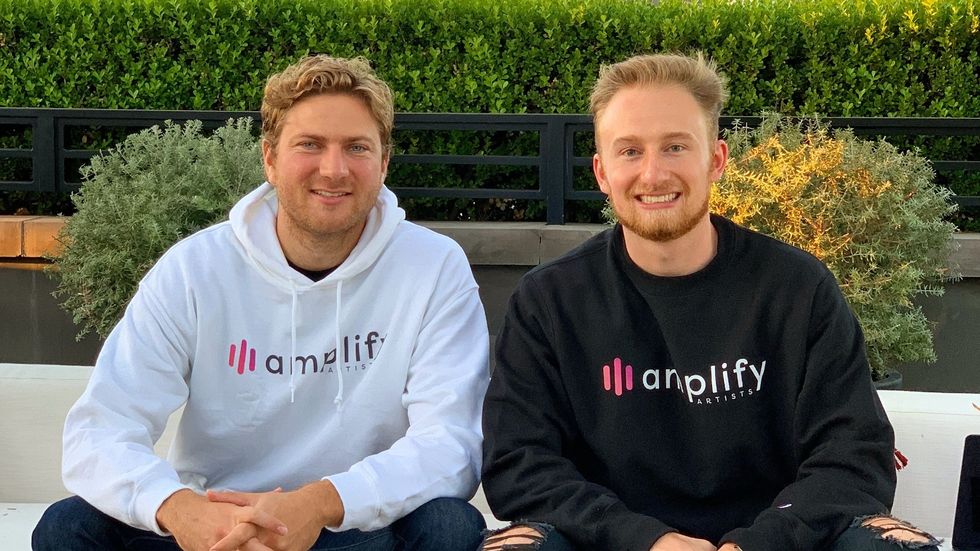
AmplifyX co-founders Bobby Kamaris (L) and Adam Cowherd.

Even if Amplify remains solely a financing platform, he sees expansion opportunities in working with more artists and eventually selling shares in legacy catalogs.

"How cool would it be for somebody who's part of the KISS Army to actually own a fractional piece of 'Detroit Rock City' or something like that?"

The company also plans to build a secondary market for trading shares, he said.

For investors, getting in on the streaming market could be attractive. From 2014 - 2019, revenue from streaming saw a 43% compound annual growth rate, and Goldman Sachs projects the $11 billion market to quadruple by 2030. And since streaming royalties are generally uncorrelated with investment returns elsewhere, they provide a means for investors to reduce risk across their investment portfolio.

Given these factors, Cowherd expects investment to come from cryptocurrency investors and the growing crowd of young traders, along with artists' super fans.

"There's a growing demand among Gen Z for investing," Cowherd said. "My uncle is the principal of a school in Michigan, and he actually had to ban Robinhood because so many kids were day-trading."

Down the road, Cowherd expects to see a lot of engagement from that younger generation. They may have the chance to invest not only in musical projects but also in other content creators as well, and the businesses those creators and influencers may start.

"I really want to power the entire creator and influencer economy," Cowherd said.

Amplify has raised about $250,000 in pre-seed funding and plans to raise a $2-3 million seed round in Q1 or Q2 next year.

For now, it'll generate revenue by taking a percentage of the capital raised from the revenue-share offering. Later, it plans to take an affiliate fee for its record label á la carte service, and a small fee for transactions through its secondary market. It may also offer debt financing, such as for underwriting concert tours.

Other companies will be competing to provide innovative forms of artist financing. L.A.-based Stem, for example, recently opened a $100 million debt-financing arm to loan artists advances against their future royalty income. Kobalt, a London-based firm, is also in the competitive mix.

Hipgnosis, which has been on a spending spree of late to allow investors to buy rights to songs and musical IP, represents the broader bubbling activity in the acquisition of music publishing rights.

Cowherd said one key way he aims to differentiate Amplify is by facilitating direct connections between fans and artists.

For Briyonna-Michelle, that connection is about more than a financial transaction.

"For a lot of people, especially people in my city, we don't really invest in nothing. You buy jewelry, you buy clothes, you buy cars or whatever and you just keep up, but it's like, at some point, when we get older, you're just gonna say you had it," she said. "I feel like no matter what the album does, it's still, like, at least you tried to invest in something, whether it worked or it didn't. I feel like it motivates people to start putting some money behind something where later on in life you can get something out of it."

    Come next week, a new set of fans will begin hoping one day to get something out of their investment in her.

    ---

    Sam Blake primarily covers entertainment and media for dot.LA. Find him on Twitter @hisamblake and email him at dot.LA

    https://twitter.com/hisamblake
    samblake@dot.la
    Heaviside Raises $28M for Autonomous Precision Munitions

    🔦 Spotlight

    Hey Los Angeles,

    For years, Southern California’s defense tech story has largely been told through satellites, rockets, drones and software. This week, another category stepped into the frame: autonomous precision munitions.

    Los Angeles-based Heaviside Industries emerged from stealth with a $28M Series A led by Interlagos, with participation from Menlo Ventures, Flume Ventures, Cantos, Anorak Ventures and several individual defense and technology investors. The company, founded in 2024, is building autonomous precision munitions for U.S. and allied special operations and conventional forces.

    The round will help Heaviside accelerate development, production and delivery of its multi-domain munitions platforms, including its first aerial and underwater systems. According to the company, its products are designed to operate in jammed and GPS-denied environments, where legacy systems can degrade or fail.

    That detail matters. Modern warfare has been reshaped by unmanned systems, contested communications and the growing need for weapons that are not only precise, but affordable enough to be produced and deployed at scale. In other words, the defense tech race is not just about building more advanced systems. It is about building systems that can actually survive the battlefield they are designed for.

    Heaviside has been operating in stealth for more than two years and says it has built a team of more than 50 engineers and operators across Los Angeles and Oslo, Norway. The company also says it already has a roster of U.S. and allied customers, with the new funding going toward expanding production and accelerating deliveries domestically and abroad.

    For LA’s hard tech ecosystem, Heaviside adds to a growing defense-tech cluster that is less about splashy software and more about applied engineering. The company’s work sits at the intersection of autonomy, manufacturing and national security, where Southern California’s aerospace and robotics talent has become increasingly relevant.

    Now onto this week’s LA venture deals and fund announcements.


    🤝 Venture Deals

      LA Companies

      • Furientis emerged from stealth with a $5M pre-seed led by Silent Ventures, with participation from Bessemer Venture Partners, SV Angel and other investors. Founded in 2025, the defense technology startup is developing cost-effective, ship-based interceptor systems designed for scalable production, with the funding going toward initial production, expanded testing and hiring across engineering, manufacturing and operations. - learn more
      • Rogue raised a $2.5M pre-seed led by Science Inc., with participation from Uncommon VC, Simple Food Ventures and strategic investors, to accelerate its national retail and digital commerce strategy. Built by the team behind Dollar Shave Club and Liquid Death, Rogue makes high-protein chips and puffs with active probiotics, no seed oils and no artificial ingredients, and will launch in 2,800 Walmart stores nationwide in July. - learn more
      • Develo raised $14M led by Blueprint Equity, with participation from Villain Capital, Z21 Ventures and Bienville Capital, to grow its AI-native operating system for pediatric practices. The platform unifies clinical, billing and family engagement workflows beyond the traditional EMR, with the new capital going toward R&D and customer success as Develo expands across pediatric providers nationwide. - learn more
      LA Venture Funds
      • Kinship Ventures participated in Nectar Social’s $30M Series A, which was led by Menlo Ventures and its Anthology Fund, with participation from True Ventures and GV. Nectar Social is building an agentic social operating system for modern marketing, helping brands manage social intelligence, community engagement, creator workflows and conversational commerce across platforms like Meta, TikTok, LinkedIn, Reddit and X. The new funding will support engineering and applied AI hiring, deepen platform partnerships and expand Nectar Agent into more brand workflows. - learn more
      • Alexandria Venture Investments participated in CREATE Medicines’ $122M Series B, which was co-led by existing investors Newpath Partners, ARCH Venture Partners and Hatteras Venture Partners. The Cambridge-based biotech is developing in vivo CAR therapies for autoimmune disease and oncology using an mRNA-LNP platform that engineers immune cells directly inside the body, with the funding going toward advancing its CD19-targeted autoimmune program into the clinic, expanding its dual CAR CD19 x BCMA program and continuing work across its oncology pipeline. - learn more
      • Overture Ventures participated in GridCARE’s $64M Series A, which was led by Sutter Hill Ventures with backing from John Doerr, National Grid Partners, Future Energy Ventures, Emerson Collective, Stanford University and other existing investors. Redwood City-based GridCARE is building a physics-based AI platform that helps identify underused grid capacity and accelerate power delivery for AI data centers, compressing interconnection timelines from years to months. The company says it is already engaged in projects across more than a dozen markets representing more than 2 GW of new AI compute capacity. - learn more
      • Taste Tomorrow Ventures invested in Harken Sweets’ seed round, joining Selva and GRTSHT as the early-stage VC firm continues backing better-for-you snack brands. Founded by Katie Lefkowitz, Harken Sweets makes cleaner-label chocolate bars sweetened with whole-food dates instead of refined sugar or synthetic alternatives, and is already sold through retailers including Sprouts, Whole Foods, Kroger, Costco, Walmart, Albertsons and Wegmans. - learn more
      • Bonfire Ventures led Ranger AI’s $8.4M seed round, with participation from 25madison, Inovia Capital and Panache Ventures. Ranger AI is building an agentic revenue operations platform for industrial tendering, helping industrial, manufacturing and supply chain companies automate complex RFP, bid and project workflows. The company says its platform is already being used across more than 1,000 projects and can cut industrial tendering time by up to 50%. - learn more
      • Fika Ventures participated in Outmarket AI’s $17M Series A, which was led by Permanent Capital Ventures, with participation from SignalFire, TTV Capital, Dash Fund and senior insurance industry executives. Outmarket AI builds AI workflow software for insurance agencies and brokers, helping teams automate policy reviews, quote comparisons, renewals, coverage gap analysis, proposal building and other core workflows. The round brings the company’s total funding to $21.7M. - learn more
      • Wedbush Ventures participated in Secludy’s $4M seed round, which was led by Impression Ventures and also included LAUNCH, The Syndicate, Precursor Ventures, Hustle Fund, Script Capital, Mana Ventures and Chispa VC. San Francisco-based Secludy helps banks, payments firms and fintech companies safely use proprietary customer data to train and evaluate GenAI models by generating privacy-protected synthetic data, with the funding going toward hiring, go-to-market growth and expanding its platform across more enterprise AI workflows. - learn more
      • Sound Ventures led a new $17M funding round for Anomaly Insights, joined by Alumni Ventures and existing investors Link Ventures, Redesign Health and RRE Ventures. The New York-based company uses AI to help health systems analyze payer behavior, identify denials, underpayments and contract issues, and strengthen how providers engage with insurers across claims management and managed care negotiations. The new funding brings Anomaly’s total raised to $34M. - learn more
      • B Capital and UP.Partners participated in Havoc’s $100M Series A, backing the company’s push to scale its all-domain autonomous systems for defense operations. Havoc’s autonomy stack is designed to operate across air, sea and land platforms, and the new funding brings its total capital raised to nearly $200M as it expands deployment capacity, engineering and partnerships with defense manufacturers. - learn more
      • B Capital led Star Catcher’s oversubscribed $65M Series A, with the round co-led by Shield Capital and Cerberus Ventures. The Florida-based company is building what it calls the first power grid in space, using optical power beaming to deliver electricity on demand to satellites and other spacecraft, with the funding going toward orbital demonstrations, engineering and commercial expansion. The round brings Star Catcher’s total funding to $88M. - learn more
      • Interlagos participated in Cowboy Space Corporation’s $275M Series B, which was led by Index Ventures and valued the company at $2B. Formerly known as Aetherflux, the San Carlos-based company is building vertically integrated orbital infrastructure for the AI era, including low-Earth orbit satellites, purpose-built launch vehicles and in-orbit data centers designed to help meet rising demand for AI compute. - learn more

        Download the dot.LA App

        The LA Startup Taking on One of Parenting’s Most Frustrating Problems

        🔦 Spotlight

        Hello Los Angeles,

        Every parent knows the feeling of becoming an overnight expert in something they never wanted to learn.

        For families navigating developmental delays, behavioral health needs, autism, speech therapy, occupational therapy or pediatric mental health support, that learning curve can become a full-time job. Finding the right specialist is hard enough. Getting those specialists, pediatricians, insurers and families to actually coordinate with each other? That’s often where the system breaks.

        That’s the problem Los Angeles-based Village is trying to solve.

        The specialty pediatrics startup raised $9.5 million in seed funding this week, led by Upfront Ventures, with participation from Bling Capital, GTMFund and Perceptive Ventures.

        Its AI-powered platform is designed to bring families, providers, pediatricians and payers into one coordinated care system for children with developmental, behavioral and mental health needs.

        The company was born out of co-founder Brandon Terry’s personal experience navigating care for his daughter after she was diagnosed with a rare genetic condition. Like many parents, his family faced long waitlists, high out-of-pocket costs and a fragmented web of specialists who were not necessarily working from the same playbook.

        The pitch is not simply “find a provider faster.” Village wants to coordinate the entire team around a child, including occupational therapists, speech-language pathologists, behavioral therapists and pediatricians. Its AI agent, Vera, is designed to help with the administrative drag that often slows pediatric practices down: scheduling, documentation, billing and care coordination.

        The company’s raise also points to a less flashy, but deeply consequential corner of health tech: making complex care easier to navigate. In specialty pediatrics, the pain point is not always the quality of care itself. It is the space between appointments, referrals, insurance approvals and provider communication where families are often left to connect the dots themselves.

        So far, Village says it has built a network of more than 400 independent pediatric specialty providers in Southern California and has contracts with major commercial insurers including Blue Cross & Blue Shield, Cigna and UnitedHealthcare. The new funding will help the company expand across Southern California, into other parts of California and eventually into new states.

        In other words, the next wave of healthcare infrastructure may not look like one giant hospital system. It may look more like a connected network built around the people who have been holding the system together all along: families.

        And yes, in this case, it really does take a Village.

        Venture deals follow below.👇


        🤝 Venture Deals

          LA Companies

          • MOSH, the brain health nutrition brand co-founded by Maria Shriver and Patrick Schwarzenegger, raised a $13M Series A led by Main Street Advisors to expand nationally across grocery retailers and accelerate product innovation. The Los Angeles-based company plans to use the funding to grow its retail footprint, including an upcoming Target launch, while expanding its lineup of brain-focused nutrition products with new high-protein bars designed to support both cognitive and physical performance. - learn more
          • Spring Labs raised $5M to expand its AI-native compliance platform for banks and fintechs, with the funding led by BankTech Ventures and Haymaker Ventures. The Marina del Rey-based company is building AI agents that automate complaint handling, dispute resolution, and other compliance workflows, helping regulated financial institutions scale operations more efficiently while maintaining oversight and auditability. - learn more
          • FlowPrompt.ai secured a strategic seed investment from ART Fund SP, part of ChainBLX SPC, as the company expands its AI orchestration platform designed to help developers build and manage complex AI workflows through a visual interface. Alongside the investment, the companies also launched a global AI hackathon and builder program that will give selected founders access to funding opportunities, platform tools, and a live investor pitch event in Los Angeles later this summer. - learn more
          • Chance Studios raised $3.2M to build a unified platform for trading card game collectors, aiming to bring inventory management, marketplace activity, and community features into a single ecosystem. The round was co-led by Makers Fund and Hashed, with participation from Arbitrum Gaming Ventures, GAM3GIRL VC, and others, as the company looks to modernize how collectors buy, track, and interact around physical and digital TCG assets. - learn more

          LA Venture Funds
          • Rebel Fund participated in Moritz’s $9M seed round, backing the AI-native law firm as it looks to automate large portions of routine corporate legal work. The company combines software with experienced attorneys to speed up contract drafting and review, and says it has already handled more than $2 billion worth of contracts across over 100 companies since launching earlier this year. - learn more
          • Rebel Fund participated in Corvera’s $4.2M seed round, backing the AI-native supply chain platform as it automates back-office operations for consumer packaged goods brands. The Y Combinator-backed startup is building AI agents that can handle workflows like order processing, invoicing, and demand planning across fragmented enterprise systems, helping brands scale operations without significantly increasing headcount. - learn more
          • Chaac Ventures participated in Astrocade’s $5.6M funding round, backing the gaming startup as it builds a social gaming platform centered around community-created interactive experiences. The company is focused on blending gaming, streaming, and creator tools into a more collaborative entertainment platform, and plans to use the funding to expand development and grow its creator ecosystem. - learn more
          • Fusion VC participated in MSICS Pharma’s $3.6M funding round, backing the biotech company as it advances psilocybin-based treatments for PTSD, depression, and OCD. The company is developing medical-grade psychedelic compounds and plans to use the funding to expand production, accelerate clinical trials, and prepare for broader commercialization as interest in psychedelic therapies continues to grow. - learn more
          • JAM Fund participated in Fun’s $72M Series A, backing the payments infrastructure startup as it scales its platform for moving money across fintech and digital asset applications. The round was co-led by Multicoin Capital and SignalFire, and the company plans to use the funding to expand internationally, pursue acquisitions, and deepen its infrastructure stack as demand grows for faster global payment systems. - learn more

          LA Exits

          • Tapin2 was acquired by Greater Sum Ventures, joining MyVenue as part of GSV’s expanded point-of-sale technology platform for stadiums, arenas and live entertainment venues. Tapin2 provides self-service, suite catering and mobile ordering technology for high-volume sports and entertainment venues, while MyVenue offers cloud-native POS software across concessions, premium seating, retail, in-seat ordering and other venue operations. Together, the companies say their technology is used in more than 70% of MLB and NFL stadiums. Terms of the transaction were not disclosed. - learn more
          • Motiv Space Systems signed a definitive agreement to be acquired by Rocket Lab, bringing its space robotics, motion control systems and precision spacecraft mechanisms into Rocket Lab’s growing space systems business. Motiv’s technology has supported major missions including NASA’s Mars Perseverance rover and lunar rover programs, and the company will be rebranded as Rocket Lab Robotics after the deal closes, which is expected in the second quarter of 2026. - learn more
          • Robyn was acquired by Los Angeles-based Tot Squad, bringing its AI-powered doula tool into Tot Squad’s broader support platform for expecting and new moms. Robyn’s AI was trained on more than 70,000 de-identified messages between parents and doulas, and the acquisition will help Tot Squad offer free, around-the-clock pregnancy and early motherhood guidance alongside access to human experts like doulas, lactation consultants and sleep coaches. Terms of the deal were not disclosed. - learn more

            Download the dot.LA App

            Match Goes Niche With $100M Move

            🔦 Spotlight

            Hello Los Angeles,

            It’s May, and LA is about to have one of its more important weeks.

            The Milken Institute Global Conference 2026 returns to Beverly Hills next week, bringing together thousands of investors, operators, policymakers, and executives. It’s one of the few places where public markets, private capital, and tech actually overlap in the same rooms, and where you can usually get an early read on what capital is leaning into before it fully shows up in the data.

            This year, one theme is already starting to surface. Platforms are getting more specific, not more broad.

            This week’s news is a good example.

            Match Group is investing $100 million into Sniffies, a fast-growing, location-based platform built for gay, bi, trans, and queer men. It’s a notable move for a company best known for mainstream dating apps like Tinder and Hinge, and it signals a deeper push into more niche, community-driven platforms.

            Sniffies operates very differently from traditional dating apps. It’s more real-time, more map-based, and more focused on immediacy than long-term matching. In other words, it’s built around behavior, not profiles.

            And that’s what makes the investment interesting.

            For years, the dominant strategy in consumer platforms was scale, build one product that works for everyone. But what we’re seeing now is the opposite. The platforms that are gaining traction tend to be the ones that understand a specific audience deeply and build for how that group actually behaves.

            Match leaning into that shift isn’t just about expanding its portfolio. It’s a recognition that growth is coming from focus.

            And in a city like Los Angeles, that’s usually where things start.

            Below are this week’s venture deals and fund announcements across LA 👇


            🤝 Venture Deals

              LA Companies

              • Illuminant Surgical raised an $8.4M seed round to accelerate the rollout of its real-time anatomical projection platform, which aims to give surgeons enhanced visibility during procedures. The company’s “Skylight” system is designed to project internal imaging directly onto the patient, improving precision and reducing risk, and the funding will support product development and early commercialization efforts. - learn more
              • Jupid raised $840K in early funding to support its AI-native accounting platform, which is designed to automate bookkeeping, tax filing, and compliance for small businesses directly within banking platforms. The company is building what it describes as an embedded “AI accountant” that integrates with financial institutions to streamline operations for entrepreneurs, and plans to use the funding to expand partnerships and accelerate product development as demand grows for automated financial tools. - learn more
              • Lumicup raised a $4.38M Series A to expand its product line and scale manufacturing as it looks to meet growing demand for its consumer health and wellness products. The company plans to use the funding to increase production capacity, invest in new product development, and strengthen its distribution as it continues to grow its footprint in the market. - learn more
              • Counterpart raised a $50M Series C to expand its AI-driven “agentic insurance” platform, which helps small businesses manage growing legal and employment risks tied to AI adoption. The round was led by Valor Equity Partners with participation from existing investor Vy Capital, bringing the company’s total funding to $106M, and the capital will be used to launch new insurance products, expand risk management capabilities, and scale its underwriting platform. - learn more
              • Nervonik raised a $52.5M Series B to advance its next-generation peripheral nerve stimulation technology, which aims to deliver more precise, personalized treatment for chronic pain. The round was led by Amzak Health with participation from Elevage Medical Technologies, U.S. Venture Partners, Lumira Ventures, Foothill Ventures, and Shangbay Capital, and the company plans to use the funding to accelerate clinical programs and move toward commercialization. - learn more
              • LighthouseAI raised an $8M Series A to expand its AI-powered platform that helps pharmaceutical companies manage state licensing and regulatory compliance. The round was led by Boxcars Ventures with participation from TGVP and existing investors, and the company plans to use the funding to enhance product development, improve service delivery, and support continued growth as it scales across the pharma supply chain. - learn more

              LA Venture Funds
              • MANTIS Venture Capital participated in Rogo’s $75M Series C, backing the AI platform as it builds autonomous financial agents designed to streamline complex workflows for banks and investment firms. The round was led by Sequoia Capital and included a mix of major financial institutions and venture firms, signaling strong demand for AI tools that can augment decision-making across high-stakes finance. - learn more
              • M13 participated in Chord’s $7M funding round, backing the AI commerce platform as it builds a “context layer” designed to unify fragmented data, tools, and workflows for retail brands. The round was led by Equal Ventures with participation from Chingona Ventures and CEAS Investments, and the company aims to help operators move beyond dashboards toward systems that can make real-time decisions and automate actions across the business. - learn more
              • Fika Ventures participated in Lumian’s funding round, backing the startup as it launches an AI-native Amazon agency designed to automate and optimize how brands operate on the marketplace. The company is focused on replacing traditional agency workflows with AI-driven systems that can manage everything from advertising to operations in real time, reflecting a broader shift toward automation in e-commerce. - learn more
              • Riot Ventures co-led True Anomaly’s $650M Series D, backing the defense space startup as it scales spacecraft, software, and autonomous systems designed for national security missions in orbit. The round values the company at around $2.2 billion and brings total funding to over $1 billion since its 2022 founding, and the company plans to use the capital to accelerate mission deployments, expand manufacturing, and grow its workforce as demand increases for space-based defense capabilities. - learn more
              • Clocktower Technology Ventures participated in Clarasight’s $11.5M Series A, backing the AI-powered travel and expense platform as it works to unify fragmented enterprise data into a single system. The round was led by AlleyCorp with participation from several travel and fintech-focused investors, and the company plans to use the funding to expand product development and scale go-to-market efforts as demand grows for AI-driven efficiency in corporate travel. - learn more
              • Halogen Ventures and Mucker Capital participated in SkyfireAI’s $11M seed round, backing the startup as it builds an AI-native platform for coordinating autonomous, multi-drone operations. The company’s software is designed for public safety and defense use cases, helping teams deploy and manage fleets of drones with greater speed and efficiency without increasing staffing, and it plans to use the funding to accelerate product development, expand its team, and scale deployments with government and mission-critical customers as demand grows for autonomous drone systems. - learn more
              • Matter Venture Partners led OpenLight’s $50M Series A-1, with participation from Acclimate Ventures, Catapult Ventures, and existing investors, backing the photonics company as it scales its next-generation chip platform for AI infrastructure. The funding brings total capital raised to $84M and will be used to accelerate global deployment of its silicon photonics technology across data centers, telecom, and other high-bandwidth applications. - learn more
              • Alexandria Venture Investments participated in Fathom Therapeutics’ $47M Series A, backing the biotech startup as it applies quantum chemistry and AI to design next-generation small molecule drugs. The oversubscribed round was led by Sutter Hill Ventures with participation from Chemistry and other investors, and the company plans to advance its platform, which simulates protein behavior inside living cells to accelerate drug discovery. - learn more

                Download the dot.LA App

                RELATEDEDITOR'S PICKS
                Trending