

No Tipping Necessary: Hundreds of Delivery Robots Are Coming to Los Angeles

Ben Bergman

Ben Bergman is the newsroom's senior finance reporter. Previously he was a senior business reporter and host at KPCC, a senior producer at Gimlet Media, a producer at NPR's Morning Edition, and produced two investigative documentaries for KCET. He has been a frequent on-air contributor to business coverage on NPR and Marketplace and has written for The New York Times and Columbia Journalism Review. Ben was a 2017-2018 Knight-Bagehot Fellow in Economic and Business Journalism at Columbia Business School. In his free time, he enjoys skiing, playing poker, and cheering on The Seattle Seahawks.

No Tipping Necessary: Hundreds of Delivery Robots Are Coming to Los Angeles

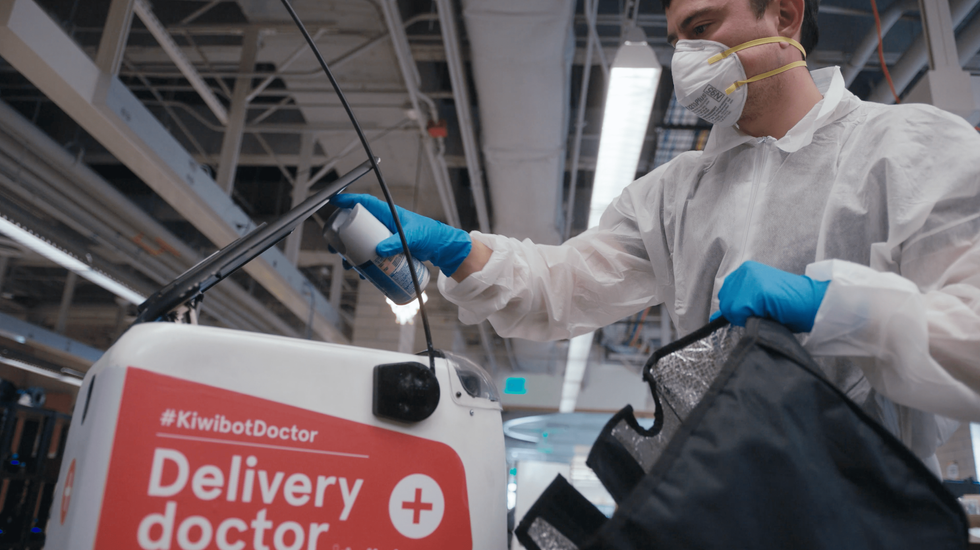
On a recent crisp winter morning outside an empty office park in the San Fernando Valley, there were no workers to be seen. That is unless one counts the cooler-sized delivery robot slowly whirring down the sidewalk as Felipe Chavez, founder and CEO of Kiwibot, nervously watched to make sure the droid did not veer of course.

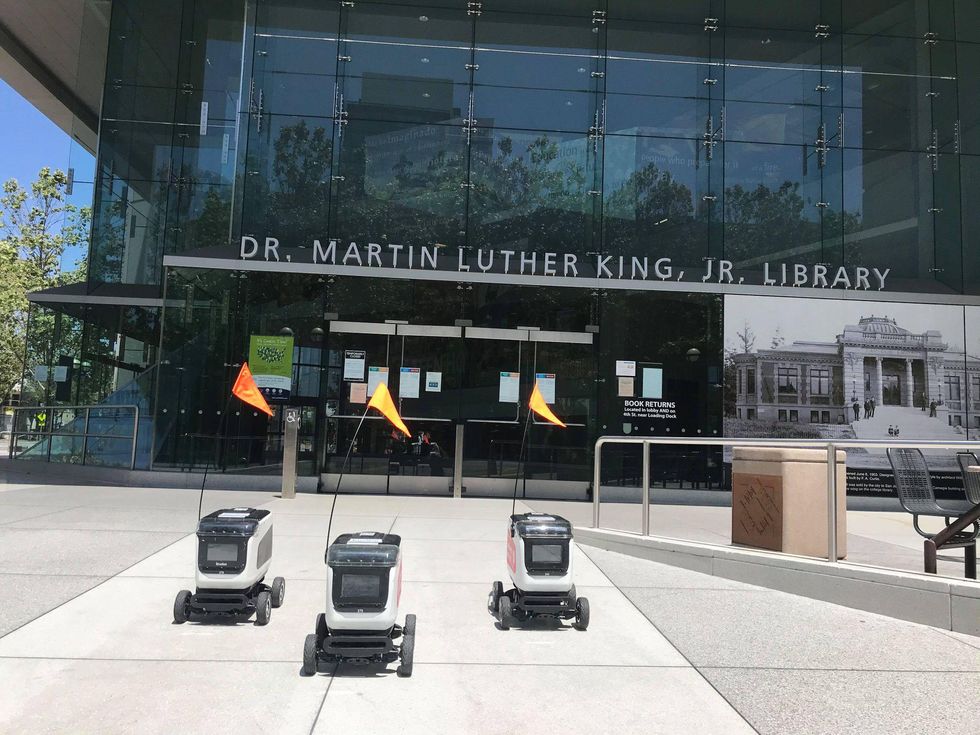
Just as no one now thinks twice about seeing e-scooters that were non-existent before late 2017, the sight of a robot ferrying salads, pizza, or groceries could become common on Los Angeles sidewalks before this year is over.


Kiwibot has quietly been testing its robots – specially designed to look cute and non-threatening – for the past few weeks in the Valley, as well as more recently at a major university campus the company won't yet name. If all goes well, Kiwibot will begin offering delivery to students through as early as next month before expanding to Santa Monica and other parts of the city after that.

"L.A. is going to be our most important city this year," Chavez said. "In the first five months of the year we plan to employ 100 robots here in the city, and we expect that by the end of the year we're going to have around 400 robots deployed."
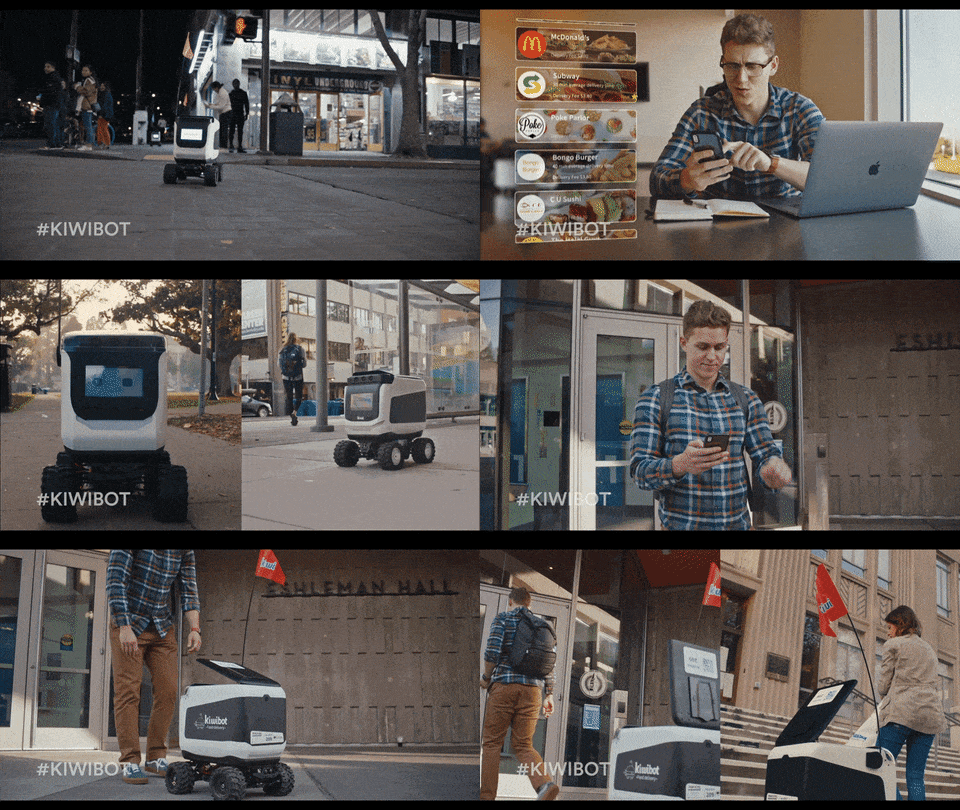
Kiwibot robot delivery

Postmates, which is now owned by Uber, has been testing a handful of delivery robots in West Hollywood since April. While those are accompanied by a human chaperone, the Kiwibot robots set out on their own, though operators take over remotely for more complex tasks like crossing the street.

Kiwibot has already made over 120,000 deliveries since 2017 during rollouts at University of California, Berkeley, University of Denver, and San Jose, where it partnered with Shopify and Ordermark. But L.A., with its vast geographic footprint, is a whole new degree of difficulty.

"It's a great challenge for us," said Chavez.

Kiwibot chose L.A. because the city already has a high adoption of food delivery, it is home to potential partners like ChowNow and Ordermark, and the city has been a willing collaborator through its Urban Movement Labs (UML), mostly by sharing data on city streets and sidewalks.

"We trust L.A. to be the best new market for us because the food delivery habit is already there, and we feel backed to scale in an organized and socially responsible and sustainable manner," said David Rodriguez, Kiwibot's head of business.

After a confrontational approach between cities and ridesharing and e-scooter companies, Lilly Shoup, UML's interim executive director, says L.A. is trying to be more collaborative with delivery robots.

"I think we've learned that it's important for city transportation agencies to get ahead of new technology before they appear on city streets," Shoup said. "It's important to understand their business models and proactively develop policies."

UML is also working on a pilot to deliver goods via drone by 2022 and in both instances Shoup says the technology can help reduce pollution and congestion since most deliveries now are made via cars.

"It's really exciting to think about new ways to reduce the environmental impact of delivery," Shoup said.

Robots substantially bring down the cost of delivery, which could help restaurants that operate on thin margins during even the best of times and have been devastated this year. But it will also mean fewer delivery jobs, most of which have been preserved as contract work in California with the recently passed Proposition 22.

Restaurants typically pay between 15% to 30% on orders placed with delivery services like Postmates or Grubhub and drivers are hardly getting rich. In fact, they often make less than minimum wage.

Kiwibot charges fees of a couple dollars on each order – which can be absorbed by the restaurant or passed onto customers. The company says its cost per delivery is now $2.98 but as it scales and the technology improves it can shave the cost down to $1.23 by the end of 2022.

Right now, Kiwibot robots – which cost between $2,500 and $4,000 each – can only operate in a 1.5 mile radius but the company's next generation can go eight miles and is large enough to fit a 12-inch pizza.
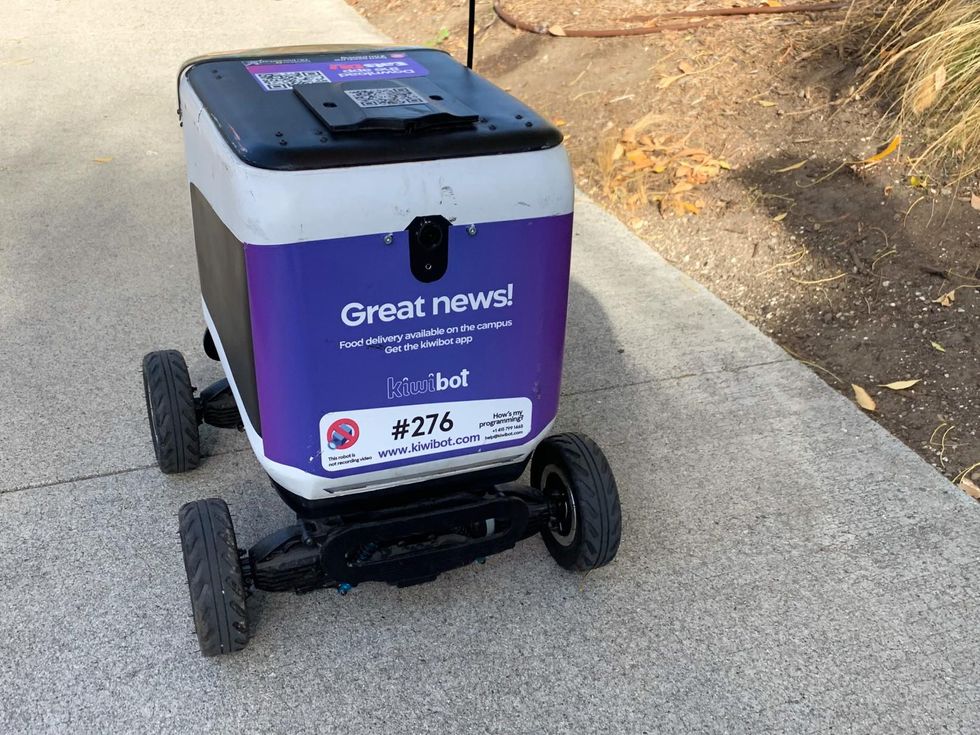
Photo by Ben Bergman
Will the Public Accept Robots?

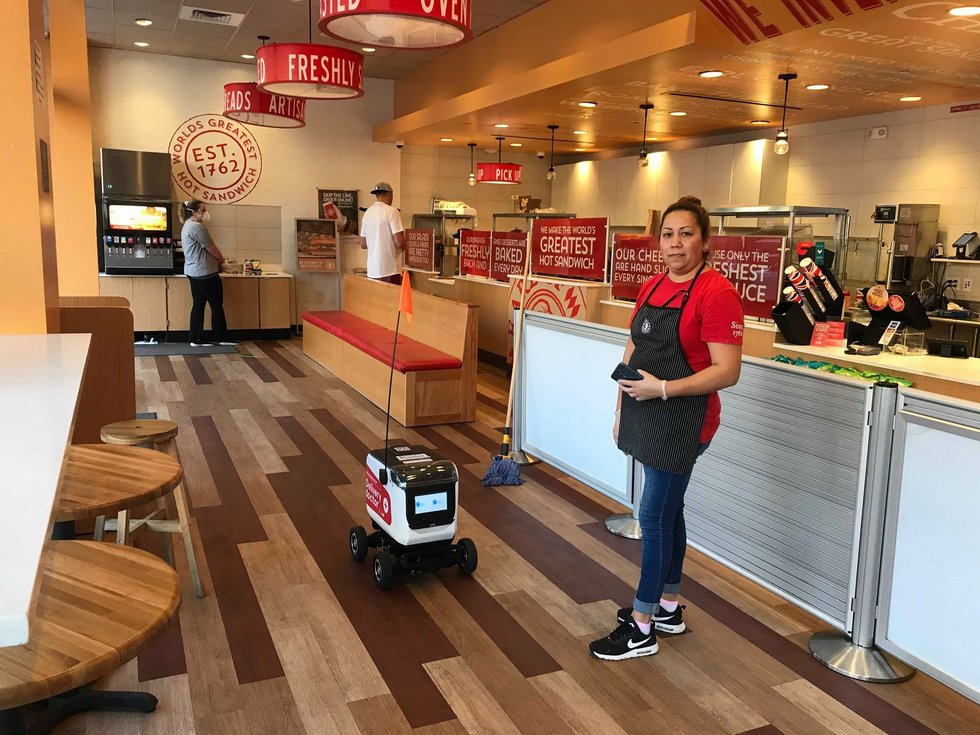
Even when the technology is ready, Kiwibot has what may be a tougher obstacle to overcome – public acceptance. Public safety commissioners in West Hollywood raised concerns about Postmates' robots and even in tech-friendly San Francisco, a city lawmaker, worried they might run into pedestrians, tried to ban them.

Kiwibot warns potential investors on its crowdfunding page: "Delivery bots have proved controversial in some regulatory environments with some cities, like San Francisco, putting out laws that make it difficult for us to deploy. If this became widespread we would have trouble going to market."

Chavez says he spends a great deal of time thinking about how he can get the public to be comfortable with robots.

"There is a sector of people that are concerned about robots and I think that it is very important to listen to them and to get their feedback on everything. but robots are going to happen," Chavez said.

The robot also has a sign affixed to the back to clarify that it is not recording any video, something that was added after homeless people in San Jose feared they were being spied on.

There is a "black box," which records in case of an emergency, but none of the devices have been stolen — so far.

Even though local regulations can allow for robots to go as fast as 10 mph, Chavez has found a speed of 6 mph makes people feel safer.

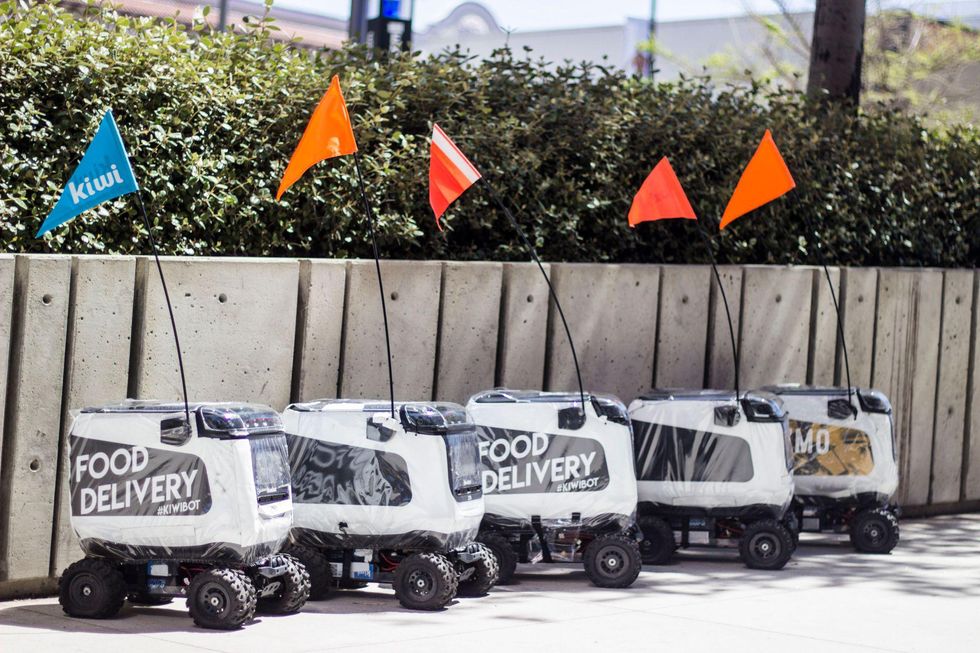
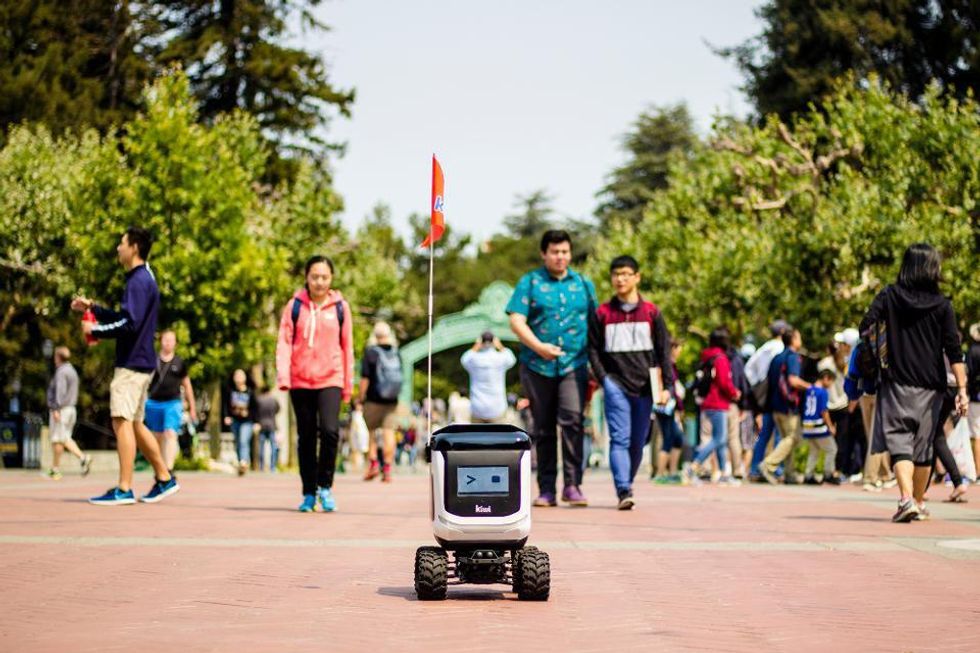
There are also important visual considerations. Kiwibot's robots look nothing like the hulking devices conjured up in sci-fi movies like "Transformers" or "The Terminator." They are more like a plastic cooler on wheels with lights on the front that resemble a smiling face.

"The new version is even more cute," said Chavez. "It's like a squirrel on a rock."

Taking a page from nature, the design is deliberately playful and small.

"When you see an animal and it is bigger than the width of your shoulders you feel threatened," Chavez said. "So we have made sure that the robot is never going to be wider [than you] so that people don't feel threatened."

Coronavirus has also been helpful, helping accelerate the adoption not only of delivery but also of robots – who you don't have to worry about coughing on you.

Competition with Bigger Robot Deliveries

Kiwibot, which is based in San Jose, has raised more than half $1 million from more than 650 investors in its latest crowdfunding campaign, to bring its fundraising total to over $3 million.

That pales in comparison to not only Uber but also much larger rivals Starship, a robot food delivery service launched in 2014 by two Skype co-founders that plans to rollout deliver to 100 universities by next summer and Nuro – an autonomous vehicle startup founded by two ex-Google engineers valued at $4 billion. The company received regulatory approval last week to operate on city streets in the Bay Area.

But with global autonomous last-mile delivery projected to grow from $11.16 billion next year to $76 billion by 2030, Kiwibot sees room for multiple competitors.

"In L.A. right now we are talking with multiple partners, very big companies," said Chavez.

"Everything is moving very fast," he added, as his robot inched along the sidewalk, heading back to the lab to continue more testing.

https://twitter.com/thebenbergman
ben@dot.la
Snap’s New Growth Engine Isn’t Ads

🔦 Spotlight

Hey LA,

This week’s most interesting story isn’t a flashy new feature, it’s a quieter flex: Snapchat is getting people to pay for Snapchat, on purpose.

Snap just proved “free app” isn’t the only business model

Snap says its direct revenue business is now running at a $1B annualized pace, with 25M+ subscribers paying across a growing menu of products like Snapchat+, Lens+, Snapchat Premium, and Memories Storage Plans. That matters because it’s not just a nice add-on to ads, it’s a different kind of relationship with users. Ads monetize attention. Subscriptions monetize intent.

And intent is sticky. If someone pulls out a card for you, they don’t churn the way an algorithm does.

Creator Subscriptions are the real tell

Snap is also launching Creator Subscriptions, starting with an alpha on February 23 for select U.S. creators, then expanding to Snap Stars in Canada, the U.K., and France in the following weeks. The offer is straightforward: subscriber-only Stories and Snaps, priority replies, and an ad-free experience inside that creator’s Stories.

The strategic move is even simpler. Snap wants “paying for closeness” to happen inside Stories and Chat, not on some external membership page. If they get that right, creators stop treating Snapchat as just a top-of-funnel channel and start treating it like a place to actually monetize their audience. Snap, meanwhile, gets a revenue stream that doesn’t care what CPMs are doing this quarter.

Meanwhile, IRL: lululemon’s Studio Yet.

Lululemon’s Studio Yet. pop-up is running Feb. 18 through March 8 at 8175 Melrose Ave. It’s a ticketed, limited-capacity lineup of workouts and community programming, with proceeds (less fees) supporting BlacklistLA.

Keep scrolling for the latest LA venture rounds, fund news and acquisitions.

🤝 Venture Deals

      LA Companies

      • Radiant announced a strategic investment from Lockheed Martin via Lockheed Martin Ventures, further oversubscribing the company’s current financing round. Radiant is developing its 1 MW Kaleidos portable nuclear microreactor and says it’s targeting a first reactor startup this summer at Idaho National Laboratory, with initial customer deployments planned for 2028. - learn more
      • Mesh Optical Technologies announced it has raised over $50M, led by Thrive Capital, to scale production of its Alpha C1 optical transceiver, which converts electrical signals to light at 1.6 Tbps for AI data centers. The startup says its edge is manufacturing: it builds the optical engine using fast, repeatable flip-chip die bonding to make high-volume, U.S.-based production of optical links possible, backed by a team with experience from SpaceX and Intel.- learn more

                  LA Venture Funds

                  • Alexandria Venture Investments participated as an existing investor in Ten63 Therapeutics’ latest strategic financing, which also included participation from Morpheus Ventures and added new backers such as Chugai Venture Fund and the Gates Foundation, bringing total funding to more than $45M. Ten63 says it will use the capital to scale BEYOND, its AI-driven “Large Quantum Chemistry Model” platform for designing small-molecule drugs against historically “undruggable” targets, including programs in oncology and an HPV-focused effort supported by the Gates Foundation.- learn more
                  • B Capital participated in Code Metal’s $125M Series B, a round led by Salesforce Ventures that valued the company at $1.25B, alongside investors including Accel, J2 Ventures, Shield Capital, Smith Point Capital, and others.Code Metal says it will use the new capital to expand engineering, accelerate product development, grow government and commercial partnerships, and scale go-to-market for its “verifiable” AI code generation and translation platform used in mission-critical environments. - learn more
                  • Bonfire Ventures co-led Odynn’s $9.5M seed round alongside 8VC, with participation from Khosla Ventures and General Catalyst. Odynn says it’s building personalized AI infrastructure for travel companies, aiming to replace one-size-fits-all booking portals with dynamic experiences that tailor search, recommendations, and conversion flows to each traveler. - learn more
                  • MTech Capital led Qumis’s $4.3M oversubscribed seed round, which also brought in American Family Ventures as a new strategic investor and pushed total funding to $6.75M. The company says it’s building an attorney-trained AI platform for commercial insurance “coverage intelligence,” and will use the funding to expand go-to-market and deepen product capabilities as adoption grows among large brokers and carriers (including NFP). - learn more
                  • WndrCo participated in Mansa’s seed funding round, which the company says totaled $12M and was led by MaC Venture Capital. Mansa is now launching a vertical “micro-drama” format inside its app, debuting with the 27-episode original series The Heiress, The Baller & The Secret Society and positioning the feature as a mobile-first way to release serialized stories globally. - learn more
                  • Alpha Edison co-led Ownwell’s $50M Series B, with Wonder Ventures participating alongside investors including Mercato Partners, Intuit Ventures, Left Lane Capital, First Round Capital, Long Journey Ventures, and PROOF Fund. The round includes $30M in equity and $20M in debt financing from Western Alliance Bank, and Ownwell says it will use the capital to expand nationally and simplify the property-tax appeal process through a new “National Appeals Packet” product. - learn more
                  • Three Six Zero participated as an existing investor in Hook’s $10M Series A, which was led by Khosla Ventures with participation from Point72 Ventures, Imaginary Ventures, and Waverley Capital, bringing Hook’s total funding to $16M. Hook is an artist-first social platform that lets fans legally remix licensed songs using simple AI-powered tools and share them across social platforms, and it says the new capital will fund user growth plus product expansion like an Android app, richer creation formats, and deeper ecosystem integrations. - learn more
                  • Overture Ventures participated as an existing investor in Zero Homes’ $16.8M Series A, which was led by Prelude Ventures alongside SJF Ventures and the Exelon Foundation. Zero Homes says it’s using the funding to expand into new markets, broaden its home-upgrade offerings, and grow its contractor network, powered by a smartphone-based “digital twin” approach that produces upgrade designs and pricing remotely. - learn more
                  • Rebel Fund participated in Sphinx’s $7.1M seed round, which was led by Cherry Ventures alongside Y Combinator, Deel Ventures, and Singularity Capital. Sphinx is building browser-native compliance agents that work inside banks’ and fintechs’ existing tools to automate AML, KYC, and KYB work, with the new funding earmarked to scale that “agentic compliance workforce.” - learn more
                  • Matter Venture Partners led ChipAgents’ oversubscribed $50M Series A1, bringing total capital raised to $74M, with participation from existing investors Bessemer Venture Partners, Micron, MediaTek, and Ericsson. ChipAgents says it will use the new funding to scale its agentic AI platform for chip design and verification, expand engineering and research, and accelerate global deployment of multi-agent “chip teams,” alongside a new HQ buildout in Santa Clara. - learn more
                  • MemorialCare Innovation Fund participated in SpendRule’s $2M round, which was led by Abundant Venture Partners with additional backing from Zeal Capital Partners. SpendRule is emerging from stealth with an AI-driven platform that helps hospitals validate invoices against complex contract terms before payments go out, aiming to reduce overspending and “contract leakage” across purchased services. The company says early customers include health systems like MemorialCare, Kettering Health, and MUSC Health. - learn more

                              LA Exits

                              • Fred Segal is being acquired by Aritzia, which is buying the brand’s rights/IP (terms not disclosed) and planning a revival under its ownership. Melrose Avenue is central to the deal too, since Aritzia is also taking a lease on Fred Segal’s iconic ivy-covered site at 8100 Melrose as part of the comeback plan. - learn more
                              • The Expert is being acquired by Havenly in an all-equity deal (terms not disclosed), bringing The Expert’s high-end virtual designer consultations and trade-oriented marketplace into Havenly’s broader home and commerce ecosystem. Lee Anne Blake will join Havenly as chief commercial officer, and while The Expert will remain a standalone website, Havenly plans to plug in its tech to strengthen The Expert’s purchasing and procurement tools for designers. - learn more

                                                      Download the dot.LA App

                                                      💘Zeitview’s New Valentine : Catching Methane Leaks

                                                      🔦 Spotlight

                                                      Hello Los Angeles, happy Friday and happy Valentine’s Day weekend.

                                                      While the rest of us are debating flowers vs. gifts vs. reservations, LA’s infrastructure nerds are out here celebrating a different kind of romance: finding leaks before they ghost your entire operation.

                                                      Zeitview just made methane a first-class feature

                                                      Zeitview has acquired Insight M, folding high-frequency aerial methane detection into its broader “see it, measure it, fix it” play for critical infrastructure. The combined offering pairs methane monitoring with Zeitview’s predictive asset-health and inspection workflows, so operators can spot emissions faster, prioritize repairs, and tie results back to ROI instead of vibes.

                                                      What Zeitview actually does, beyond the buzzwords

                                                      If you haven’t been tracking them, Zeitview is essentially the operating layer for inspecting big, physical assets using drones, aircraft, and computer vision. They can analyze imagery you already have or capture fresh data, then turn it into inspection reports and analytics through their Asset Insights platform.

                                                      Zeitview was previously known as DroneBase and rebranded after raising an expansion round, signaling a broader push beyond “drones” into enterprise-grade infrastructure intelligence across energy and other asset-heavy industries.

                                                      Why Insight M fits, and why this isn’t just “climate tech”

                                                      Methane is the rare climate problem that also hits the P&L, because a leak is both emissions and lost product. Insight M has built credibility around methane monitoring that’s meant to be operational, not just observational, and that plugs neatly into Zeitview’s inspection footprint.

                                                      Put together, this looks less like a single acquisition and more like a workflow upgrade: one system that finds a problem, quantifies it, routes it to the right team, and proves it was fixed. The least romantic Valentine’s message of all, maybe, but also the most adult: “I noticed something small, and I handled it before it became expensive.”

                                                      Keep scrolling for the latest LA venture rounds, fund news and acquisitions.

                                                      🤝 Venture Deals

                                                          LA Companies


                                                          • HAWKs (Hiking Adventures With Kids), a nature-based children’s enrichment brand founded in Los Angeles, secured a strategic investment from Post Investment Group to accelerate its nationwide franchise expansion. The company plans to scale its mobile, outdoor-program model (after-school adventures, camps, and weekend sessions) by opening franchise territories across the U.S. while using Post’s franchising platform to build the operational infrastructure and support system for new operators. - learn more

                                                                      LA Venture Funds

                                                                      • Allomer Capital Group participated in TRUCE Software’s newly closed Series B, a round led by Yttrium with additional backing from New Amsterdam Growth Capital. The company did not disclose the amount, but says it will use the funding to scale go-to-market for two mobile-first product suites: an AI video telematics platform for commercial fleets that runs on standard smartphones, and TRUCE Family, a software approach to limiting student phone distractions in K–12 schools. - learn more
                                                                      • Wonder Ventures participated in The Biological Computing Company’s $25M seed round, which was led by Primary Venture Partners alongside Builders VC, Refactor Capital, E1 Ventures, Proximity, and Tusk Ventures. The startup is commercializing “biological compute,” connecting living neurons to modern AI systems to make certain tasks dramatically more energy-efficient, and says its first product shows a 23x retained improvement in video model efficiency while also helping discover new AI architectures. - learn more
                                                                      • Bonfire Ventures co-led Santé’s $7.6M seed round, with backing from Operator Collective, Y Combinator, and Veridical Ventures. Santé is building an AI- and fintech-driven operating system for wine and liquor retailers that brings POS, inventory, e-commerce, delivery orders, and invoice workflows into one platform to replace a lot of manual, fragmented processes. - learn more
                                                                      • B Capital co-led Apptronik’s initial 2025 Series A and participated again in the company’s new $520M Series A extension, bringing the total Series A to $935M+ (nearly $1B raised overall). The company says it will use the fresh capital to ramp production and deployments of its Apollo humanoid robots and invest in facilities for robot training and data collection, with the extension also bringing in new backers like AT&T Ventures, John Deere, and Qatar Investment Authority alongside repeat investors including Google and Mercedes-Benz. - learn more
                                                                      • WndrCo participated in Inertia Enterprises’s new $450M Series A, a round led by Bessemer Venture Partners with additional investors including GV, Modern Capital, and Threshold Ventures. The company says it will use the milestone-based financing to commercialize laser-based fusion built on physics proven at the National Ignition Facility at Lawrence Livermore National Laboratory, including building its “Thunderwall” high-power laser system and scaling a production line to mass-manufacture fusion fuel targets. - learn more
                                                                      • Riot Ventures participated as a returning investor in Integrate’s $17M Series A, which was led by FPV Ventures with participation from Fuse VC and Rsquared VC. Integrate is pitching an ultra-secure project management platform built for classified, multi-organization programs, and says it has become a requirement for certain U.S. Space Force launch efforts. The company plans to use the new funding to ship additional capabilities for government customers and scale go-to-market across the defense tech sector. - learn more
                                                                      • MANTIS Ventures participated in Project Omega’s $12M oversubscribed seed round, which was led by Starship Ventures alongside Buckley Ventures, Decisive Point, Slow Ventures, and others. Project Omega is emerging from stealth to build an end-to-end nuclear fuel recycling capability in the U.S., aiming to turn spent nuclear fuel into long-duration power sources and critical materials, with early lab demonstrations underway and an ARPA-E partnership to validate a commercially viable recycling pathway. - learn more
                                                                      • Plus Capital participated in Garner Health’s $118M round, which was led by Khosla Ventures with additional backing from Founders Fund and existing investors including Maverick Ventures and Thrive Capital, valuing the company at $1.35B. Garner says it helps employers steer members to high-quality doctors using its “Smart Match” provider recommendations and a reimbursement-style incentive called “Garner Rewards,” and it will use the funding to expand its offerings, grow its care team, and scale partnerships with payers and health systems. - learn more
                                                                      • Emerging Ventures co-led Taiv’s $13M Series A+ alongside IDC Ventures, with continued support from investors including Y Combinator and Garage Capital. Taiv says it will use the funding to scale its “Business TV” platform, which uses AI to detect and swap TV commercials in venues like bars and restaurants with more relevant ads and on-screen content, as it expands across major North American markets. - learn more

                                                                                LA Exits

                                                                                • Mattel163 is being acquired by Mattel, which is buying out NetEase’s remaining 50% stake and valuing the mobile games studio at $318M. The deal gives Mattel full ownership and control of the team behind its IP driven mobile titles, strengthening its in-house publishing and user acquisition capabilities as it expands its digital games business. - learn more
                                                                                • DJ Mex Corp. is set to be acquired in part by Marwynn Holdings, which signed a non-binding letter of intent to purchase a 51% stake in the U.S.-based e-waste sourcing and logistics company. The deal would bring DJ Mex into Marwynn’s EcoLoopX platform to expand its asset-light “reverse supply chain” services for recyclable materials, though it’s still subject to due diligence and final agreements. - learn more

                                                                                                        Download the dot.LA App

                                                                                                        Skyryse Raised $300M+ to Do What Most Startups Can’t

                                                                                                        🔦 Spotlight

                                                                                                        Hello Los Angeles

                                                                                                        LA just minted another aviation unicorn, and it is not because someone built a prettier helicopter demo. It's because Skyryse is trying to do the rarest thing in tech: turn software into something regulators will sign their name to, and that pilots will trust when conditions are at their worst.

                                                                                                        El Segundo’s newest unicorn is simplifying the cockpit

                                                                                                        Skyryse raised $300M+ in a Series C at a $1.15B valuation. The round was led by Autopilot Ventures and returning investor Fidelity Management & Research Company, with participation from Qatar Investment Authority, ArrowMark Partners, Atreides, BAM Elevate, Baron Capital Group, Durable Capital Partners, Positive Sum, Rokos (RCM Private Markets Fund), and Woodline Partners, among others.

                                                                                                        Image Source: Skyryse

                                                                                                        The pitch is bold and deceptively simple. Skyryse is building a “universal operating system for flight,” SkyOS, designed to replace the cockpit’s maze of mechanical controls with a computer-driven system that makes routine flight easier and emergency situations more manageable. The bigger claim is standardization: if you can make the interface and controls feel consistent across aircraft, you reduce training friction, lower pilot workload, and create fewer opportunities for human error when the stakes spike.

                                                                                                        The real work starts after the press release

                                                                                                        Skyryse says the funding will be used to accelerate FAA certification and scale SkyOS across additional aircraft platforms, including the Black Hawk. That is the hard part, and also the part most startups never reach. Aviation is where software has to prove itself in edge cases, repeatedly, with zero tolerance for surprises, because “mostly works” is another way of saying “eventually fails.”

                                                                                                        The bet hiding inside the headlines

                                                                                                        If Skyryse clears certification and can port SkyOS across aircraft types the way software ports across devices, it could unlock a new category of safety automation for fleets that cannot afford downtime, confusion, or long training cycles. Emergency response, defense modernization, and industrial aviation are all markets where reliability is the product, and simplicity is the differentiator. In a world obsessed with shipping faster, Skyryse is playing a different game: getting permission to ship at all.

                                                                                                        Keep scrolling for the latest LA venture rounds, fund news and acquisitions.

                                                                                                        🤝 Venture Deals

                                                                                                            LA Companies

                                                                                                            • Accrual announced it has raised $75M in new funding led by General Catalyst, with participation from Go Global Ventures, Pruven Capital, Edward Jones Ventures, and a group of founders and industry executives. The company says the raise supports its official launch and continued buildout, alongside early partner firms, investors, and advisors. - learn more
                                                                                                            • Morpheus Space secured a $15M strategic investment led by Alpine Space Ventures and the European Investment Fund, with continued support from existing investors, to fuel its next phase of growth. The company says it will use the capital to expand mass-production capacity and its team at its Dresden “Reloaded” facility, helping industrialize its GO-2 electric propulsion systems and meet rising demand from large satellite constellations. - learn more
                                                                                                            • Machina Labs raised a $124M Series C to build its first large-scale “Intelligent Factory,” a U.S.-based production site aimed at rapidly manufacturing complex metal structures for defense, aerospace, and advanced mobility. The company says the funding, backed by investors including Woven Capital, Lockheed Martin Ventures, Balerion Space Ventures, and Strategic Development Fund, will help it scale its AI-and-robotics “software-defined” manufacturing approach from breakthrough tech into high-throughput production infrastructure. - learn more
                                                                                                            • Midi Health raised a $100M Series D led by Goodwater Capital, with new investors Foresite Capital and Serena Ventures joining and existing backers including GV, Emerson Collective, and others returning, valuing the company at over $1B. The women’s telehealth provider says it will use the funding to scale beyond menopause care into a broader, AI-enabled women’s health platform, expanding access and using AI to personalize care and streamline clinical operations. - learn more
                                                                                                            • Mitra EV raised $27M in financing, combining equity led by Ultra Capital with a credit facility from S2G Investments, to expand its “no upfront capital” fleet electrification model. The Los Angeles-based company says it will use the money to grow its shared charging network, roll out additional fleet solutions, and expand into new markets, positioning itself as a fully managed package that bundles EV leasing, overnight charging, and access to shared fast-charging hubs. - learn more
                                                                                                            • Plug raised a $20M Series A to scale its EV-first marketplace, following $60M in used EV sales since launching in 2024. The round was led by Lightspeed with participation from Galvanize and existing investors including Autotech Ventures, Leap Forward Ventures, and Renn Global, as Plug positions itself as infrastructure for the coming wave of off-lease EV inventory with EV-native pricing, battery health insights, and faster dealer transactions. - learn more
                                                                                                            • Breezy, a Los Angeles-based AI operating system for residential real estate professionals, raised an oversubscribed $10M pre-seed round led by Ribbit Capital, with participation from Fifth Wall, DST Global, Liquid 2 Ventures, O.G. Venture Partners, and others. The company says it will use the funding to strengthen its product and data platform, grow engineering and design, invest in security, and prepare for broader U.S. and international rollout. - learn more

                                                                                                                      LA Venture Funds

                                                                                                                      • Upfront Ventures participated in Daytona’s $24M Series A, a round led by FirstMark Capital with participation from Pace Capital and existing investors E2VC and Darkmode, plus strategic checks from Datadog and Figma Ventures. Daytona is building “composable computers” for AI agents, essentially programmatic, stateful sandboxes that can be spun up, paused, and snapshotted on demand so agents can safely run code and explore many paths in parallel at scale. - learn more
                                                                                                                      • Second Sight Ventures participated in Willie’s Remedy+’s $15M Series A, a round led by Left Lane Capital to fuel national retail expansion and continued product development for its hemp-derived THC beverages positioned as an alcohol alternative. The company says it has already sold 400,000+ bottles in under a year and claims the top spot for online THC beverage sales as it gears up for broader distribution in 2026. - learn more
                                                                                                                      • Navitas Capital led Cadastral’s $9.5M funding round, with participation from JLL Spark Global Ventures, AvalonBay, Equity Residential, and 1Sharpe. Cadastral says it will use the capital to accelerate product development and expand go-to-market for its vertical AI platform, positioning the product as an “AI analyst in a box” that automates core commercial real estate workflows like underwriting and due diligence. - learn more
                                                                                                                      • B Capital participated in Lunar Energy’s $232M raise, which the company disclosed as two rounds: a $102M Series D led by B Capital and Prelude Ventures, and a previously unannounced $130M Series C led by Activate Capital. The startup says it will use the capital to rapidly scale home-battery manufacturing and deployments, turning those distributed systems into a grid-supporting virtual power plant as electricity demand surges. - learn more
                                                                                                                      • B Capital participated in Goodfire’s $150M Series B at a $1.25B valuation, a round that also included investors like Juniper Ventures, DFJ Growth, Salesforce Ventures, Menlo Ventures, Lightspeed, South Park Commons, Wing, and Eric Schmidt. Goodfire says it will use the funding to scale its interpretability-driven “model design environment,” aimed at helping teams understand, debug, and deliberately shape how AI models behave in high-stakes settings. - learn more
                                                                                                                      • Helena participated in Positron AI’s oversubscribed $230M Series B at a post-money valuation above $1B, alongside strategic investors including Qatar Investment Authority and Arm. The round was co-led by ARENA Private Wealth, Jump Trading, and Unless, and the company says it will use the capital to scale energy-efficient AI inference now and accelerate its next-generation “Asimov” silicon roadmap. - learn more
                                                                                                                      • Smash Capital participated in ElevenLabs’ $500M Series D, which values the company at $11B as it scales its voice and conversational AI products for enterprise use. The round was led by Sequoia Capital with support from existing backers like Andreessen Horowitz and ICONIQ Capital, plus additional participation including Lightspeed Venture Partners. - learn more
                                                                                                                      • MTech Capital participated in Pasito’s $21M Series A, a round led by Insight Partners with additional participation from Y Combinator. Pasito says it’s building an AI-native workspace for group health, life, and retirement benefits that turns messy, unstructured plan and census data into a unified layer so carriers and brokers can automate workflows end-to-end, from quoting and enrollment to support and claims. - learn more
                                                                                                                      • Rebel Fund participated in Ruvo’s $4.6M seed round, led by 1confirmation with participation from Coinbase Ventures and others, as the Y Combinator-backed fintech expands its cross-border payments infrastructure between Brazil and the U.S. Ruvo says it operates like a U.S. dollar account for Brazilians, combining Pix, stablecoins, ACH/wire transfers, and a Visa card in one app to speed up remittances by reducing intermediaries. - learn more
                                                                                                                      • Rainfall Ventures participated in a seed funding round for Deft Robotics alongside Spring Camp, backing the company’s push to build AI-driven automation tools for manufacturers. The round amount wasn’t disclosed in the announcement, but the funding is positioned to help Deft scale product development and customer deployments in industrial settings. - learn more
                                                                                                                      • Trousdale Ventures participated in CesiumAstro’s Series C by leading the $270M equity portion of a $470M total growth-capital raise, alongside investors including Woven Capital, Janus Henderson Investors, and Airbus Ventures. CesiumAstro says the broader financing also includes $200M from Export-Import Bank of the United States and J.P. Morgan, and will fund a major U.S. scale-up including a new 270,000-square-foot HQ and expanded manufacturing to accelerate deployment of its software-defined, AI-enabled space communications platforms. - learn more
                                                                                                                      • Mucker Capital participated in Linq’s $20M Series A, which was led by TQ Ventures to help the company become infrastructure for AI assistants that run directly inside messaging apps. Linq’s platform lets developers and businesses deploy assistants through channels like iMessage, RCS, and SMS, and the company says the funding will go toward expanding the team, building a go-to-market motion, and continuing to develop the product. - learn more
                                                                                                                      • Sound Ventures participated in Day AI’s $20M Series A, which was led by Sequoia Capital with additional participation from Greenoaks, Conviction, and Permanent Capital. Day AI says the funding will help scale its AI-native CRM platform and support its move into general availability, positioning “CRMx” as a faster, context-driven alternative to legacy systems that turn simple questions into slow projects. - learn more
                                                                                                                      • Chaac Ventures participated in Arbor’s $6.3M seed round, which was led by 645 Ventures with additional backing from Next Play Ventures, Comma Capital, and angel investors. Arbor is building an AI interview and research platform that captures frontline employee and customer conversations and turns that qualitative “ground truth” into structured operational intelligence leaders can act on quickly, without slow surveys or pricey consultants. - learn more
                                                                                                                      • B Capital participated in When’s $10.2M Series A, a round co-led by ManchesterStory and 7wire, with new investor Mairs & Power Venture Capital and returning backers Enfield Capital Partners, TTV Capital, and Alumni Ventures. When says it helps employers and departing or transitioning employees navigate health coverage changes by steering people to more affordable alternatives to COBRA through an AI-powered marketplace and targeted reimbursements, with the new capital going toward team growth and expanding into more transition scenarios like Medicare eligibility and early retirements. - learn more

                                                                                                                                              Download the dot.LA App

                                                                                                                                              RELATEDEDITOR'S PICKS
                                                                                                                                              Trending