
Forget Opioids, Virtual Reality Could Be the Future of Pain Management

Keerthi Vedantam

Keerthi Vedantam is a bioscience reporter at dot.LA. She cut her teeth covering everything from cloud computing to 5G in San Francisco and Seattle. Before she covered tech, Keerthi reported on tribal lands and congressional policy in Washington, D.C. Connect with her on Twitter, Clubhouse (@keerthivedantam) or Signal at 408-470-0776.

Forget Opioids, Virtual Reality Could Be the Future of Pain Management

It's hard to overstate just how painful a process treating burn victims is – for burn victims, air itself is excruciatingly painful. They have to undergo weeks of undressing wounds, cleaning the tender skin of debris, slathering the area with ointment, and redressing it with new bandages, and it is considered one of the most physically painful treatments in medicine. To combat this, most patients rely on consistent and heavy opioid usage.


But in 2008, University of Washington researchers published the first study of its kind using virtual reality (VR) to mitigate the use of the highly-addictive drugs. The researchers replaced the clinical hospital setting with a computer-generated snowtopia where patients could throw snowballs with penguins and snowmen through a VR headset as doctors washed the treatment area. It worked, and the study concluded that VR could replace part of an opioid dose.

A decade later, VR medicine has taken off, spawning a clutch of companies and a new field of study for what is considered one of the most promising and powerful noninvasive tools to treat pain. It's now a growing part of an $885.7 million VR health care industry.

In the eyes of Jeffrey I. Gold, a pain management doctor at the Children's Hospital Los Angeles, it's the future of medicine, as virtual reality has the potential of eliminating the need for billions of dollars worth of drugs.

If Gold is right, as researchers are increasingly finding, this could have a ripple effect across the healthcare industry eventually lowering health care costs as patients rely less on drugs to offset pain.

"That's really where VR needs to go, is into the place where you can start reducing the need for certain types of medicines that may have side effects." Gold said.

How VR Works to Mitigate Pain

Conventional pain management techniques rely on distractions like blowing bubbles with younger patients or administering pain relievers or sedation. Unlike those, VR has the unique ability to manipulate how the brain processes pain by engaging the senses with powerful immersive experiences.

Gold published a study looking at how VR impacted pain in children. Researchers gave children aged 12 to 17 who were getting blood drawn VR headsets and instructed them to play a game made specifically to soothe pain. Once they put on the set, health care workers drew blood.

They then compared the experience to children who were given traditional distraction methods like bubbles or reading a book, and soothing techniques.

The study found children who used VR during their procedures felt less pain and anxiety than children who didn't.

"People always talk about, 'you're just distracting the kid like, 'hey, look over here'.' Well, that's not what we're doing," Gold said. "It's a little bit more involved with regards to immersion, presence, something we call cognitive load."

One way to think about pain is like an "alarm" the brain sets off. VR directs the brain to set off more relaxing "sounds" in the form of a visual and audible world that forces the senses to experience something else. This drowns out that "alarm" created by the pain. The brain, effectively, does not register the needle placement as as painful as it would be without VR.

The study confirmed what researchers have been seeing for years. But what excited Gold was its potential for children: By making procedures more engaging and less painful, children with chronic conditions may become less fearful about treating their condition, he said.

"For a child to have a positive experience on a routine procedure, that can be a game changer for that kid."

Other researchers looking at the use of VR are finding that not only does the technology engage the patient's senses, but in some cases it can act as a support network, much like a family. Another study by Cedars-Sinai Los Angeles used VR to assist women going into labor with painful contractions. Researchers put a headset on women in labor showing them soothing animated scenes of nature that pulsated, almost as if the elements were breathing. A calm voice used words of encouragement to help the mother through contractions.

Women who used the VR reported lower levels of pain and anxiety, much like the children.

"What I think was so impactful about this particular intervention, actually, is that what they were hearing was very much the same things ... you might hear from a doula" said Dr. Melissa Wong, maternal-fetal medicine specialist at Cedars-Sinai Los Angeles who led the study.

'A Pharmacy of VR'

Wong's study at Cedars-Sinai indicated VR could be an alternative to epidurals or nitrous oxide – two common pain management solutions used during labor. But, even more than that, it pointed to a slew of history that shows pain is not just an acute or chronic sensation in the body that causes your brain to raise alarm, it's also the environment around you.

Wong said one of the strongest indicators of whether or not patients ask for epidurals during labor is whether or not they have a birth support person in the form of a partner, family member or doula. Patients that don't are more likely to need an epidural.

"So it's suggesting, again, that [pain] is sort of the entire way in which everything is being approached, rather than just literally the pain fibers," said Wong.

In other words, pain isn't simply a feeling. It is also a patient's support system, surroundings and mental fitness. By taking patients out of a clinical hospital setting of linoleum floors and wheeling carts and into a magical virtual world that has its own soundscapes and therapeutic guides, their pain can appear to be far less than what it might be.

Brennan Spiegel, a doctor at Cedars-Sinai Los Angeles who oversees virtual reality programs, coined "a pharmacy of VR" -- the idea that VR therapies should be created to help specific situations, like going through labor, dressing a burn wound, undergoing chemotherapy or having an anxiety attack.

But the industry is still young and many of the devices have yet to gain full Food and Drug Administration approval. Still, there's growing demand.

Companies Are Getting Involved

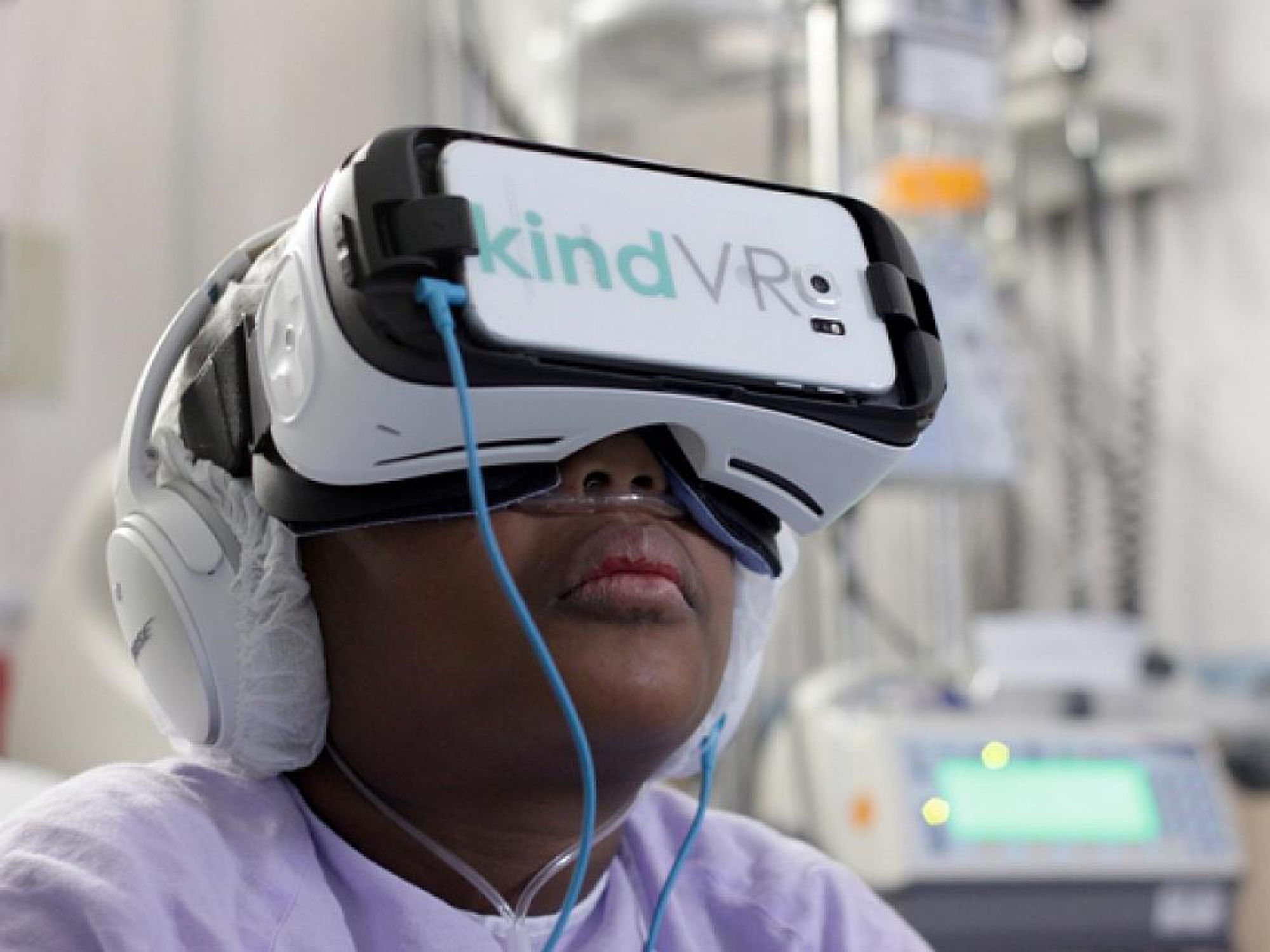
Companies like seven-year-old Alameda-based KindVR are using virtual reality programs to soothe pediatric patients before an MRI and calm them before an operation. XRHealth, a five-year-old company based in Massachusetts, offers a host of applications designed to treat physical immobility and mental health.

And the six-year-old Los Angeles-based AppliedVR developed a suite of VR-based "video games" meant to soothe anxiety for veterans and treat acute pain for people giving birth and burn victims. The company has raised around $34 million to date, the most any startup in the chronic pain market has raised, and valued at over $67 million, according to Pitchbook.

Following the idea of a 'pharmacy for VR', AppliedVR has two opioid-sparing treatments -- one for patients to use to help with acute pain, and one for chronic pain. The effects of chronic pain are often long lasting stress and a feat of moving, which is why the company incorporates cognitive behavioral therapy into the treatment.

Their chronic pain product is EaseVRx, a VR device used in an eight-week program that takes patients through different educational and training modules to explain to them how stress can affect pain, how they can avoid stress, and how to utilize breathing and acceptance-based therapy to reduce pain long after taking off the VR headset.

Laura Garcia, director of research, design and product innovation at AppliedVR said the company found that patients are able to utilize the benefits of VR up to six months after taking off the headset.

"While you're in the headset, you're able to learn your skill sets and change your brain so that you're able to cope with the pain differently," she said. "So imagine having a pill that gives you benefits and relieves [pain] for the time that you use the pill for, but also six months after."

Correction: An earlier version of this misidentified EaseVRx and misstated the length of its VR training program.

https://twitter.com/KeerthiVedantam
keerthi@dot.la
LA Is Betting on Nukes, Netflix and Next-Gen Attention

🔦 Spotlight

Hey Los Angeles.

If you were looking for a quiet week, this was not it. LA is backing a portable nuclear reactor, Netflix just took a big step closer to owning Warner Bros. Discovery’s future, and Snapchat is basically handing the city a mirror and saying, “Here is what you did with your attention all year.”

Let’s dive in.

Radiant’s microreactors and LA’s new nuclear moment

Radiant Nuclear raised more than $300M in a Series D round to build Kaleidos, a one megawatt portable nuclear microreactor that is designed to roll off a factory line, ship in a standard container and replace diesel generators at remote sites, military bases and disaster zones. The new capital will fund a full scale test at Idaho National Lab and the build out of Radiant’s R 50 factory in Oak Ridge, Tennessee, which aims to produce up to 50 reactors a year starting later this decade.

For LA’s climate and infrastructure ecosystem, this is a big tell. The city that got rich on pipelines of content is now funding pipelines of electrons, betting that small, modular nuclear can be part of the grid story that powers everything from data centers to defense. It is a very different flavor of LA tech, but the pattern is familiar: take a frontier technology, wrap it in product thinking and try to make it feel as boring and reliable as a utility bill.

Netflix and Warner Bros. Discovery: one step closer

On the media front, Netflix just received an official recommendation from Warner Bros. Discovery’s board to proceed with the planned acquisition of WBD’s studios and streaming business. The board reaffirmed that the Netflix deal, which would fold Warner Bros. film and TV, HBO and HBO Max into Netflix, is in the best interest of shareholders, even as competing ideas swirl around what to do with the company.

Practically, this does not mean the deal is done. It means the process has moved from “big idea in a press release” into the slower, more serious phase of shareholder approvals and regulatory review. For Los Angeles, every incremental step like this reinforces the likely end state: a world where a handful of global platforms control not just distribution but also the studios and libraries that defined Hollywood’s last century.

Snapchat’s 2025 Recap and the attention economy in our backyard

Then there is Snapchat, which used its 2025 Recap to show off what its mostly Gen Z and Gen Alpha users actually did on the app this year. The company is leaning into personalized “year in review” stories that highlight top chats, memories, maps moments and creator content, while quietly reminding brands and investors that Snap still owns a very specific slice of youth attention that is hard to find anywhere else.

For LA, Snapchat’s recap is more than a cute end of year product. It is a reminder that some of the most important social infrastructure for the next generation is being built and iterated a short drive from Santa Monica Boulevard. While the grown ups argue about nuclear reactors and studio mergers, Snap is training the next wave of consumers how to communicate, create and remember their lives on a platform that barely existed fifteen years ago.

Taken together, this week says a lot about what “LA tech” means in 2025. On one end, you have Radiant trying to change how we power the physical world. On the other, Netflix and Snapchat are fighting over how we package and monetize the stories that live in our heads. Somewhere in the middle are the founders, investors and operators here who see all of this as raw material.Now keep scrolling for this week’s LA venture deals, fund announcements and acquisitions.

🤝 Venture Deals

      LA Companies

      • Fixated secured a $50M strategic investment from Eldridge Industries to fuel what it calls the “next era of creator-led empires.” The company says the capital will help it expand its capabilities and partnerships that support creators in building and scaling their own brands and businesses beyond traditional sponsorship deals. - learn more
      • Vital Lyfe raised $24M in financing, including more than $18M in seed funding, in a round led by Interlagos and General Catalyst with participation from Generational Partners, Cantos, Space.VC and Also Capital. The Hawthorne based startup, founded by former SpaceX engineers, will use the capital to ramp manufacturing of its portable, autonomous “water making” systems, expand early deployments with partners like maritime operators and NGOs, and prepare for its first consumer ready products in 2026. - learn more
      • Molly Sims’ YSE Beauty closed a $15M Series A growth equity round led by Silas Capital, with participation from L Catterton and existing backers Willow Growth Partners and Halogen Ventures. The clinically tested skincare brand, which targets women 35+ and recently rolled out nationally at Sephora, will use the funding to fuel product development, expand across Sephora doors in the U.S., and grow its direct-to-consumer e-commerce business. - learn more
      • Ember LifeSciences raised a $16.5M Series A led by Sea Court Capital, with participation from Cardinal Health, Carrier Ventures and other strategic investors including former U.S. Secretary of State Mike Pompeo. The Los Angeles based cold chain tech company will use the funding to launch its next generation Ember Cube 2 shipping system and expand globally, helping pharma and healthcare customers cut temperature related losses and waste in medicine distribution. - learn more
      • Strada, a Los Angeles–based media collaboration startup, received a strategic investment from Other World Computing (OWC) to accelerate its product roadmap. The company’s peer-to-peer platform lets video pros access, share and review large files directly from local drives anywhere in the world, without uploading to the cloud. The partnership will also include co-marketing efforts, joint NAB 2026 presence, and bundled offerings that pair Strada’s software with OWC’s storage and workflow hardware. - learn more

          LA Venture Funds

          • Calibrate Ventures participated in Manifold’s Series B round, backing the company as it scales its AI technology platform. Manifold plans to use the new capital to accelerate product development, deepen its capabilities for enterprise customers, and grow its team to support broader commercial rollout. - learn more
          • SmartGateVC participated in NeuraWorx’s oversubscribed seed round, which was led by Nexus NeuroTech to back the company’s neurotechnology based therapies for central nervous system (CNS) disorders. NeuraWorx plans to use the capital to advance its R&D and early clinical work, build out its technology and product pipeline, and expand its team as it moves toward bringing new CNS treatments to market. - learn more
          • Kinship Ventures participated in Lovable’s $330M Series B, which values the Stockholm based “vibe coding” platform at $6.6B in a round co-led by CapitalG and Menlo Ventures’ Anthology fund. The company lets non developers build full stack software from natural language prompts, and says it will use the new capital to scale its AI native platform globally, deepen enterprise features and integrations, and support a fast growing base of business users building production apps on Lovable. - learn more
          • B Capital participated in MoEngage’s $180M Series F follow-on, which brings the customer engagement platform’s total Series F raise to $280M. The round was led by ChrysCapital and Dragon Funds, with Schroders Capital and TR Capital also joining, and will be used to accelerate MoEngage’s Merlin AI product roadmap, expand go-to-market teams across North America and EMEA, and pursue strategic acquisitions while also funding an employee and early-investor liquidity program. - learn more
          • O'Neil Strategic Capital led HEN Technologies’ $22M financing, which combines a $20M oversubscribed Series A with $2M in venture debt, to build what the company calls the industry’s first operating system for fire defense. The Hayward based startup will use the capital to scale its IoT enabled hardware and Fluid IQ predictive AI platform, capture a comprehensive operational fire dataset, and expand global deployments with distributors and agencies as it aims to make fire suppression faster, more efficient and data driven. - learn more
          • Core Innovation Capital participated in Transparency Analytics’ second funding round, backing the company alongside lead investor Deciens Capital, Allianz Life Ventures, Mouro Capital, FJ Labs and SUM Ventures. Transparency Analytics, which provides quantitative, tech enabled credit ratings and benchmarking for private credit, will use the funding to scale its platform, refine go to market strategy and build out products like its private credit index as the asset class grows. - learn more
          • Upfront Ventures participated in Nanit’s $50M growth round, which was led by Springcoast Partners with support from JVP. The company will use the funding to expand its AI powered Parenting Intelligence System and related tools that give parents real time, personalized insight into a baby’s sleep, health and development between pediatric visits. - learn more
          • Integrity Growth Partners fully funded Fluency’s $40M Series A, coming in as the company’s first major institutional investor. Fluency, a “digital advertising operating system,” centralizes and automates paid media across Google, Meta, TikTok, programmatic and more, already powering nearly $3B in annual ad spend and over 250,000 monthly campaigns. The company plans to use the capital to enhance its automation and agentic AI capabilities, expand integrations with publishers and tech partners, and grow its team. - learn more
          • JAM Fund joined Last Energy’s oversubscribed $100M+ Series C, backing the advanced nuclear startup as it pushes to commercialize its factory built microreactors. The round was led by Astera Institute with investors including Gigafund, The Haskell Company, AE Ventures, Ultranative, Galaxy Interactive and Woori Technology. Last Energy plans to use the capital to complete its PWR-5 pilot reactor under the U.S. DOE’s Reactor Pilot Program, ramp manufacturing in Texas, and advance its larger PWR-20 units toward commercial deployment in the U.S. and U.K. - learn more

            LA Exits

            • NextWave is being acquired by Pattern, bringing the TikTok-focused commerce agency under Pattern’s umbrella to strengthen its TikTok Shop and creator-led commerce capabilities. The deal folds NextWave’s expertise in TikTok Shop strategy, operations and creator partnerships into Pattern’s broader ecommerce platform, giving brands a single partner to manage marketplace, DTC and social shopping channels. - learn more
            • Ubiquitous is being acquired by Humanz as part of Humanz’s broader push to build a next-gen, data driven creator economy platform alongside its recently announced $15M funding round. The deal folds Ubiquitous’ creator marketing and TikTok/native social expertise into Humanz’s influencer analytics and campaign tooling, giving brands a more end-to-end partner for strategy, creator management and performance measurement across major social channels. - learn more
            • Silver Tribe Media is being acquired by TPG-backed Initial Group, which is folding the company into its broader sports and entertainment platform. The deal brings Silver Tribe’s storytelling, production and athlete brand work under Initial Group’s umbrella, giving it more capital and distribution while expanding Initial’s in-house content capabilities around teams, athletes and sponsors. - learn more
            • Duffl, the YC-backed campus delivery startup, is being acquired by Rev Delivery, bringing its “10M campus delivery pioneer” operation under Rev’s umbrella. The acquisition folds Duffl’s college-focused, ultra-fast delivery network and playbook into Rev’s hyper-growth delivery operators, with the goal of scaling on-demand service across more campuses and strengthening Rev’s position in student-centered last-mile logistics. - learn more

                              Download the dot.LA App

                              Disney Picks AI, Paramount Picks a Fight

                              🔦 Spotlight

                              Happy Friday, Los Angeles.

                              If last week felt like Netflix bought the script for Hollywood’s future, this week Disney and Paramount walked in with rewrites. One is handing its most valuable characters to an AI model. The other is trying to yank Warner Bros. away from Netflix with an all cash offer. Underneath both headlines is the same fight over who really owns the audience.

                              Disney, OpenAI and the AI powered vault

                              The Walt Disney Company struck a multiyear agreement with OpenAI that turns Sora into a kind of licensed imagination engine for more than 200 characters across Disney, Marvel, Pixar and Star Wars. Fans will be able to generate short, Sora made videos and images featuring Mickey, Moana, Darth Vader and others, with Disney curating select clips onto Disney Plus, while ChatGPT also rolls out inside the company.

                              For a studio that has spent years guarding its IP with lawyers, this is a big tone shift. Disney is telling the next generation of fans that playing with the characters happens through an AI model, not just a camera or sketchbook. That could create new formats and jobs, but it also blurs the line between human made and machine made work and puts fresh pressure on ongoing union conversations about training data, credits and compensation.

                              Paramount crashes the Netflix and Warner Bros. story arc

                              On the deal side, Warner Bros. Discovery is suddenly the lead in a love triangle. After Netflix announced plans to buy WBD’s studios and streaming business for a mix of cash and stock, Paramount Skydance came in with a hostile, all cash tender offer at 30 dollars per share for the entire company, including linear networks like CNN, TNT Sports and Discovery.

                              So WBD investors are looking at two very different futures. A Netflix deal would bolt Warner’s IP and production engine onto the world’s largest streaming platform and strip away cable. A Paramount deal would fuse two legacy Hollywood houses and keep more of the old bundle intact. For creators and crews in LA, both paths point to the same reality: fewer, bigger buyers with more control over what gets made, how it is distributed and who gets paid.

                              Taken together, Disney’s OpenAI partnership and the escalating fight over Warner Bros. are not just AI news or M&A news. They are signals that the next version of Hollywood will be built by a tight circle of platforms that own the IP, the channels and now the models that sit between creators and audiences.

                              Now keep scrolling for this week’s LA venture deals, fund announcements and acquisitions.

                              🤝 Venture Deals

                                  LA Companies

                                  • K2 Space, a Torrance-based startup building large, high-power satellite platforms, raised a $250M Series C at a $3B valuation in a round led by Redpoint with participation from T. Rowe Price–advised accounts, Hedosophia, Altimeter, Lightspeed and Alpine Space Ventures. The company says the funding will accelerate deployment of its next generation “heavy-lift era” spacecraft, built to deliver far more power and capability than typical smallsats and to support missions across LEO, MEO and GEO for commercial and U.S. government customers, where it already has over $500M in signed contracts. - learn more
                                  • Stic raised a $10M bridge round led by Accretion Capital, bringing the Los Angeles based out of home adtech startup’s valuation to $200M. The company, which turns everyday drivers into mobile ad inventory for brands, plans to use the funding to expand across more than 30 U.S. states and Canada, deepen relationships with national advertisers and agencies, and strengthen its operations in new markets. - learn more
                                  • Machina Labs secured a strategic investment and initial partnership agreement from Abu Dhabi’s Strategic Development Fund, the investment arm of EDGE Group, as part of a plan to deploy its AI driven robotic manufacturing technology in the UAE. The deal includes an initial capital infusion with potential funding of up to AED 125 million as the parties explore a joint venture to produce advanced metal structures for sectors like aerospace, defense, and mobility. Machina Labs’ software defined RoboCraftsman platform will anchor the collaboration, enabling rapid, flexible production of complex metal components closer to regional demand. - learn more
                                  • AnySignal raised a $24M Series A led by Upfront Ventures, with participation from Also Capital, BlueYard Capital, Balerion Space Ventures, First In Ventures and other strategic backers. The Los Angeles based company plans to use the funding to scale production of its space communications and RF systems, expand its national security product lines, and build a new LA area facility that brings everything from algorithm design to high rate manufacturing under one roof. - learn more
                                  • Saviynt raised a $700M Series B growth round at an approximately $3B valuation, in a financing led by KKR with participation from Sixth Street Growth, Ten Eleven, and existing backer Carrick Capital Partners. The Los Angeles based identity security company says it will use the capital to accelerate product development and integrations as enterprises lean on its AI powered platform to govern human, machine, and AI agent identities across applications, data, and infrastructure. - learn more
                                  • Haven Energy raised $40M in new funding to accelerate its push into distributed residential power, combining an equity round led by Giant Ventures with a debt facility from Turtle Hill and additional backing from investors including the California Infrastructure Bank, Carnrite Ventures, Chaac Ventures, Comcast Ventures, and Lerer Hippeau. The Los Angeles based company plans to use the capital to deepen partnerships with utilities and community choice aggregators, expand its solar plus battery leasing model and Channel Partner Program for local installers, and scale one of the nation’s largest residential virtual power plant networks, building on more than 10 MW installed and over 50 MW in development for 2026. - learn more
                                  • Diald AI raised $3.75M in funding to expand its AI powered real estate due diligence and underwriting platform for investors and lenders. The company says it will use the capital to deepen its data coverage, enhance underwriting automation, and grow its customer base of institutional and private real estate investors looking to analyze deals faster and with more consistency across markets. - learn more
                                  • Hot Smart Rich, Maggie Sellers Reum’s fast growing “female ambition” media brand, has secured a seven figure strategic investment from Steven Bartlett’s media and investment company FlightStory. The partnership aims to turn HSR into a transatlantic platform that connects culture, content, capital, and community, with ambitions to 10x revenue and headcount across production, marketing, product, ecommerce, and membership. In under a year, Hot Smart Rich has already built a cult following with around 1.8M downloads and roughly 500,000 audience members by blending money and business talk with an intimate, group chat tone. - learn more

                                    LA Venture Funds

                                    • Mucker Capital backed Orion Sleep’s $18M seed round, joining investors including Browder Capital and Second Sight to support the launch of the company’s AI powered Smart Cover. The startup’s mattress cover fits over any standard bed, uses built in sensors to track heart rate, breathing and sleep stages, and automatically heats or cools each side of the bed to optimize deep and REM sleep. Orion says the funding will help scale production and commercialization of its system, which starts at $2,295 and is designed as a more accessible alternative to fully replacing a mattress. - learn more
                                    • B Capital led Fervo Energy’s oversubscribed $462M Series E, backing the Houston based company’s push to make next generation geothermal a core source of always on, carbon free power. Fervo says the round will accelerate buildout of its flagship Cape Station project in Utah, expected to reach 500 MW by 2028, and support early development of additional plants as rising AI and electrification demand strain the grid. - learn more
                                    • Trousdale Ventures joined Vatn Systems’ $60M Series A, a round led by BVVC that the Rhode Island based defense tech company says is one of the largest financings in the autonomous underwater vehicle space. Vatn plans to use the capital to expand its team, accelerate R&D, and scale manufacturing of its Skelmir AUV platforms and INStinct navigation system as it deepens work with the U.S. Navy and Marine Corps and grows its international customer base. - learn more
                                    • Morpheus Ventures participated in Nu Quantum’s $60M Series A, an oversubscribed round led by National Grid Partners with Gresham House Ventures also joining to back the company’s distributed quantum networking platform. Nu Quantum says it will use the capital to accelerate its “Entanglement Fabric” roadmap, scale its team, and expand globally as it connects multiple quantum processors into a modular, fault tolerant “quantum datacenter” architecture. - learn more
                                    • Morpheus Ventures joined Fresco’s €15M Series C round, backing the company’s push to power AI driven cooking experiences across a growing network of connected kitchen appliances. The round, which also included new and existing investors like Middleby, ACT Venture Capital, AE Ventures and Alsop Louie Partners, will help Fresco scale its AI Cooking Companion and KitchenOS platform globally, integrate more OEM partners, and deliver personalized, cross brand cooking guidance to home cooks. - learn more
                                    • Rainfall Ventures participated in Zed’s $16.5M Series A, a round led by Accel that brings the company’s total funding to $22.5M. The husband and wife founded fintech, is building a digital bank for young professionals across Asia, and plans to use the new capital to expand its APAC footprint, grow its team in San Francisco and Manila, and deepen its AI driven underwriting and credit products for this demographic. - learn more
                                    • GroundForce Capital invested in RTZN Brands, the company behind Righteous Felon, to help scale its cleaner, craft-first jerky and meat snack portfolio. The funding follows a year of triple digit sales growth and expanding national distribution, and will support broader retail rollout, deeper club and grocery partnerships, and new high protein, clean ingredient products as Righteous Felon pushes to become a defining brand in the better for you meat snack category. - learn more
                                    • Amplify.la participated in Pryzm’s $12.2M seed round, which was led by Andreessen Horowitz’s American Dynamism fund with additional backing from XYZ Venture Capital and Forum Ventures. Pryzm is building an AI powered operating system for federal procurement that helps government agencies discover, evaluate, and acquire emerging technology faster, while giving contractors a unified view of opportunities and capture workflows. The company plans to use the funding to scale its platform across more defense and civilian agencies and grow its team in key hubs like Washington, D.C., Boston, and New York. - learn more
                                    • Saban Ventures joined Lin Health’s $11M oversubscribed Series A, backing the company’s virtual, neuroscience based chronic pain recovery platform alongside lead investor Proofpoint Capital and other new and existing backers. Lin Health plans to use the funding to advance product innovation, strengthen partnerships with major health systems and payers, and expand nationwide access to its non opioid, physician led and coach supported programs for conditions like migraines, IBS, and back and joint pain. - learn more

                                    LA Exits

                                    • tvScientific is being acquired by Pinterest, which has entered into a definitive agreement to buy the connected TV performance advertising platform as it pushes deeper into CTV. Pinterest plans to integrate tvScientific’s outcome based CTV buying, automation and attribution tools into its Performance+ and other AI powered ad products, giving advertisers a clearer view of how connected TV contributes to performance campaigns. The deal, which is subject to regulatory review and expected to close in the first half of 2026, will see tvScientific continue operating under its own brand while tapping Pinterest’s intent rich audience data across 600 million monthly users. - learn more
                                    • VuePlanner has been acquired by Cadent, which is folding the YouTube ad planning and measurement startup into its predictive advertising platform to strengthen what it calls a “Total Video” strategy across linear TV, CTV, and YouTube. The deal gives Cadent’s clients access to VuePlanner’s AI and expert curated tools for contextual targeting, quality scoring, and independent measurement on YouTube, so advertisers can plan and activate campaigns across premium creator content and traditional TV from a single, end to end workflow. - learn more
                                    • Cinapse is being acquired by Wrapbook and will join the film and TV payroll and production accounting platform to create a more “connected back office” that links scheduling, payroll, and accounts payable in one system. The deal brings Cinapse’s modern, cloud based scheduling tools and track record across more than $6 billion in productions into Wrapbook’s financial infrastructure, with the goal of giving producers, ADs, and studios a unified way to plan shoots and track every dollar from schedule to spend. - learn more

                                                    Download the dot.LA App

                                                    The Streaming Era Just Ate the Studio Era

                                                    🔦 Spotlight

                                                    Hello Los Angeles!

                                                    In a week where everyone was already arguing about what “the future of entertainment” is supposed to look like, Netflix decided to skip the debate and buy a giant piece of the past and, possibly, the future. Netflix announced a definitive agreement to acquire Warner Bros. Discovery’s Studios and Streaming business, including Warner Bros. film and television studios plus HBO and HBO Max. This is not just another media merger. It is a power transfer, from the studio era where the gatekeepers were greenlight committees to the platform era where the gatekeepers are subscriber relationships, home screens, and retention math.

                                                    Here are the bones of the deal. WBD shareholders would receive $27.75 per share, made up of $23.25 in cash and $4.50 in Netflix stock, with the stock portion subject to a symmetrical collar. Netflix puts the transaction at roughly $72 billion in equity value and $82.7 billion in enterprise value, and expects it to close in 12 to 18 months, but only after WBD completes its planned separation of its Global Networks business into Discovery Global, now expected in Q3 2026.

                                                    Now zoom in on why this matters in Los Angeles specifically.

                                                    LA’s creative engine is about to be run by a single, very efficient distribution machine

                                                    Warner Bros. is not just a studio. It is an institutional muscle memory for how to develop, package, and produce at scale, plus a library and franchises that can carry a business through multiple economic cycles. Netflix is not just a distributor. It is the largest direct to consumer entertainment subscription platform on earth, built around global reach, product iteration, and data feedback loops. Put them together and you get a company that can create, market, distribute, and monetize premium entertainment without needing anyone else’s permission.

                                                    That will sound exciting to some creators and terrifying to others, often for the same reason. When the same entity owns the audience relationship and the content factory, it can take bigger swings because it has more margin for error. It can also take fewer swings because it does not need to. The incentive shifts from “What is culturally important?” to “What makes people stay?” Those are sometimes the same question. Sometimes they are not.

                                                    This deal won’t be decided in a writers’ room. It’ll be decided by regulators.

                                                    This is exactly the type of consolidation regulators have been itching to interrogate. A combined Netflix plus HBO Max instantly raises questions about market power, competition, and pricing, plus downstream effects on theaters, independent studios, and negotiating leverage with talent. Even if Netflix vows to maintain current operations and keep the consumer experience strong, the political story is straightforward: fewer giant buyers typically means less bargaining power for everyone who sells into the system.

                                                    Also worth noting, Reuters reports a termination fee of $5.8 billion under certain circumstances, which tells you both sides are bracing for a drawn out, high scrutiny process.

                                                    The quiet subtext: the bundle is coming back, just wearing a streaming hoodie

                                                    Netflix will almost certainly pitch this as more choice and better value. Regulators will hear less competition. Consumers will hear how much is this going to cost me. The most plausible end state is not a single mega app on day one. It is a reimagined bundle: separate brands, packaged pricing, shared sign on, cross promotion, and eventually tighter integration if the politics and churn math allow it.

                                                    The real disruption is not whether HBO Max keeps its name. It is whether Netflix becomes the default front door to premium scripted entertainment globally.

                                                    🤝 Venture Deals

                                                        LA Companies

                                                        • Castelion, a Torrance based defense technology startup, raised a $350M Series B round led by Altimeter Capital and Lightspeed Venture Partners, with participation from investors including Andreessen Horowitz, General Catalyst, Lavrock Ventures, Space VC, Avenir and Interlagos Capital. The money will be used to scale production of its Blackbeard hypersonic weapon, stand up its Project Ranger manufacturing campus in New Mexico, and support multiservice testing and integration with U.S. Army and Navy platforms starting in 2026. - learn more
                                                        • Antares announced a $96M Series B to accelerate an iterative “build, test, iterate” approach to developing nuclear reactors quickly, with the funding going toward hardware and subsystem testing, fuel fabrication, manufacturing, and the infrastructure to turn on a reactor. The company says it plans a low-power “Mark-0” reactor demonstration in 2026 at Idaho National Laboratory, with a pathway to a full-power electricity-producing reactor as early as 2027 and a commercial prototype microreactor (“Mark-1”) after the Mark-0 milestone. - learn more

                                                          LA Venture Funds

                                                          • With FirstLook Partners participating, Flex raised a $60M Series B led by Portage, bringing its total equity raised to $105M to build an AI native finance platform for middle market business owners. The company says it will use the new funding to accelerate product expansion and scale its AI agent infrastructure across areas like private credit, business finance, personal finance, payments, and ERP. - learn more
                                                          • Led by MTech Capital, Curvestone AI raised a $4M seed round with participation from Boost Capital Partners, D2 Fund, and Portfolio Ventures to scale its AI automation platform for regulated industries like financial services, legal, and insurance. The company says it’s tackling the “compound error” problem that makes multi step AI workflows unreliable, and will use the funding to accelerate product development and go to market expansion. - learn more
                                                          • Co-led by CIV, Unlimited Industries raised a $12M seed round (alongside Andreessen Horowitz) to scale its “AI-native construction” approach to designing and building major infrastructure projects. The company says its platform can generate and evaluate massive numbers of design configurations to optimize for cost, safety, and performance, cutting pre-construction engineering timelines from months to weeks, and it is initially focusing on projects that rapidly expand U.S. power capacity for things like data centers, critical minerals, and advanced manufacturing. - learn more
                                                          • With Hyperion Capital participating (alongside Amplify Venture Partners, Spark Capital, Tamarack Global and others), Antithesis raised a $105M Series A led by Jane Street, which is both an investor and an existing customer. The company says it will use the capital to accelerate its deterministic simulation testing platform and scale go to market efforts across North America, Europe, and Asia, positioning the product as “critical infrastructure” for teams running complex distributed systems. - learn more
                                                          • With XO Ventures participating, Orq.ai raised an oversubscribed €5M seed round led by seed + speed Ventures and Galion.exe to help enterprises build, deploy, and manage production grade AI agents with stronger control over data, behavior, and compliance. The company says the funding will accelerate expansion of its platform, including its newly launched Agent Studio and managed runtime, as it pushes to close the “AI production gap” for companies moving beyond demos into real deployment. - learn more
                                                          • Untapped Ventures participated in Lemurian Labs’ oversubscribed $28M Series A, co-led by Pebblebed Ventures and Hexagon, as the company builds a software-first platform designed to run AI workloads efficiently across any hardware and across edge, cloud, and on-prem environments. Lemurian says the funding will help it expand engineering, accelerate product development, and deepen ecosystem collaborations aimed at reducing vendor lock in and infrastructure costs. - learn more
                                                          • Fifth Wall and Park Rangers Capital participated in Ridley’s $6.4M seed round, which Fifth Wall led, backing the company’s push to rebuild the real estate process around consumers with fewer commission-heavy frictions. Ridley says the capital will help launch an AI-powered buy-side experience that surfaces private, for-sale, and “soon-to-be-listed” homes using predictive analytics, while also expanding its commission-free seller tools and “Preferred Agents” network for on-demand support. - learn more
                                                          • Anthos Capital participated in Kalshi’s $1B Series E at an $11B valuation, a round led by Paradigm with other backers including Sequoia, Andreessen Horowitz, Meritech, IVP, ARK Invest, CapitalG, and Y Combinator. Kalshi says its trading volume now exceeds $1B per week across 3,500+ markets, and it will use the new capital to accelerate consumer adoption, integrate more brokerages, strike news partnerships, and expand product offerings. - learn more

                                                                          Download the dot.LA App

                                                                          RELATEDEDITOR'S PICKS
                                                                          Trending