

Meet the Bird ‘Fleet Managers’ Who Hunt and Release E-Scooters in Downtown Los Angeles

Maylin Tu
Maylin Tu is a freelance writer who lives in L.A. She writes about scooters, bikes and micro-mobility. Find her hovering by the cheese at your next local tech mixer.
Meet the Bird ‘Fleet Managers’ Who Hunt and Release E-Scooters in Downtown Los Angeles
Photo by Maylin Tu

It’s Friday night in Downtown Los Angeles and fleet manager Adan Aceves is cruising the streets in his Ford Ranger pickup truck looking for a bird — not an e-scooter, but an actual bird.

“First time I saw the bird I was wondering what the hell is it doing in Downtown?,” said Aceves. “It doesn't seem like a city bird, like a pigeon or a seagull…The second time I realized, ‘Damn, I only find this fool in Skid Row.’”

We never come across the mysterious bird who acts like a human. Instead, we drive the streets of Downtown, dropping off and picking up scooters — a different type of Bird — under the bright lights and amid throngs of people, many of them dressed to the nines and out on the town, looking for a good time.

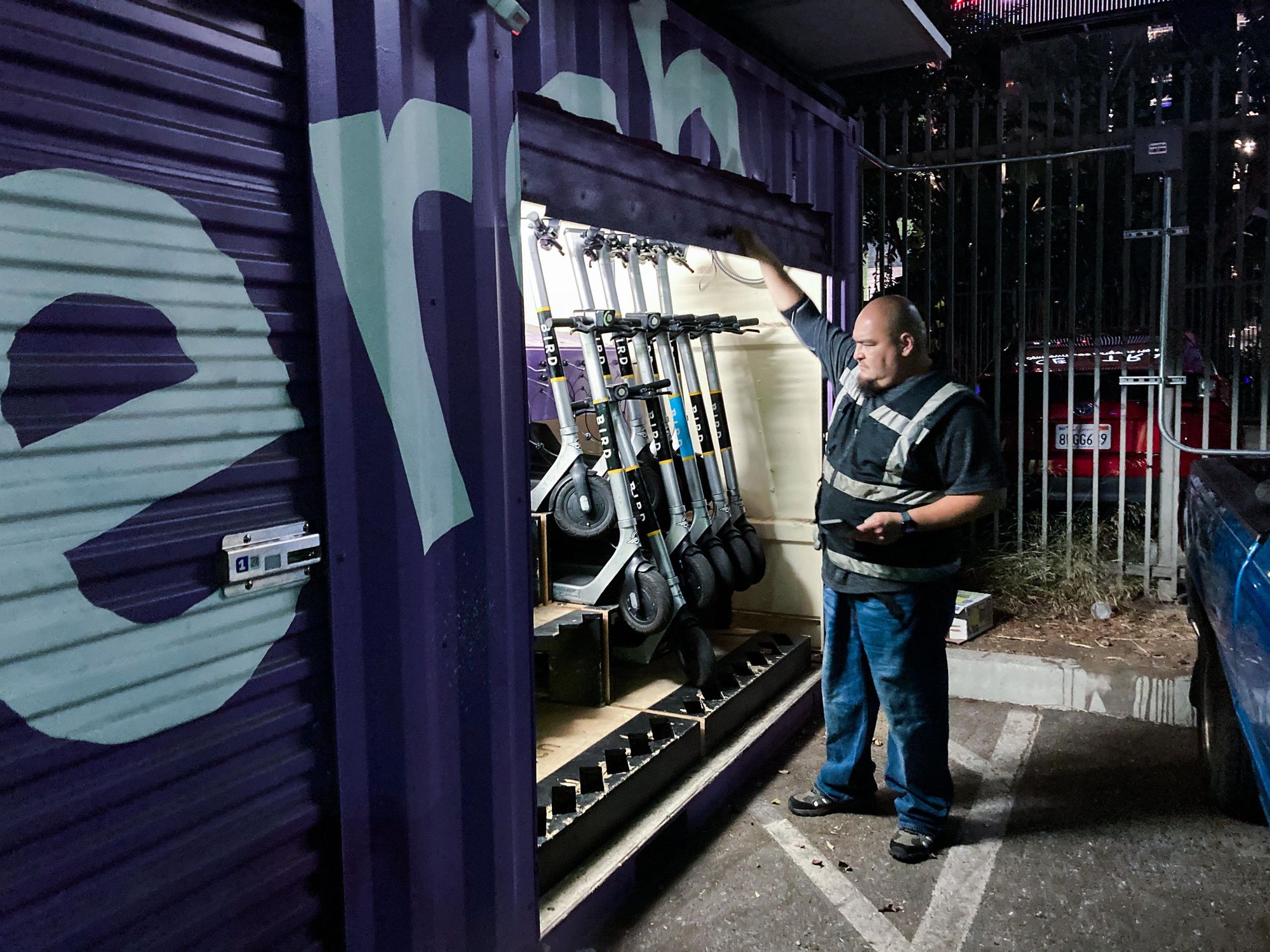
By day, Aceves, 41, works in his family’s business repairing power tools in South Central. By night, he deploys, charges and rebalances e-scooters for Bird, one of eleven fleet managers located Downtown. The zone that he covers includes Dignity Health on Grand Avenue (once called California Hospital) where he was born.


He wears a security vest that reads “Bird Ambassador” and it’s a fairly accurate description of his role in the hustle and flow of the city at night. In all the chaos, he’s a steady presence.

When the COVID-19 pandemic hit in March 2020, Aceves was already charging scooters for Bird, Lime and Wheels, making pretty good money, about $100 for three hours of work a night. But when the virus shut down his family business and prompted companies to pull their scooters from the streets, he suddenly had no work and no income. Then, he got a call from Bird.

Photo from inside Adan Aceves's car. His responsibilities at night range from deploying e-scooters, charging and re-balancing the e-scooters. Photo by Maylin Tu

From Flyer to Fleet Manager

For deploying, charging and fixing a fleet of about 150 scooters, 100 of which are on the street at any given time, Aceves takes home on average $4,500 per month after expenses. Bird deducts a city fee, an insurance and hardware services fee and something called “contra.”

“If someone claims, ‘Hey, the scooter doesn't work,’ they get a discount. So that goes against me,” Aceves explained. His contra normally comes out to about 1% to 2%, while for other fleet managers it can run as high as 7% or 8%. After everything is deducted, Bird and Aceves split the remaining profit 50-50.

As for expenses, he spends $1,200 a month renting a charging container from portable charging infrastructure Perch — an investment he says has reduced the amount he spends on gas by 50%. If he only needs to cover a short distance, he’ll sometimes use a scooter to pick up other scooters, saving himself even more money on gas, an expense that currently comes out to about $100 per week. He also purchases parts directly from Bird to make repairs, another expense.

Aceves starts every night at 10 p.m. and works for four to five hours. Between repairing power tools and managing a fleet of scooters, he works 11 to 12 hour days to put his two daughters, 15 and 19, through college.

It’s physically taxing work — a Bird Two, the model in Aceves’ fleet, weighs 46 to 47 pounds. “After you pick up 40, 50 scooters, then you start to feel it,” he said.

As one of the top flyers, Aceves is a perfect fit for the role.

Born in and raised in South Central and Downtown L.A., Aceves said both sides of his family were from Guadalajara. His grandfather on his father’s side helped build the railroads in California. His father died when he was 11 and he mostly lost touch with that side of his family.

He went to Cathedral High School in Chinatown, an all-boys Catholic school, before attending Los Angeles Trade Technical College for industrial technology and machining, skills that have come in handy in his work repairing power tools — which he’s been doing for the past 30 years.

“So I would go from South Central to Chinatown and I was always in Downtown. Though I gotta tell you, when I was in high school in the 90s — Downtown was not the place to be.”

When he turned 18, his mom told him, “You're out of high school, figure it out.” Now, he’s working to get his daughters through college without taking on student debt.

He knows Downtown’s streets inside and out. This gives him an advantage when scooters go missing, trapped in parking garages or parked under bridges where the GPS is spotty. He uses the Bird fleet manager app to track, fix and release scooters. In a sense, Bird also uses the app to track fleet managers.

“Bird sees everything. I wouldn't be surprised if they're listening to us right now.”

When Bird launched the fleet manager program, he was excited to start repairing scooters.

“As a mechanic, I take a lot of pride in my work. So I'll keep mine to where they're working 100%, if not better.”

Photo of Adan Aceves, working on this fleet of Bird e-scooter. Photo by Maylin Tu

The Pokémon GO Era of E-Scooter Charging

Back in the early days of the e-scooter boom, companies offered a “bounty” for retrieving, charging and redeploying scooters. You could make up to $20 per device — companies paid a premium for devices that were harder to find. According to multiple sources, it was like a grown-up version of Pokémon GO. People would hunt scooters with their partners, friends or kids.

This cadre of independent scooter wranglers and chargers — Bird called them “flyers” and Lime called them “juicers” — made good money and had fun doing it. But it wasn’t a sustainable solution for Bird, Lime and their successors — or the environment.

“The thing about the independent contractor model is that it's great for high growth,” said Harry Campbell, founder of The Rideshare Guy. Companies could launch rapidly in cities without going through the trouble and expense of hiring local employees — showing up with a truck full of scooters and using gig-workers hired through Craigslist to charge and deploy them. Bird, flush with investor cash, was willing to shell out a premium for this new job.

But that model was short-lived, partly because the micromobility startups realized that while using independent contractors was great to help them rapidly scale in unfamiliar cities, it also left them with little control over workers. Some flyers also started to cheat the system by hoarding scooters until the bounty on them went up, Campbell said.

When he started as a flyer, Campbell was making between $40 to $50 an hour. “I was like…I know that this isn't sustainable,” he said, “because this has happened over and over in the gig economy.”

Bird's independent scooter wranglers and chargers are called “flyers” and used to be able to make $20 per device wrangled. Photo by Maylin Tu

How AB5 Impacted E-Scooter ‘Flyers’

In 2019, California passed AB5, a bill targeting companies who misclassify employees as independent contractors.

In response, Uber and Lyft and other companies that rely on gig-workers spent $200 million to pass Prop 22 in California, exempting themselves from the law’s requirements.

E-scooter companies were forced to take a different route. Bird launched its fleet manager program in early 2020. The program employs small businesses like Aceves’s to manage e-scooters while giving them a cut of the profits. To become a fleet manager, individuals must register their businesses as an LLC. Lime uses logistics partners, while competitors like Superpedestrian and Veo make a point of hiring W-2 workers from the local community.

As municipalities ratchet up their regulations around micromobility services, they tend to look favorably on companies that employ W-2 workers. Los Angeles, for instance, is an “open permit” city, which means there is no competitive request for proposal (RFP) process, but companies must submit an annual permit application and a $20,000 fee. Campbell points out that for many cities, including Santa Monica and Long Beach, operators are required to submit detailed applications that are scored on multiple metrics, including community investment.

“It also makes them stand out relative to Bird or Lime that [aren’t] using that type of employment setup,” said Campbell.

Critics of AB5 say that gig-work is actually ideal for parents, caregivers or anyone looking for flexible work with a low-cost of entry.

“It'd be great to have these easy entry, easy exit jobs, where you can hustle when you want and put them down when you don't,” said Erin Hatton, professor of sociology at the University of Buffalo. But some employers take advantage of workers by offering flexible work without employee rights and benefits, which Hatton calls a “false construct.”

The “hybrid” fleet manager model was a logical next step for e-scooter companies, according to Campbell. As the rapid growth in the shared micromobility market started to slow, there was also regulatory uncertainty with AB5.

“Bird probably had hundreds of thousands of chargers at a certain point, so it would have been really hard for them to do a 180 and pivot to an employee model,” said Campbell.

The new fleet manager program seemed like a win-win for both Bird and the independent contractors it hired. No longer were contractors hunting down devices for a bounty. Instead, they would become responsible for the care, charging and placement of individual scooters. The better a fleet manager’s e-scooters perform, the more money they can make. On its recruitment page, Bird advertises that fleet managers can make up to $1,500 per week (with fine print caveats).

At the same time as it offloaded risk and gained more control, Bird didn’t have to invest in hiring W-2 employees.

Bird did not respond to a detailed list of questions about its fleet manager program, but confirmed to dot.LA that it employs 40 “independently owned businesses” in the city of L.A. who are “deeply invested in the communities they serve” and offer “bespoke block-by-block operational expertise.”

“I do not represent or speak for Bird or on their behalf,” Aceves read from his phone while sitting in the driver’s seat of his pickup truck in the parking lot outside of the Perch container. “So, I'm only speaking for my LLC, which is called Up Now.” He added that, per this message received from his engagement manager at Bird, “My relationship with Bird is as a logistics service provider.”

It’s not just about money. Going from “flyer” or “juicer” to “fleet manager” can be a source of pride. Aceves said that some flyers were ashamed to be charging scooters and that it was stigmatized as the “Millennial’s way of collecting cans.” But after they became fleet managers, those same people started bragging about how much money they were making.

“They have hustle,” said Perch Mobility co-founder and CEO Tom Schreiber. “They want to build a better life and have all the dreams everyone else does.”

In 2020, Medium’s tech-focused OneZero publication released an investigation into the program, claiming that Bird was “luring” fleet managers into thousands of dollars of e-scooter debt. However, a follow-up by Smart Cities Dive offered a different picture, focusing on some fleet managers who said they were happy with the program and making good money.

Bird is careful to refer to fleet managers as independent small businesses (not employees) and to emphasize the autonomy that fleet managers have to manage their own fleet. While fleet managers are responsible for repairing damaged scooters, Bird owns the scooters and fleet managers are not financially liable for lost or stolen scooters. But if owning your own business is part of the American dream, that dream can also be exploited by companies who promise one thing and deliver another, according to Hatton.

“Being able to realize a dream of being an entrepreneur — especially when you're coming from such a background — is really powerful,” she said. “And if it pays off for them, I'm all for it. But if they're being taken advantage of under the guise of a dream, then that's deeply problematic.”

From Bounty Hunter to Fleet Shepherd

Adan Aceves has seen things as a Bird fleet manager working nights in Downtown L.A. He jokes that he should start wearing a body cam to capture it all. At 2 a.m. when the bars and clubs get out, things start to get interesting.

Last week, he broke up a fight between two men in front of Union Station. One man was accusing the other of raping his niece.

“And I said, ‘If this dude's a rapist. I'm gonna help you beat him up. When and where?’ And he said it happened 20 years ago in Compton.”

The man being accused said he didn’t know the other man and that he was sleeping when he was attacked.

He’s been in some tense situations while trying to retrieve scooters, including being threatened by a guy with a stick and pulling out his knife in self-defense.

At night, Aceves functions as “eyes on the street” In Downtown L.A., providing a kind of crucial, if unrecognized, public service, in keeping the city safe and vibrant (as urbanist Jane Jacobs outlined in her book “The Death and Life of Great American Cities”).

There are the drunk people who think it’s funny to knock over a row of scooters like so many dominoes or tangle them up in a torturous triangle for fun. He only lines up three to four scooters at a time because he’s found that people are less likely to mess with them.

People have left scooters on the freeway or under bypasses, and once, someone threw a Bird onto a street sign, where it hung suspended like an upside down “L.”

“They’ll leave them in places where it's like, ‘Why? Why would you put it here?’ Not only is it time-consuming but sometimes it can be dangerous,” he said.

Sometimes an enterprising user will ride a Bird scooter all the way to Venice or Marina del Rey, where he has to go to retrieve it, cutting into his profit margin.

One Bird recently made its way all the way to Mexico. “I told Bird, “Hey — this bird decided to migrate.”

All told, he’s lost about 130 scooters since he started. And while e-scooters are extremely visible on the streets of L.A. — much to the chagrin of some Angelenos — Aceves works mostly behind the scenes, not only recharging and rebalancing scooters, but also making sure that they are legally parked and not blocking the public right of way.

“That is one thing I would like people to know — that there [are] actual humans behind each scooter,” Aceves said.

For Lack of a Safety Net

Photo by Maylin Tu

Aceves works with two other fleet managers (one is his brother). He said they help each other out. Otherwise, it can be hard to maintain a grueling, seven-nights-a-week schedule, with no vacation pay or sick days.

He makes more money than he would as a so-called gig-worker, but he doesn’t receive either the legal protections afforded employees under federal and state law, nor the types of perks tech companies often offer.

“One of the things that is quite tricky about the independent contractor model is that the costs of that model are not readily apparent,” said Hatton.

Nonetheless, for many workers, the trade-off is worth it and Aceves says he enjoys the flexibility.

“I enjoy the freedom. I enjoy driving Downtown. I like the fact that the scooters are providing a service to a city without majorly giving us pollution and decreasing traffic,” he said. “I always think to myself, ‘I gotta leave this planet better than when I came in. Because my kids are here and possibly their kids’.”

Aceves grew up during “some of the worst years in South Central'' and wants to write a book about the experience. He thinks he has enough material — the kind of stories you wouldn't believe if he told them to you — for two or three seasons of a TV show.

He was 11 during the 1992 Los Angeles Riots, when the streets were on fire.

“I was like, ‘What the hell's going on? Is it the end of the world?’.”

As a teenager, he said he had a few run-ins with the LAPD’s infamous Rampart Division . Aceves said corrupt cops would try to shake down gang leaders for money and retaliate against people in the neighborhood when they refused — doing everything from beating them up, to trying to plant drugs or guns on them, to picking them up and leaving them in a rival gang’s neighborhood.

“So basically expecting you to get killed ‘cause it wasn't like they were going to greet you — or offer you a ride back. So I would be running home at 2 a.m. down Central Avenue, as fast as I could. People would think I was on drugs and I was just running home for my life.”

Today, Aceves cruises through the streets of Downtown L.A. every night, to put his daughters through college and to make the world a better place.

In working with cities, companies like Bird straddle the line between private enterprise and public service — claiming to make cities greener, safer and more equitable. And shared micromobility has changed the landscape of Downtown L.A., arguably for the better. But it’s people like Aceves who deal with the best and the worst the city has to offer.

At one point, Aceves leans down to pick up a LINK scooter that’s lying with its handlebars in the street. “We’re not supposed to touch competitors’ scooters,” he explains. “But normally, if they're in a situation like this, I pick it up…I feel like it's my community.”

JetZero Just Raised $175M to Rewrite How We Fly

🔦 Spotlight

Happy Friday, Los Angeles ✈️

While everyone in tech is still busy arguing about the next AI model, one startup based out of Long Beach just raised a whole lot of money to change the shape of the airplane itself.

Image Source: JetZero

JetZero closed a $175 million Series B to build its blended wing body “all-wing” airliner, with B Capital leading the round alongside United Airlines Ventures, Northrop Grumman, 3M Ventures, Trucks VC and RTX Ventures. The company is working toward a full-scale Demonstrator aircraft that targets at least 30% better fuel efficiency than today’s tube-and-wing jets, with a first flight planned for 2027 and a commercial Z4 airliner to follow in the early 2030s.

This is not a small bet. JetZero’s pitch is that airlines and regulators need a way to hit climate targets without waiting on sci-fi batteries or hydrogen infrastructure, and that a radically more efficient airframe is the most realistic path. It is also very much an LA story: deep aerospace talent, strategic money at the table, and a product that looks like a mashup of climate tech, defense tech and old-school manufacturing rather than another SaaS dashboard.

There is still a long way to go. The next few years are about turning simulations and wind-tunnel charts into flight data, working with regulators and proving that a manta-ray-shaped jet can slot into a world built for Boeings and Airbuses. But if JetZero gets anywhere close, it will mean that one of the most ambitious hardware bets in commercial aviation is being engineered out of Long Beach.

Scroll on for the latest LA venture rounds, fund news and acquisitions.

🤝 Venture Deals

      LA Companies


      • No Agent List secured $10M in private investment to launch its AI powered real estate platform ahead of a planned Spring 2026 debut. The Los Angeles based company aims to put “agent level” tools directly in the hands of buyers, sellers and vendors, offering direct access to off market properties, FSBOs, distressed assets, foreclosures, tax liens and auctions that have traditionally been gated by agents and insiders. The funding will support product development and rollout of the platform, which promises more control over transactions while using AI to surface opportunities and streamline the deal process. - learn more
      • Hadrian, the Los Angeles based advanced manufacturing startup, announced new capital led by accounts advised by T. Rowe Price Associates to accelerate its push to “reindustrialize” American manufacturing. The financing, which also includes Altimeter Capital, D1 Capital Partners, StepStone Group, 1789 Capital, Founders Fund, Lux Capital, a16z, Construct Capital and others, values the company at $1.6B and will be used to expand its high-throughput factories, grow its workforce and deploy more AI, software and automation across its “factories-as-a-service” platform for aerospace, defense and critical infrastructure customers.- learn more

            LA Venture Funds

            • Blue Bear Capital joined Hydrosat’s $60M Series B, backing the thermal infrared satellite data company alongside lead investors Hartree Partners, Subutai Capital Partners and Space 4 Earth. The funding will help Hydrosat expand its constellation beyond its two current satellites, ramp global coverage and deepen its AI-powered “thermal intelligence” products for water resource management, agriculture, civil government and defense customers worldwide. - learn more
            • Elysian Park Ventures led a $12M growth round for Diamond Kinetics, backing the Pittsburgh-based baseball tech company as it doubles down on youth development. The new capital will help Diamond Kinetics scale sidelineHD, its AI-powered youth baseball and softball live streaming and highlights platform, and expand its broader suite of training tools as MLB’s Trusted Youth Development Platform. - learn more
            • MANTIS Ventures participated in Depthfirst’s $40M Series A round, backing the San Francisco based applied AI lab alongside lead investor Accel, Alt Capital, BoxGroup, Liquid 2 Ventures and SV Angel. Depthfirst is building an AI-native “General Security Intelligence” platform that uses autonomous agents to detect, triage and remediate software vulnerabilities across code and infrastructure, aiming to outpace a new wave of AI-powered cyberattacks. The fresh capital will fund R&D, go-to-market efforts and hiring as the company scales its security platform for enterprise customers. - learn more
            • Cedars-Sinai Health Ventures participated in Vista AI’s $29.5M Series B, joining a slate of leading health systems backing the company’s automated MRI scanning software. The Palo Alto-based startup will use the funding to expand its FDA-cleared cardiac MRI platform to additional anatomies like brain, prostate and spine, and to roll out remote scanning services that let hospitals without in-house MRI expertise offer advanced imaging while easing backlogs and technologist shortages - learn more
            • Fourward Ventures is leading a new strategic growth investment in Mermaid Gin, backing the Isle of Wight–based premium spirits brand as it accelerates expansion in the U.S. market. The round brings Fourward’s founder Will Ward onto the board as lead investor and is paired with a national distribution partnership with Southern Glazer’s Wine & Spirits, plus the appointment of longtime Moët Hennessy veteran Jim Clerkin as CEO for the U.S. push. The capital and partnership are aimed at scaling Mermaid Gin in the fast-growing U.S. super-premium gin segment while preserving its sustainability-focused, Isle of Wight roots. - learn more
            • Hyperion Capital joined Haiqu’s $11M seed round, backing the quantum software startup alongside Primary Venture Partners, Collaborative Fund, Alumni Ventures, Qudit Ventures, Silicon Roundabout Ventures, Harlow Capital, Toyota Ventures and MaC Venture Capital. Haiqu is building a hardware-aware quantum operating system and middleware layer that boosts the performance of today’s noisy quantum hardware, with the new funding going toward productizing its platform and enabling near-term commercial use cases in areas like finance, cybersecurity and scientific computing. - learn more
            • Sound Ventures led WitnessAI’s $58M strategic funding round, backing the Mountain View based AI security and governance platform alongside investors including Fin Capital, Qualcomm Ventures, Samsung Ventures and Forgepoint Capital Partners. The company will use the capital to accelerate global go-to-market efforts and expand its platform, which secures AI agents and models by monitoring agent activity, linking human and agent actions, and blocking prompt injection and other attacks in real time. WitnessAI also unveiled new agentic AI governance tools that give enterprises deeper observability and policy control as they scale AI agents across their operations. - learn more
            • Alexandria Venture Investments joined Proxima’s oversubscribed $80M seed financing, backing the newly rebranded AI-native biotech (formerly VantAI) alongside lead investor DCVC, NVentures (NVIDIA’s venture arm), Braidwell, Roivant and others. Proxima is building a generative AI driven platform for “proximity-based medicines” that modulate protein protein interactions, including molecular glues and PROTACs, to go after historically undruggable targets in oncology, immunology and beyond. The new capital will accelerate its NeoLink structural proteomics and Neo AI model stack, and advance a pipeline of first-in-class proximity-modulating therapeutics toward the clinic. - learn more
            • Clocktower Technology Ventures participated in WeatherPromise’s oversubscribed $12.8M Series A, backing the weather-guarantee startup alongside lead investor Maveron, 1Sharpe, Lerer Hippeau, Commerce Ventures, MS Transverse, Start Ventures, 1Flourish and others. WeatherPromise partners with major travel brands like Marriott, Expedia and JetBlue to offer “weather guarantees” that automatically refund trips when conditions are worse than promised, driving demand for travel, events and outdoor experiences. The new capital will accelerate product development, expand strategic partnerships and scale the platform across more consumer categories. - learn more
            • MANTIS Ventures participated in Sandstone’s $10M seed round, backing the AI-native legal tech startup alongside lead investor Sequoia Capital and others. Sandstone is building an operating system for in-house legal teams that uses AI agents to route requests, draft and review contracts, and surface answers directly inside tools like email, Slack and Salesforce, turning institutional legal knowledge into reusable workflows. The new capital will help the Brooklyn-based company scale its product and grow its customer base of corporate legal departments. - learn more
            • Strong Ventures participated in Hupo’s $10M Series A round, backing the Singapore-based AI sales coaching startup alongside lead investor DST Global Partners, Collaborative Fund, January Capital and Goodwater Capital. Hupo’s platform uses AI to coach frontline banking, insurance and financial services sales teams in real time, helping them ramp faster and close more deals across highly regulated markets in APAC and Europe. The new funding will support product development, expansion of its coaching features and scaling enterprise deployments as the company eyes broader international growth. - learn more
            • Freeflow Ventures joined Vivere Oncotherapies’ more than $10M funding round, backing the UC Berkeley spinout alongside YK Bioventures, Pillar, Berkeley Frontier Fund and the National Cancer Institute. Vivere is developing targeted immunotherapies for “cold” solid tumors like colorectal and ovarian cancers, aiming to activate the immune system against tumors that typically evade detection and resist existing treatments. The new capital will support advancement of its proprietary bioengineering platform and pipeline of therapies for patients with few effective options today. - learn more
            • Alexandria Venture Investments joined Precede Biosciences’ $63.5M Series B equity round, part of an $83.5M total financing package that also includes a $20M strategic, non-dilutive credit facility. The Boston based precision diagnostics and data company is scaling its blood-based platform, which measures target expression and pathway activity to support next-generation cancer therapies like drug, radio and immune conjugates. The new capital will help Precede meet growing demand from biopharma partners developing these precision medicines and accelerate commercialization and health system adoption. - learn more
            • Alexandria Venture Investments participated in Recludix Pharma’s new equity financing round alongside Access Biotechnology, NEA and Westlake BioPartners, with additional strategic investment from Eli Lilly. The San Diego based, clinical-stage biotech will use the $123M in total equity raised to advance clinical development of its novel SH2 domain inhibitor pipeline for inflammatory diseases and to tap Lilly’s TuneLab AI/ML platform to accelerate discovery across its broader SH2 domain program. - learn more
            • BOLD Capital Partners participated in MagicCube’s $10M funding round, backing the Cupertino-based software security company alongside strategic investor Verifone and other existing backers. MagicCube plans to use the capital to expand beyond its core tap-to-phone payments offering into biometrics, identity verification and AI-driven device security, while scaling its Software Defined Trust platform that delivers hardware-grade protection through software on standard mobile and IoT devices.- learn more

                  LA Exits

                  • Webalo is being acquired by Prometheus Group, which is folding the Los Angeles based “no-code for the frontline” platform into its enterprise asset management software suite. The deal will combine Webalo’s mobile, real-time workflows for frontline workers with Prometheus Group’s planning and scheduling tools, aiming to create a closed-loop digital execution platform that connects shopfloor actions directly back into systems of record like SAP and Oracle. - learn more

                                      Download the dot.LA App

                                      Inside Tinder’s 380-Matches-Per-Second Sunday

                                      🔦 Spotlight

                                      Happy New Year, Los Angeles. 💘

                                      If you want a clear read on how people actually behave when the calendar flips, you do not need a survey. You need Tinder’s Dating Sunday data. The numbers below are from January 2025, compared with 2024, and they show a pattern the app sees every year when millions of people log in and take their love life off pause.

                                      🔥 Tinder’s Annual Traffic Spike, By The Numbers

                                      On Dating Sunday, the first Sunday of the year, Tinder hit its biggest activity spike on the calendar. Compared with the app’s typical daily averages for that year, and trends versus the prior year:

                                      📈 Swipes were nearly 13% higher

                                      💬 Messages were nearly 10% higher

                                      ❤️ Likes were over 10% higher

                                      🗣️ Users had almost 7% more conversations

                                      🤝 Matches climbed to about 380 matches per second, roughly a 10% lift compared to the rest of the year

                                      Across Peak Season, from January 1 through February 14, Tinder saw on the order of 10 million more messages per day and roughly 40 million additional likes than its non peak baseline.

                                      The figures are from last January, but the shape of this curve is remarkably consistent year after year, which is why they are a solid proxy for what is happening again at the start of 2026.

                                      ⚡ Not Just More Use, Different Use

                                      What makes the Dating Sunday data more interesting than a simple “usage went up” story is how behavior shifted compared with the same day the year before.

                                      Users replied about 2 hours and 25 minutes faster on average while also sending more messages, more likes and starting more conversations. That looks less like background swiping and more like a concentrated intent spike, people coming back to the app with a clear goal and actually engaging.

                                      From a product and infrastructure perspective, that turns this one Sunday into a full stack exercise. Ranking, recommendations, notifications, trust and safety and core scale all get hammered at once, with high signal data flooding the system over a short window. Most apps only see that kind of behavior during a one off viral moment or a big launch. Tinder sees it every January.

                                      📊 What The Surge Actually Signals

                                      There is plenty of talk about people being tired of apps. The behavior here tells a more nuanced story.

                                      When the calendar flipped last year, people reopened Tinder, used it more, started more conversations and replied faster than they had the year before. That does not look like a category that has lost its grip on users. It looks like a mature consumer network that can still generate predictable, measurable spikes of attention and intent on cue.

                                      If those patterns hold, the first few weeks of 2026 once again look less like a slow reset and more like a live load test for an LA built product at global scale.

                                      Now keep scrolling for this week’s LA venture deals, fund announcements and acquisitions.

                                      🤝 Venture Deals

                                          LA Companies

                                          • Cambium, an El Segundo based advanced materials startup, raised a $100M Series B led by 8VC. The company uses AI, chemical informatics and high-performance computing to design new polymers and composites for defense, aerospace and other high-performance sectors, and will use the funding to accelerate its product pipeline and scale manufacturing capacity across the U.S. and Europe following its acquisition of SHD. - learn more

                                                LA Venture Funds

                                                • Plus Capital joined Pomelo Care’s $92M Series C, backing the New York based virtual care company at a $1.7B valuation alongside lead investor Stripes, Andreessen Horowitz, Atomico, BoxGroup and SV Angel. Pomelo, which already covers about 25 million lives and nearly 7% of U.S. births, will use the funding to take its proven, outcomes-driven maternity model and expand it across women’s and children’s health more broadly, from reproductive care and pediatrics through hormonal health, perimenopause and menopause. - learn more
                                                • Kittyhawk Frontier is leading a $2M seed round in Denver based encoord, joining new and existing investors to back the company’s grid-planning software platform. encoord’s flagship product, SAInt, is designed to give utilities, developers, data centers and grid operators an integrated financial and operational view of the power system, helping cut interconnection timelines by up to five years and optimize capital planning. The new capital will go toward expanding the team, advancing the platform and scaling into key markets as demand for smarter, electrification-ready grid planning tools accelerates. - learn more
                                                • Alexandria Real Estate Equities participated in Mediar Therapeutics’ oversubscribed $76M Series B, joining new investors like Longwood Fund and Asahi Kasei Pharma Ventures in a round co-led by Amplitude Ventures and ICG. The Boston-based biotech will use the funding to advance its first-in-class fibrosis portfolio, including MTX-474, now in a global Phase 2a trial for systemic sclerosis, and MTX-439, which is moving into Phase 1 studies for fibrosis associated with chronic kidney disease, alongside its partnered MTX-463 program with Eli Lilly. - learn more
                                                • GordonMD Global Investments joined Soley Therapeutics’ $200M Series C, backing the South San Francisco based biotech as it advances its AI-enabled cell stress sensing platform and oncology pipeline. The round, led by Surveyor Capital with participation from new and existing investors, will fund IND-enabling work and early clinical trials for Soley’s lead acute myeloid leukemia (AML) program and a second solid-tumor asset, while also expanding non-oncology programs in neurodegenerative and metabolic diseases and scaling the platform. - learn more

                                                    LA Exits

                                                    • CareRev is being acquired by IntelyCare, which is combining its post-acute healthcare staffing platform with CareRev’s on-demand workforce marketplace for acute care. The deal creates one of the more comprehensive clinical labor platforms in the market, spanning clinician-facing job boards, internal resource pool tools, contingent labor and recruiter solutions to help health systems manage permanent and flexible staff in one place. Both brands will continue operating under their existing names while integrating offerings for hospitals, health systems and clinicians. - learn more

                                                                        Download the dot.LA App

                                                                        LA Is Betting on Nukes, Netflix and Next-Gen Attention

                                                                        🔦 Spotlight

                                                                        Hey Los Angeles.

                                                                        If you were looking for a quiet week, this was not it. LA is backing a portable nuclear reactor, Netflix just took a big step closer to owning Warner Bros. Discovery’s future, and Snapchat is basically handing the city a mirror and saying, “Here is what you did with your attention all year.”

                                                                        Let’s dive in.

                                                                        Radiant’s microreactors and LA’s new nuclear moment

                                                                        Radiant Nuclear raised more than $300M in a Series D round to build Kaleidos, a one megawatt portable nuclear microreactor that is designed to roll off a factory line, ship in a standard container and replace diesel generators at remote sites, military bases and disaster zones. The new capital will fund a full scale test at Idaho National Lab and the build out of Radiant’s R 50 factory in Oak Ridge, Tennessee, which aims to produce up to 50 reactors a year starting later this decade.

                                                                        For LA’s climate and infrastructure ecosystem, this is a big tell. The city that got rich on pipelines of content is now funding pipelines of electrons, betting that small, modular nuclear can be part of the grid story that powers everything from data centers to defense. It is a very different flavor of LA tech, but the pattern is familiar: take a frontier technology, wrap it in product thinking and try to make it feel as boring and reliable as a utility bill.

                                                                        Netflix and Warner Bros. Discovery: one step closer

                                                                        On the media front, Netflix just received an official recommendation from Warner Bros. Discovery’s board to proceed with the planned acquisition of WBD’s studios and streaming business. The board reaffirmed that the Netflix deal, which would fold Warner Bros. film and TV, HBO and HBO Max into Netflix, is in the best interest of shareholders, even as competing ideas swirl around what to do with the company.

                                                                        Practically, this does not mean the deal is done. It means the process has moved from “big idea in a press release” into the slower, more serious phase of shareholder approvals and regulatory review. For Los Angeles, every incremental step like this reinforces the likely end state: a world where a handful of global platforms control not just distribution but also the studios and libraries that defined Hollywood’s last century.

                                                                        Snapchat’s 2025 Recap and the attention economy in our backyard

                                                                        Then there is Snapchat, which used its 2025 Recap to show off what its mostly Gen Z and Gen Alpha users actually did on the app this year. The company is leaning into personalized “year in review” stories that highlight top chats, memories, maps moments and creator content, while quietly reminding brands and investors that Snap still owns a very specific slice of youth attention that is hard to find anywhere else.

                                                                        For LA, Snapchat’s recap is more than a cute end of year product. It is a reminder that some of the most important social infrastructure for the next generation is being built and iterated a short drive from Santa Monica Boulevard. While the grown ups argue about nuclear reactors and studio mergers, Snap is training the next wave of consumers how to communicate, create and remember their lives on a platform that barely existed fifteen years ago.

                                                                        Taken together, this week says a lot about what “LA tech” means in 2025. On one end, you have Radiant trying to change how we power the physical world. On the other, Netflix and Snapchat are fighting over how we package and monetize the stories that live in our heads. Somewhere in the middle are the founders, investors and operators here who see all of this as raw material.Now keep scrolling for this week’s LA venture deals, fund announcements and acquisitions.

                                                                        🤝 Venture Deals

                                                                            LA Companies

                                                                            • Fixated secured a $50M strategic investment from Eldridge Industries to fuel what it calls the “next era of creator-led empires.” The company says the capital will help it expand its capabilities and partnerships that support creators in building and scaling their own brands and businesses beyond traditional sponsorship deals. - learn more
                                                                            • Vital Lyfe raised $24M in financing, including more than $18M in seed funding, in a round led by Interlagos and General Catalyst with participation from Generational Partners, Cantos, Space.VC and Also Capital. The Hawthorne based startup, founded by former SpaceX engineers, will use the capital to ramp manufacturing of its portable, autonomous “water making” systems, expand early deployments with partners like maritime operators and NGOs, and prepare for its first consumer ready products in 2026. - learn more
                                                                            • Molly Sims’ YSE Beauty closed a $15M Series A growth equity round led by Silas Capital, with participation from L Catterton and existing backers Willow Growth Partners and Halogen Ventures. The clinically tested skincare brand, which targets women 35+ and recently rolled out nationally at Sephora, will use the funding to fuel product development, expand across Sephora doors in the U.S., and grow its direct-to-consumer e-commerce business. - learn more
                                                                            • Ember LifeSciences raised a $16.5M Series A led by Sea Court Capital, with participation from Cardinal Health, Carrier Ventures and other strategic investors including former U.S. Secretary of State Mike Pompeo. The Los Angeles based cold chain tech company will use the funding to launch its next generation Ember Cube 2 shipping system and expand globally, helping pharma and healthcare customers cut temperature related losses and waste in medicine distribution. - learn more
                                                                            • Strada, a Los Angeles–based media collaboration startup, received a strategic investment from Other World Computing (OWC) to accelerate its product roadmap. The company’s peer-to-peer platform lets video pros access, share and review large files directly from local drives anywhere in the world, without uploading to the cloud. The partnership will also include co-marketing efforts, joint NAB 2026 presence, and bundled offerings that pair Strada’s software with OWC’s storage and workflow hardware. - learn more

                                                                                LA Venture Funds

                                                                                • Calibrate Ventures participated in Manifold’s Series B round, backing the company as it scales its AI technology platform. Manifold plans to use the new capital to accelerate product development, deepen its capabilities for enterprise customers, and grow its team to support broader commercial rollout. - learn more
                                                                                • SmartGateVC participated in NeuraWorx’s oversubscribed seed round, which was led by Nexus NeuroTech to back the company’s neurotechnology based therapies for central nervous system (CNS) disorders. NeuraWorx plans to use the capital to advance its R&D and early clinical work, build out its technology and product pipeline, and expand its team as it moves toward bringing new CNS treatments to market. - learn more
                                                                                • Kinship Ventures participated in Lovable’s $330M Series B, which values the Stockholm based “vibe coding” platform at $6.6B in a round co-led by CapitalG and Menlo Ventures’ Anthology fund. The company lets non developers build full stack software from natural language prompts, and says it will use the new capital to scale its AI native platform globally, deepen enterprise features and integrations, and support a fast growing base of business users building production apps on Lovable. - learn more
                                                                                • B Capital participated in MoEngage’s $180M Series F follow-on, which brings the customer engagement platform’s total Series F raise to $280M. The round was led by ChrysCapital and Dragon Funds, with Schroders Capital and TR Capital also joining, and will be used to accelerate MoEngage’s Merlin AI product roadmap, expand go-to-market teams across North America and EMEA, and pursue strategic acquisitions while also funding an employee and early-investor liquidity program. - learn more
                                                                                • O'Neil Strategic Capital led HEN Technologies’ $22M financing, which combines a $20M oversubscribed Series A with $2M in venture debt, to build what the company calls the industry’s first operating system for fire defense. The Hayward based startup will use the capital to scale its IoT enabled hardware and Fluid IQ predictive AI platform, capture a comprehensive operational fire dataset, and expand global deployments with distributors and agencies as it aims to make fire suppression faster, more efficient and data driven. - learn more
                                                                                • Core Innovation Capital participated in Transparency Analytics’ second funding round, backing the company alongside lead investor Deciens Capital, Allianz Life Ventures, Mouro Capital, FJ Labs and SUM Ventures. Transparency Analytics, which provides quantitative, tech enabled credit ratings and benchmarking for private credit, will use the funding to scale its platform, refine go to market strategy and build out products like its private credit index as the asset class grows. - learn more
                                                                                • Upfront Ventures participated in Nanit’s $50M growth round, which was led by Springcoast Partners with support from JVP. The company will use the funding to expand its AI powered Parenting Intelligence System and related tools that give parents real time, personalized insight into a baby’s sleep, health and development between pediatric visits. - learn more
                                                                                • Integrity Growth Partners fully funded Fluency’s $40M Series A, coming in as the company’s first major institutional investor. Fluency, a “digital advertising operating system,” centralizes and automates paid media across Google, Meta, TikTok, programmatic and more, already powering nearly $3B in annual ad spend and over 250,000 monthly campaigns. The company plans to use the capital to enhance its automation and agentic AI capabilities, expand integrations with publishers and tech partners, and grow its team. - learn more
                                                                                • JAM Fund joined Last Energy’s oversubscribed $100M+ Series C, backing the advanced nuclear startup as it pushes to commercialize its factory built microreactors. The round was led by Astera Institute with investors including Gigafund, The Haskell Company, AE Ventures, Ultranative, Galaxy Interactive and Woori Technology. Last Energy plans to use the capital to complete its PWR-5 pilot reactor under the U.S. DOE’s Reactor Pilot Program, ramp manufacturing in Texas, and advance its larger PWR-20 units toward commercial deployment in the U.S. and U.K. - learn more

                                                                                  LA Exits

                                                                                  • NextWave is being acquired by Pattern, bringing the TikTok-focused commerce agency under Pattern’s umbrella to strengthen its TikTok Shop and creator-led commerce capabilities. The deal folds NextWave’s expertise in TikTok Shop strategy, operations and creator partnerships into Pattern’s broader ecommerce platform, giving brands a single partner to manage marketplace, DTC and social shopping channels. - learn more
                                                                                  • Ubiquitous is being acquired by Humanz as part of Humanz’s broader push to build a next-gen, data driven creator economy platform alongside its recently announced $15M funding round. The deal folds Ubiquitous’ creator marketing and TikTok/native social expertise into Humanz’s influencer analytics and campaign tooling, giving brands a more end-to-end partner for strategy, creator management and performance measurement across major social channels. - learn more
                                                                                  • Silver Tribe Media is being acquired by TPG-backed Initial Group, which is folding the company into its broader sports and entertainment platform. The deal brings Silver Tribe’s storytelling, production and athlete brand work under Initial Group’s umbrella, giving it more capital and distribution while expanding Initial’s in-house content capabilities around teams, athletes and sponsors. - learn more
                                                                                  • Duffl, the YC-backed campus delivery startup, is being acquired by Rev Delivery, bringing its “10M campus delivery pioneer” operation under Rev’s umbrella. The acquisition folds Duffl’s college-focused, ultra-fast delivery network and playbook into Rev’s hyper-growth delivery operators, with the goal of scaling on-demand service across more campuses and strengthening Rev’s position in student-centered last-mile logistics. - learn more

                                                                                                    Download the dot.LA App

                                                                                                    RELATEDEDITOR'S PICKS
                                                                                                    Trending