
'The Writing's on the Wall': Electric Batteries' Rapid Progress May Have Just Doomed Natural Gas Trucks

David Shultz

David Shultz reports on clean technology and electric vehicles, among other industries, for dot.LA. His writing has appeared in The Atlantic, Outside, Nautilus and many other publications.


'The Writing's on the Wall': Electric Batteries' Rapid Progress May Have Just Doomed Natural Gas Trucks
Image from Tesla

Last month, when dot.LA toured the Hexagon Purus facility in Ontario, California, multiple employees bemoaned the California Air Resources Board’s (CARB) ruling on renewable natural gas (RNG) as a hindrance to decarbonizing trucking-haul trucking. They argued that keeping RNG classified as a “near-zero emission” fuel prevented companies using financial incentives like the Hybrid and Zero-Emission Truck and Bus Voucher Incentive Project, which, as the name suggests, is only available to true zero-emission trucks. The effect, they said, was that the agency was missing an opportunity to accelerate the state’s transition away from diesel.

But over the weekend, Tesla CEO Elon Musk took to Twitter to announce that the EV company’s battery powered class 8 semi-truck had completed a 500-mile trip fully loaded (to the tune of 81,000 lbs). It now appears CARB’s refusal to classify renewable natural gas (RNG) as a zero-emission fuel source was ultimately the right decision.


Just two years ago Bill Gates famously declared that, “even with big breakthroughs in battery technology” electric vehicles were simply not ready to tackle long-haul trucking. If Tesla’s numbers hold up to scrutiny, it proves Gates and many other industry experts were likely wrong to suggest that “we need a different solution for heavy, long-haul vehicles.” And while 500 miles represents the lower limit for what’s necessary to transition long-haul transportation to battery power, Tesla’s announcement proves the tech is getting there.

What’s interesting is that the transportation sector saw the same arguments in the 2010s against passenger EVs. But then lithium-ion batteries underwent a small revolution where energy density gains outpaced even the most bullish predictions. And while such a surge in performance is unlikely to be repeated, even incremental gains on a truck with 500-mile range could cement the technology as the dominant energy source for the sector.

So what does this latest announcement mean for natural gas trucks?

As it currently stands, natural gas, in addition to hydrogen fuel cells, is still touted as a low- or even negative-carbon solution that could let the trucking industry slash emissions and get to net zero. In such a model, biowastes such as manure or plant scraps are harvested and converted into natural gas that can be combusted inside an engine. While this process does create CO2 as a byproduct, the amount of carbon saved by cleaning up the biowaste is often equal to or even greater than what’s created when the gas is burned. Industry insiders have often pointed to the fact that renewable natural gas can outperform alternatives from a greenhouse gas emissions perspective.

Tesla’s announcement also comes at a time when trucking giant Cummins recently showed off a new 15-liter natural gas engine design, which the company has advertised as a way for fleets to reduce their carbon usage and comply with California’s stricter nitrogen oxide emission requirements coming in 2024. Natural gas, the company has said, could once again be the “bridge fuel” that buys the industry time while hydrogen fuel cell and battery tech matured.

But outside of the trucking industry, environmental policy experts also seem increasingly confident that batteries represent the best chance for decarbonization. Colin Murphy, the deputy director of UC Davis' Policy Institute for Energy, Environment and the Economy, points to the fact that RNG is only carbon negative due to the credits it receives for reducing methane emissions.

Put another way, if California cleans up its methane problem anyway–as CARB has been proposing–there’s no sense in rewarding transportation companies for capturing and burning natural gas.

“If agriculture has to reduce their emissions in order to keep in line with the rest of the economy, they can't have this giant emission of methane out there that transportation is taking credit for,” says Murphy. “It's carbon negative for now, but it will not be carbon negative forever.”

Without the credit for capturing methane, burning natural gas is still 60% to 70% better than diesel in terms of greenhouse gas emissions, but compared to a battery charged from a grid that’s increasingly powered by solar, wind and other zero-carbon renewables, natural gas quickly loses much of its luster.

The same logic applies to RNG’s benefits to nitrogen oxide (NOx) emissions compared to diesel: They’re real, but they’re second best to actual zero-emissions tech like hydrogen and batteries. NOx pollution is generated in both diesel and natural gas engines and emitted at the tailpipe. While these chemicals don’t contribute as much to climate change as CO2, they create smog and air pollution that is a major health burden worldwide.

“These [natural gas] vehicles, they certainly are contributing to climate change, but they're much more closely tied to the local air quality,” says Patricio Portillo, a senior advocate for the NRDC’s Climate & Clean Energy Program. “And what we've seen, especially with natural gas vehicles, is that they don't really live up to the hype.”

Portillo notes that the vehicles receive their NOx ratings at the time they’re manufactured. But as the trucks age, components degrade and the actual amount of pollution they create increases.

“On the other hand, you are plugging into an increasingly clean grid with zero-emission vehicles,” he says. “So if anything, those things are just going to get cleaner over time, as the electricity grid continues to get cleaner.”

As CARB continues to drive policy with the state announcing a ban on new diesel truck sales by 2040, the transition to greener transportation will be a massive effort. To be clear, there is still a ton of work to do, on both the infrastructure side and on the supply chains needed to power such a massive undertaking. But at the moment, announcements like Tesla’s are increasingly looking like a signal that legacy truck makers and fleet owners would be wise to heed.

“If I'm a fleet looking at this, I think it's pretty clear that the writing's on the wall,” says Portillo. “It took some time for the technology to get there, but it's there now. It's not worth continuing to invest in second-best technology, because the result is going to be stranded assets for natural gas.”

Hello Sunshine Sold for More Than $900M. Now Reese Witherspoon Is Buying It Back.
Image Source: Hello Sunshine

🔦 Spotlight

Hey there, LA.

In Hollywood, every successful story eventually gets a sequel. This one brings Reese Witherspoon back to the company she built.

Five years after selling control of Hello Sunshine in a deal worth more than $900M, Witherspoon is partnering with French production group Mediawan to buy back the Los Angeles media company.

The reported purchase price is in the low-to-mid eight figures, significantly below Hello Sunshine’s valuation when Candle Media acquired a controlling stake in 2021.

That difference tells a larger story than any single Hollywood transaction.

Hello Sunshine was one of the most prominent acquisitions made during the streaming boom, when platforms were spending aggressively and investors placed enormous value on production companies with recognizable founders, established audiences and libraries of intellectual property.

Witherspoon had built all three.

Founded in 2016, Hello Sunshine developed its business around stories centered on women, producing projects including “Big Little Lies,” “The Morning Show,” “Little Fires Everywhere” and “Daisy Jones & The Six.” It also turned Reese’s Book Club into an influential audience and discovery platform that now reaches 6.2 million readers and drives approximately $900M in annual U.S. book sales, according to the company.

By 2021, that combination of talent, intellectual property and direct audience access looked like the foundation of a next-generation media empire.

Candle Media, backed by capital from Blackstone, acquired Hello Sunshine as part of a broader effort to assemble a portfolio of entertainment brands. The company also purchased businesses including Moonbug Entertainment, ATTN: and Faraway Road Productions.

Then the streaming market changed.

Entertainment companies became more disciplined about content spending. The race to accumulate subscribers gave way to pressure for profitability. Production budgets tightened, consolidation slowed and some of the valuations assigned during the streaming boom became difficult to maintain.

Hello Sunshine’s return to founder-led ownership reflects how dramatically the media landscape has changed since 2021. It also gives Witherspoon an opportunity to regain greater influence over the company at a moment when its core assets may matter more than its former valuation suggests.

Under the new ownership structure, Hello Sunshine plans to refocus on premium film and television, Reese’s Book Club and new storytelling and distribution formats. Mediawan brings an international production network, while Witherspoon brings something harder to manufacture: a trusted personal brand and an audience willing to follow her recommendations from books to screens.

That relationship with consumers is increasingly valuable in a fragmented media market. Studios can finance productions. Streaming services can distribute them. Far fewer companies can reliably convince millions of people to care before a project is even released.

For Los Angeles, the deal reflects the increasingly fluid boundary between entertainment company, consumer brand and technology-enabled audience platform. The most resilient media businesses may not be those producing the greatest volume of content, but those that own a direct relationship with a specific community.

The first Hello Sunshine deal captured the optimism of the streaming era.

The second may offer a more focused model for what comes next, with the company once again guided by the founder who understood its audience from the beginning.

Hollywood loves a comeback story.

This time, the company is making one too.

LA Tech Week’s Final Stretch

Still making the most of LA Tech Week? We have organized the remaining events by location to make planning the weekend a little easier:

Event schedules may change, so confirm the latest details with the organizer before heading out.

More from this week’s LA startup and venture scene below.

🤝 Venture Deals

    LA Companies

    • Goodweek raised a $12M seed round led by Adara Ventures to expand its AI management platform for small and midsize businesses. The company brings tools such as ChatGPT, Claude, Gemini and Mistral into one governed workspace and will use the capital to accelerate sales and expand into Latin America and Asia. - learn more

    LA Venture Funds
    • Fika Ventures co-led Otter Health’s $8M seed round alongside Evidenced Capital, with participation from Slow Ventures, Metrodora, CoFound Partners, Patient Capital, SemperVirens and Layout Ventures. The startup will use the funding to scale its AI-powered platform, which helps healthcare payers and providers reduce unnecessary care and manage quality without relying as heavily on traditional prior authorization. - learn more
    • Nant Capital co-led Prolific Machines’ $50M Series B2 alongside Atoms & Bits, bringing the biotechnology company’s total funding to more than $100M. Prolific will use the capital to scale its light-controlled biomanufacturing platform, expand pharmaceutical and biotech programs and begin early work on tissue and organ fabrication. - learn more
    • Family Fund participated in Allara’s $30M funding round alongside new investors Camino Partners and Foreground Capital, while existing backers including Index Ventures and GV increased their commitments. The women’s healthcare company will use the capital to expand AI-enabled care, grow its provider and enterprise partnerships and advance research into hormonal, metabolic and reproductive conditions. - learn more
    • Vida Ventures participated in Soufflé Therapeutics’ oversubscribed $135M Series B, which was led by Juvia Group. The biotech will use the funding to move three lead programs into clinical trials for muscular dystrophy, heart failure and muscle and metabolic disorders while advancing its broader pipeline of targeted RNA therapies. - learn more
    • FJOR participated in LightSprint’s $6.1M seed round, which was led by 645 Ventures. The AI software platform will use the funding to expand its enterprise product and grow its engineering and go-to-market teams as it helps employees across departments make changes to company codebases while keeping engineers in control. - learn more
    • Muse Capital participated in Collective X Health’s oversubscribed $3.2M pre-seed round, which was co-led by Council Capital and Anthemis Female Innovators Lab Fund. The women’s health intelligence startup will use the funding to expand its female-focused research and data platform, meet growing enterprise demand and support new research aimed at closing the women’s health data gap. - learn more
    • Act One Ventures participated in Intake AI’s $2.5M pre-seed round, which was led by Kapor Capital. The startup is building AI agents that automate clinical-trial setup and operations, helping research teams turn protocols into documents, search study materials and transfer approved forms into existing systems. - learn more
    • M13 participated in Ultra’s $62M financing, which included a $50M Series A led by Framework Ventures. The Brooklyn-based robotics startup will use the capital to expand deployment of its AI-powered warehouse robots, which handle packing, sorting and other fulfillment tasks and have already processed more than 500,000 orders. - learn more

    LA Exits

    • Farcaster is being acquired by Balaji Srinivasan’s Network School from Neynar, marking the decentralized social network’s second change in ownership this year. The deal includes Farcaster’s app, protocol repositories and related products, with its new owner planning to introduce a rules-based “social smart contract” governing full participation on the platform; financial terms were not disclosed. - learn more
    • Creator Authority has been acquired by Billion Dollar Boy Group, bringing the agency’s B2B influencer marketing expertise and LinkedIn specialization into BDB’s global creator business. The deal will help Creator Authority scale its work with enterprise brands while strengthening BDB’s presence on the U.S. West Coast and expanding its B2B creator marketing capabilities; financial terms were not disclosed. - learn more
    • Burbank-based CareerArc was acquired by AI hiring platform Humanly, with financial terms undisclosed. The deal combines CareerArc’s recruitment marketing and social recruiting tools with Humanly’s AI-powered candidate engagement, screening and interviewing platform, creating a more connected system for employers managing high-volume hiring. - learn more
    • Ethiqly was acquired by Carnegie Learning from Owl Ventures and the company’s management, with financial terms undisclosed. Carnegie Learning plans to integrate Ethiqly’s AI-powered writing platform into its literacy offerings, helping students improve their writing while giving teachers greater visibility into the drafting, revision and learning process. - learn more

      Download the dot.LA App

      How to Navigate LA Tech Week 2026

      🔦 Spotlight

      Happy Friday, Los Angeles.

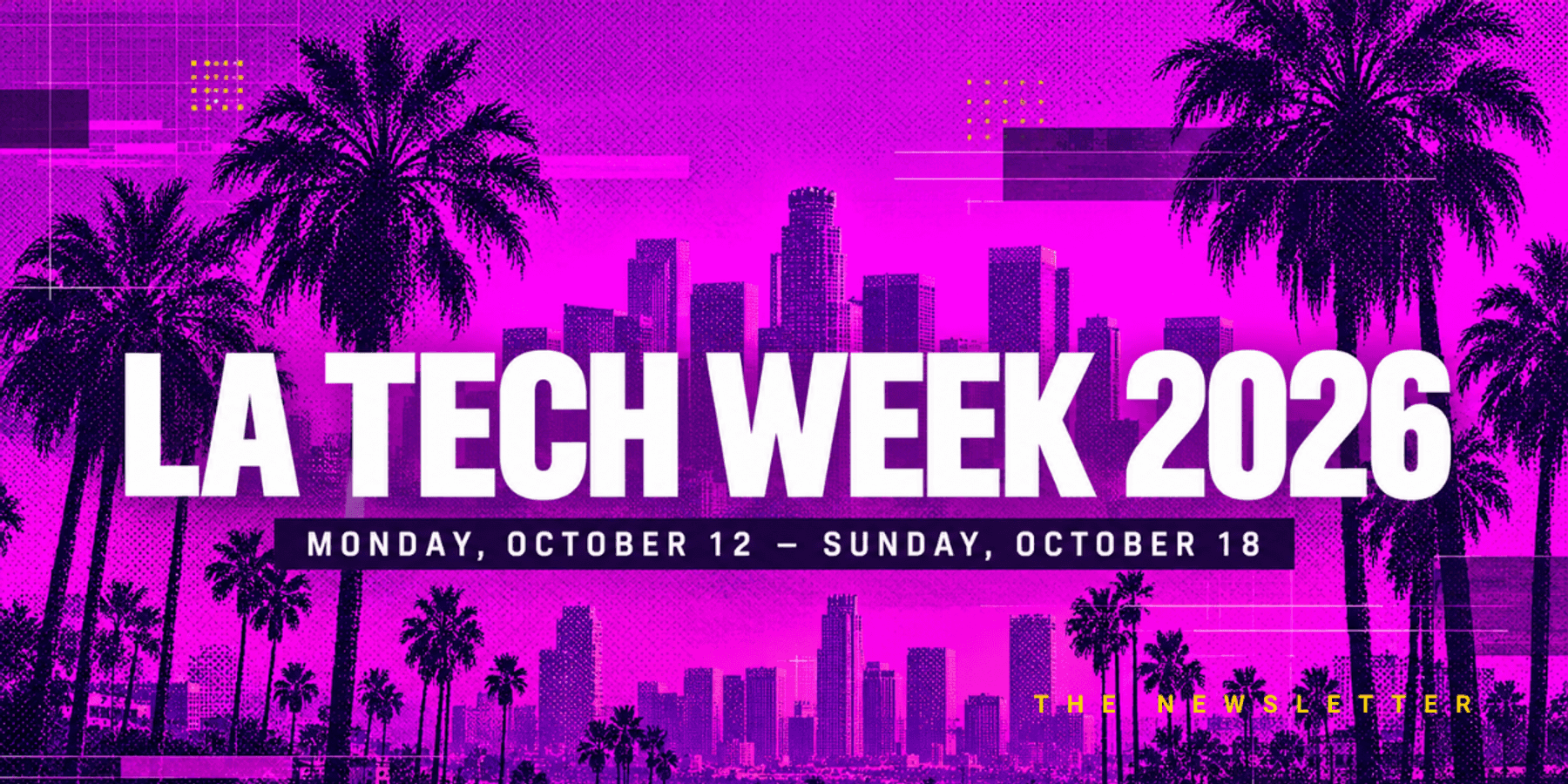
      Next week, hundreds of tech events will take over the city, bringing founders, investors, engineers and creators together from October 12 through 18.

      Calling LA Tech Week a conference does not quite capture the experience.

      Presented by Andreessen Horowitz, Tech Week is a decentralized collection of panels, workshops, demonstrations and gatherings hosted independently by startups, venture firms and technology companies. There is no convention center or central stage. The programming stretches from Santa Monica and Venice to Culver City, Downtown, El Segundo and beyond.

      In other words, the city is the venue.

      AI remains the dominant theme for 2026, appearing across enterprise software, healthcare, finance, media and the creator economy. The schedule also reflects industries where Los Angeles has built a particular advantage, including aerospace, defense, robotics, advanced manufacturing, entertainment and consumer technology.

      That range is what makes LA Tech Week distinct. It brings together the software companies shaping what comes next with the industries that already define Southern California.

      The challenge is deciding where to show up.

      Our advice: apply early and organize your schedule by neighborhood. Crossing from Santa Monica to Downtown may look manageable on a calendar created by someone who has never driven in Los Angeles.

      To help you spend more time meeting people and less time crossing the city, we have organized each day’s events by location:

      You can also browse the complete official LA Tech Week calendar.

      Plan carefully, but do not fill every minute. The best conversation of the week may be the one that was never on your calendar.

      More from this week’s LA startup and venture scene below.

      🤝 Venture Deals

        LA Companies

        • El Segundo-based Gallatin AI raised a $50M Series A from new and existing investors including 8VC and Silent Ventures, bringing its total funding to $70M. The defense technology startup will expand its engineering team and advance Navigator, an AI platform that helps U.S. military units coordinate vehicle readiness, supplies, medical logistics and other mission-support operations. - learn more
        • Pasadena-based quantum computing startup Oratomic raised a $475M Series B at a $5.4B valuation, just three months after its Series A. ARCH Venture Partners, Spark Capital, Khosla Ventures, Index Ventures, General Catalyst and Bezos Expeditions co-led the round, bringing Oratomic’s total funding to $775M as it works toward a commercially viable, fault-tolerant quantum computer by 2030. - learn more
        • Torrance-based Fortastra raised a $30M Series A led by First In, with participation from Upfront Ventures, Space Capital, Rsquared, Side Door Ventures, ATX Ventures and existing investors. The company will use the capital to develop its next-generation maneuverable spacecraft, expand its engineering and operations teams and scale production of systems designed to protect critical assets in orbit. - learn more
        • Parallel Systems raised a $100M Series C led by AVP, with participation from Hillspire, Agility Global, Cobalt Capital, Anthos Capital, Congruent Ventures, Riot Ventures and Collaborative Fund. Founded by former SpaceX engineers, the company will use the funding to scale production and commercial deployment of its autonomous, battery-electric Panther rail vehicles, which are designed to make short-haul freight more competitive with trucking. - learn more
        • Gaming studio Gardens Interactive secured more than $35M in a Series B led by Lightspeed, with participation from Sequoia Capital, Index Ventures, Accel, Innovation Endeavors, Zenith Capital and other investors. The company will use the funding to launch and operate its debut social role-playing “strandbox” game, an evolving multiplayer world shaped by players’ actions and interactions. - learn more
        • Outer Spaces raised an $8M pre-seed round led by Upfront Ventures, with participation from Unlock Venture Partners, Mucker Capital and Genius Ventures. The startup is developing outdoor furnishings with integrated solar panels and batteries, turning backyards into sources of clean energy and backup power. - learn more
        • Furientis raised a $25M seed round led by Benchmark at a reported $125M valuation, following a $5M pre-seed announced in May. The defense startup will use the capital to scale production of lower-cost missile interceptors designed to be assembled quickly with readily available components, with a long-term goal of producing 1,000 systems annually at each factory. - learn more
        • Hiyo raised a $20.8M Series B led by Constellation Brands, with returning investor Live Nation also participating. The nonalcoholic beverage company will use the funding to expand its adaptogen- and nootropic-infused social tonics across more than 13,000 retail locations while growing its presence at hospitality venues and live events. - learn more
        LA Venture Funds
        • Navitas Capital participated in Vesta’s $30M Series B, which was led by Conversion Capital and included backing from several major mortgage lenders and financial institutions. The company will use the funding to scale its AI agents across mortgage origination, automating tasks such as application reviews, underwriting decisions and closing-document checks. - learn more
        • MTech Capital led Nettle’s oversubscribed $4.8M seed round, with participation from Project A Ventures, Sure Valley Ventures, Portfolio Ventures and Ventures Together. The insurtech startup will use the funding to expand across the U.S. and Europe while growing its AI platform, which helps commercial insurers identify property risks, accelerate inspections and generate reports. - learn more
        • Bonfire Ventures doubled down on Santé by participating in the company’s $15M Series A, which was led by FINTOP and included other returning investors. The New York startup will use the funding to expand its AI-powered operating system for independent wine and liquor stores, which combines point-of-sale, e-commerce, payments, inventory and marketing tools in one platform. - learn more

        LA Exits

        • Winnow Solutions was acquired by Marina del Rey-based Spring Labs, with financial terms undisclosed. Winnow’s attorney-built library of more than 100,000 state and federal regulatory requirements will become a core part of SpringGRC, helping financial institutions connect changing laws directly to their compliance policies, controls and workflows. - learn more

          Download the dot.LA App

          LA Tech Week 2026: Sunday’s Event Lineup

          🔦 Spotlight

          LA Tech Week 2026 closes Sunday with one final day of events across Los Angeles. We have organized the remaining lineup by neighborhood so you can finish the week with a few last conversations before everyone returns to their regularly scheduled inboxes.

          ARTS DISTRICT

          12:00 PM

          CARSON

          12:00 PM

          CULVER CITY

          9:00 AM

          • Women in Cleantech & Sustainability Hike and Network: See Details Here
            Women in Cleantech & Sustainability

          6:00 PM

          • Founders pitch competition: See Details Here
            Biomorphix solutions, Nightingale regenerative

          HOLLYWOOD

          10:00 AM

          4:00 PM

          • AI International: Film, Music Video & Micro-Drama: See Details Here
            AI International Film Festivals

          MID CITY

          1:00 PM

          OTHER

          12:00 PM

          • ORGANIC LIFE LABS™ PRESENTS THE ALIGNMENT LAB: The Science of human performance: See Details Here
            The Blue Room Collective

          SANTA MONICA

          8:00 AM

          1:00 PM

          6:00 PM

          SOUTH LA

          2:00 PM

          • Future Builders : Family STEM Day: See Details Here
            Black L.A. Tech Week (Community Collective)

          VENICE

          10:00 AM

          12:00 PM

          • How to Raise Funds to Fund Any Business Using Digital Products.: See Details Here
            DN Events

          VIRTUAL

          5:00 PM

          WEST HOLLYWOOD

          3:00 PM

          Each session provides unique opportunities to gain insights, network, and explore various fields of tech innovation. For updates or more event information, visit the official Tech Week calendar.

          Download the dot.LA App

          RELATEDEDITOR'S PICKS
          Trending