
Q&A: Bobacino CEO Darian Ahler Makes His Case for Food Automation

Decerry Donato

Decerry Donato is a reporter at dot.LA. Prior to that, she was an editorial fellow at the company. Decerry received her bachelor's degree in literary journalism from the University of California, Irvine. She continues to write stories to inform the community about issues or events that take place in the L.A. area. On the weekends, she can be found hiking in the Angeles National forest or sifting through racks at your local thrift store.

Q&A: Bobacino CEO Darian Ahler Makes His Case for Food Automation

After a year and a half of the pandemic, the robots have arrived—at least in restaurants.

A new report from market research firm Global Industry Analysts (GIA) found that the global food automation market grew to $9.7 billion in 2020, spurred in part by a desire to offer customers contactless service. The GIA researchers projected the market would swell to $13.6 billion by 2026.


While food automation offers an exciting new avenue for entrepreneurs, there's also a fear that machines will ultimately replace their human counterparts. (Food service is far from the only industry to grapple with the threat of automation.)

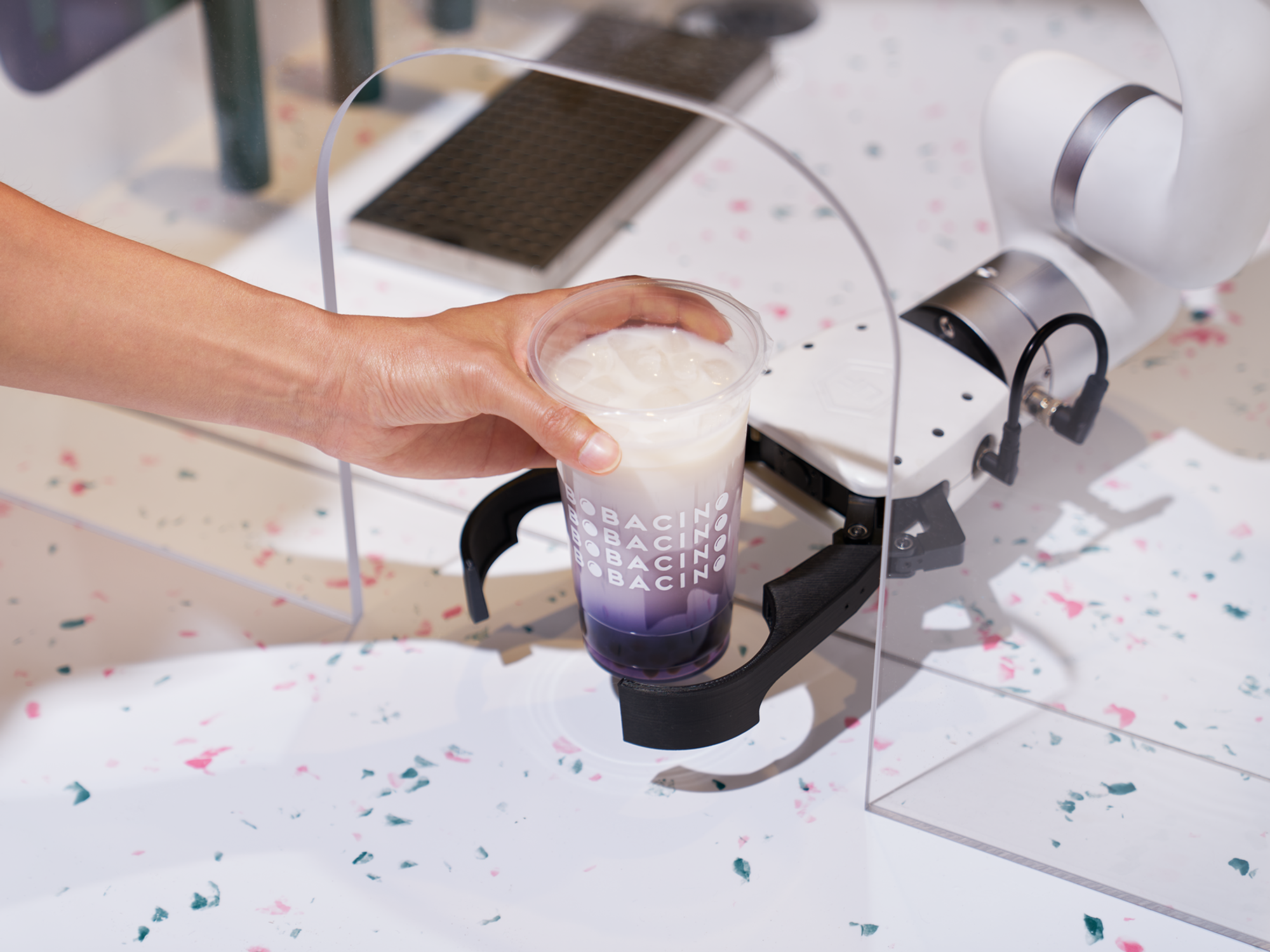
Darian Ahler, CEO of Bobacino.

But Darian Ahler doesn't see it that way. The 37-year-old director of product strategy and food automation at Wavemaker labs and CEO of Santa Monica-based Bobacino insists that automation will automate those dreaded tasks and provide a contactless option amid the pandemic.

Ahler argues that his $50,000 boba making-machine will elevate food service, bringing fast, quick specialty drinks to mom-and-pop stores and in the process eliminate lines. (The first Bobacino pod is expected in early 2022.) And he says his new deal with a facial recognition software, PopID will offer consumers a quicker and safer way to pay.

Ahler spoke with dot.LA about Bobacino and the future of food automation.

The technology for automating food service has been around a while, but big companies have been slow to adopt it. Why is that?

If you look at it historically, automation is trying to streamline functionality and production in the food space. New York in the early 1940s and 50s had the automat.

They were building and making meals in the background and then you would go and grab a mac and cheese or a cheesecake at one of these lockers. That ended because people wanted to see their food made fresh in front of them.

Fast forward to today. There is the taboo that automation is replacing human labor. I understand the concern, but it's a bit of a misnomer. What we're trying to do is really automate those less desirable tasks, we're automating the process not the people.

Do you see automation changing the face of restaurants?

To some degree, for sure. I don't think we're going to fast forward 50 years from now and all restaurants are going to be robotic. I think it will be a continued fusion between the two.

Think about how much a kitchen has been automated over time when you have specific machines to do specific tasks rather than having somebody cook a stew. You might do that in an instapot, and that can speed up the process.

We're going to continue to see that trend. We're on the forefront of it. We're not trying to automate away the restaurant. We're trying to automate certain processes so that existing brick and mortars can have their employees do their jobs better.

The trend that I've been seeing that might be changing the structure of restaurants is the growing advent of ghost kitchens—leveraging one kitchen that might serve multiple restaurants for delivery. So removing the front of house for certain restaurants, seeing the delivery sector grow massively.

Many people are worried that technology like yours will replace human workers. What do you say to those critics?

So, it's a little bit of a misnomer. We're not trying to automate jobs, we're trying to automate processes. The difference being that we're not trying to replace people, we want to replace portions of their functions. For example, as an employee, what they're having to do is extremely tedious. We can [allow them] to focus on the customer.

With an existing boba shop, a lot of the overhead goes to labor but a good chunk of it just goes to rent, paying for the bills of utilities and the support of the space itself. With our model, being able to partner with small business owners, we can start to create a hub-and-spoke network where they can have an existing shop and they can drop 3, 5, 8, 10 of our Bobacino units.

We can deploy these out around their space and they're able to have a larger reach and larger impact without requiring the footprint or the utilities or the cost required with a brick and mortar.

How would a customer order a drink using your boba machine and the PopID technology?

If there's a long line, but you want one of the classic drinks you can go to the Bobacino pod and order one there. Everything is staged and ready to go to make your drink. If you want a traditional milk tea with boba, you walk up to our ordering interface which is a tablet with integration of PopID. If you are registering with PopID—which is an opt-in solution—you would opt-in to the process and then scan your face for payment.

You'll see the robotic arm come to life and grab a cup and bring it to the boba dispenser. Then it will deliver your drink to one of the secure pickup locations. If you have PopID, you go to that kiosk and have it scan your face and open the door. If you don't, then we provide a QR code or pin to access the drink and make sure they're getting their drink and nobody else's.

If you want a more custom drink then you wait in line and have a person build that drink for you. That can help expand the company's production and ability to serve more drinks faster without needing a larger footprint which seems to be one of the biggest issues.

Was there pushback on the price of the machine?

Nobody pushed back on it. The other part here is that we are offering leasing options, for those people that can't come up with $50,000 of liquid capital. It would be a monthly spend and that is a little bit more tangible and should have a faster return on investment even though they might be paying that out over a longer period of time.

What other projects do you have going on aside from boba?

I occupy this dual role because I came in as CEO of Bobacino, and that was partially on the business development side and partially on the product development side. But I have now fully embedded myself into Wavemaker labs as Director of Product Strategy for food automation. I work across our portfolio companies.

So we have another company called Piestro which makes pizza from scratch. We have another concept that we are developing called Nommi, it's a bowl-based concept. So I help inform across all those channels, not only with the experience, but with the functionality with my background as an engineer.

Your Bobacino prototype is up and running, correct?

Yeah, it's at our headquarters. We're not really showing it off for demos yet.

We wanted to be able to develop a unit so we could show people what we're making for our equity crowdfunding campaign, but also it was for validation. We built this in six months with hardware that is super fast from initial concept to deployment, and it will make the drink, top to bottom, which is super fun!

I will fully admit that the drink can be improved and the process can be improved. But first, we made it fast. This next version is making it good, and excited to get those first units out in front of people and get some real feedback.

This interview has been edited for length and clarity.

Correction: An earlier version of this story misspelled the names of food startups Piestro and Nommi.

Valar Atomics Wants to Power AI, Literally

🔦 Spotlight

Hello, Los Angeles.

This week’s spotlight belongs to a startup chasing one of the biggest and messiest questions in tech right now: where all the power for AI is actually supposed to come from. El Segundo-based Valar Atomics, founded by Isaiah Taylor, is reportedly raising $450 million at a $2 billion valuation to build clusters of small nuclear reactors aimed at powering data centers and other energy-hungry industrial sites.

That is not a subtle ambition. On its website, Valar says it wants to build “hundreds of nuclear reactors” on what it calls gigasites, focusing on grid-independent products including data center power, hydrogen, heavy industrial power, and clean hydrocarbon fuels. Its reactor approach is based on high-temperature gas reactor design principles using TRISO fuel, and the company is explicitly pitching its model as a way to meet the surge in power demand coming from AI.

Valar’s investor roster also helps explain why the company has drawn so much attention. The startup is backed by Palmer Luckey and Palantir CTO Shyam Sankar, and its earlier $130M round in November 2025 was led by Snowpoint Ventures.

What makes the story especially interesting is that this is not just another AI infrastructure company talking about faster chips or more efficient software. It is a bet that the next bottleneck is electricity itself, and that the winning response might look a lot more like hard infrastructure than cloud optimization. In a market full of startups promising to power the future metaphorically, Valar is making a much stranger and bolder claim: it wants to do it literally.

The company is also moving with unusual speed. Valar says it has been selected by the U.S. Department of Energy to achieve criticality on American soil by July 4, 2026 under the administration’s accelerated nuclear program, and related company materials tie its Project NOVA work to the Nuclear Reactor Pilot Program. Whether that timeline proves realistic or not, it tells you something important about the kind of company this wants to be: not a distant science project, but a startup trying to force nuclear power onto AI’s timetable.

And maybe that is the bigger LA angle here. For all the conversation around software, content, and consumer apps, Southern California keeps producing founders who are drawn to the hard stuff: defense, aerospace, energy, logistics, real-world systems with real-world constraints. Valar may still have plenty to prove, but it is hard to accuse this one of thinking small.

Now onto this week’s LA venture deals, fund announcements and acquisitions.

🤝 Venture Deals

                  LA Venture Funds

                  • Matter Venture Partners participated in Anvil Robotics’ $5.5M seed round, which it led and which also included Humba Ventures, DNX Ventures, Vivek Sodera, Spacecadet Ventures, and Position Ventures. Anvil said it is building a kind of “Legos for robots” platform for physical AI teams, with open-source custom robots that can ship in one to two days, and has already delivered more than 100 units globally while surpassing seven figures in revenue. - learn more
                  • WndrCo led daydream’s $15M Series A, backing the AI-native SEO agency alongside First Round Capital and Basis Set Ventures. daydream said the round brings total funding to $21M and will be used to accelerate hiring, product development, and go-to-market expansion as it combines SEO agents with human experts to help companies navigate both traditional search and AI search. - learn more
                  • Embark Ventures participated in Via Separations’ $36M funding round, which also brought in new strategic backing from Climate Investment, Aramco Ventures, and Marathon Petroleum Corporation. Via said the capital will help deploy more commercial projects and expand its membrane-based industrial filtration platform into refining and chemicals, building on commercial traction in pulp and paper and a pilot completed at a major Gulf Coast refinery. - learn more
                  • Finality Capital Partners co-led Alien’s $7.1M round alongside Initialized, backing the company’s push to build identity infrastructure for both humans and AI agents. According to the X post announcing the raise, Alien plans to use the funding to develop unique identity systems at a time when proving whether an entity online is human or agentic is becoming increasingly important. - learn more
                  • M13 participated in OpenFX’s $94M Series A, as the company builds API infrastructure for global FX liquidity. OpenFX said it now moves more than $45B a year across borders, settles 98% of transactions in under 60 minutes, and plans to use the funding to expand its institutional-grade, API-first platform for cross-border payments and treasury operations. - learn more
                  • M13 led Jimini Health’s $17M seed round, backing the company alongside Town Hall Ventures, LionBird, Zetta Venture Partners, and OneMind as it builds a clinician-supervised AI platform for behavioral health. Jimini said the funding will help scale Sage into more care settings and deepen partnerships with major behavioral health providers across the U.S., positioning it as a safer alternative to unsupervised consumer AI tools for mental health support. - learn more
                  • MANTIS Venture Capital participated in depthfirst’s $80M Series B, which was led by Meritech Capital and also included Forerunner Ventures, The House Fund, Accel, Box Group, Liquid 2 Ventures, and Alt Capital. The company said the new funding will be used to train additional security models, grow its AI research team, and scale enterprise adoption as it builds an AI-native platform for software security and launches its first in-house security model. - learn more
                  • Freeflow Ventures participated in TippingPoint Biosciences’ $4.5M seed round, joining SOSV, LKS Fund, Sazze Partners, StoryHouse Ventures, Sontag Innovation Fund, BrightEdge, XEIA Venture Partners, West Coast Angel Network, and others. The company said the financing will help de-risk its epigenetic discovery platform as it works to translate chromatin biology into new therapeutics. - learn more

                                    LA Exits

                                    • Warner Music Group agreed to acquire Revelator, a B2B music platform focused on digital distribution, rights management, royalty accounting, and real-time analytics for independent labels, artists, and distributors. WMG said the deal will strengthen its distribution and label services business, expand the tools available through its labels and ADA, and allow Revelator to keep serving its existing customers while scaling through WMG’s global infrastructure. - learn more
                                    • Omni Agent Solutions has been acquired by Fortress Investment Group, which said the deal will provide long-term capital and resources to expand Omni’s tech-forward platform for bankruptcy and restructuring case administration. Omni said the investment will support continued technology development and scale across services such as claims management, noticing, solicitation support, securities services, disbursements, and call center operations, while its executive and operational teams remain in place. - learn more
                                    • Apium Swarm Robotics is being acquired by Red Cat, adding its distributed control technology for autonomous swarming drones and uncrewed surface vessels to Red Cat’s broader defense platform. Red Cat said Apium will continue operating independently while its autonomy stack is integrated across the business to strengthen coordinated multi-agent operations in contested and communications-degraded environments. - learn more
                                    • HOPWTR is being fully acquired by Constellation Brands, which first invested in the non-alcoholic sparkling water brand through its venture arm in 2021. Constellation said the deal strengthens its no- and low-alcohol portfolio as consumer demand in the space grows, while HOPWTR is expected to keep operating as it does today in the near term with CEO Jordan Bass remaining involved. - learn more

                                                              Download the dot.LA App

                                                              This LA Startup Just Raised $49M for the Chaos Behind High-Stakes Lawsuits

                                                              🔦 Spotlight

                                                              Happy Friday, Los Angeles.

                                                              In a startup market obsessed with AI copilots and productivity promises, Steno just raised $49M for something far less glamorous and probably far more durable: the machinery behind depositions, transcripts, and high-stakes litigation. It is the kind of business that sounds boring right up until you realize how much money, urgency, and operational chaos moves through it every day.

                                                              The LA legal tech company, which positions itself as both a court reporting service and a software platform, said the Series C was led by Savano Capital Partners, with continued backing from First Round Capital, The Legal Tech Fund, and other strategic investors. Steno plans to use the funding to expand geographically, deepen its reach into the AmLaw 200, and roll out the next evolution of its AI-powered Transcript Genius product.

                                                              Steno’s bet is not that lawyers want another standalone AI tool dropped into an already messy workflow. It is betting that the real opportunity is owning more of the process itself, from court reporting and remote depositions to transcript analysis and financing, then using software to make the whole machine run faster.

                                                              That is what makes this story interesting: Steno is building around legal work that is already happening, already expensive, and already painful. In a market full of companies trying to invent new behavior, there is something compelling about one focused on making an old, high-friction system work better.

                                                              Now, onto this week’s LA venture deals, fund announcements and acquisitions.

                                                              🤝 Venture Deals

                                                                  LA Companies

                                                                  • SIGMAS raised a $1M seed round co-led by Mucker Capital and HongShan Capital as the performancewear brand expands from marketplace incubation into a broader direct-to-consumer push. The company, which was incubated through SHEIN’s Supply Chain as a Service program, said it has already launched more than 600 men’s activewear SKUs and plans to use SHOPLINE to support its owned-channel and international growth. - learn more
                                                                  • Solace received an initial $50,000 investment from Audos as part of the launch of the Audos Publishing House, a new platform aimed at helping everyday entrepreneurs build AI-native businesses. The Santa Monica startup, created by founder Sarah Gwilliam after losing her father, is building an AI-powered grief coaching platform focused on active coaching, guided journaling, and memory preservation, with Audos also offering up to $100,000 in non-dilutive funding through a 15% revenue-share model. - learn more
                                                                  • Triangle Health emerged with $4M in pre-seed funding after cofounder Arun Verma turned his own brain cancer diagnosis into the inspiration for the company’s AI-powered health navigation platform. The Pasadena startup says its product helps patients gather complete medical records, surface treatment options and clinical trials, and review findings with a licensed physician, with backing from investors including Kevin Mahaffey, Hannah Grey, Antler Criticality Fund, John Hering, Marty Tenenbaum, and Kestrin Pantera. - learn more
                                                                  • Primestor secured a $10M equity investment from New Jersey Community Capital for The Walk, its mixed-use development in Norwalk, marking NJCC’s expansion into Southern California. The 8.2-acre project is planned to include 374 homes, 56 of them affordable, along with about 94,000 square feet of retail and restaurant space as Primestor advances a broader community-focused development effort in the region. - learn more
                                                                  • Sift raised a $42M Series B led by StepStone Group, with GV as its largest investor, bringing total funding to $67M as it builds what it calls an observability layer for hardware engineering. The El Segundo company said the funding will help scale its platform for turning fragmented telemetry from spacecraft, defense systems, autonomous vehicles, and factories into real-time, AI-ready data. - learn more

                                                                                  LA Venture Funds

                                                                                  • Emmeline Ventures participated in Prickly Pear Health’s follow-on pre-seed round, helping bring the company’s total funding to more than $600,000 alongside existing backers Bayless Ventures and AZ Venture Capital Inc. Prickly Pear said it will use the new capital to accelerate user growth and expand deployments of its AI-powered women’s brain health platform with mental health practices, beginning in Arizona, after surpassing 2,000 active users since launching in 2024. - learn more
                                                                                  • Riot Ventures participated in Shield AI’s new financing round, which values the defense tech company at $12.7B and accompanies its planned acquisition of software simulation company Aechelon. Shield AI said the capital will support growth across its autonomy software and broader defense platform, while the Aechelon deal is meant to strengthen its simulation and training capabilities as it scales AI-powered systems for military customers. - learn more
                                                                                  • Starshot Capital participated in Rumin8’s latest funding round, which added a new $3M commitment from AgriZeroNZ as the company pushes toward commercializing its methane-reducing livestock feed additives in New Zealand. Rumin8 said the new backing will help support pivotal trials and move it toward final registration, with first commercial sales in New Zealand targeted for 2027. - learn more
                                                                                  • Compa Capital participated in Kairos Labs’ $2.4M seed round, which was led by 6th Man Ventures and also included Lattice and Advancit Capital. The company said the funding follows a beta that generated more than $300M in notional swap volume and will help support the launch of its permissionless, non-custodial interest rate swap protocol on Ethereum mainnet and Base in the coming weeks. - learn more
                                                                                  • Morpheus Ventures co-led Applied Atomics’ oversubscribed $8.3M seed round, backing the company alongside Transition as it works to deploy full-stack nuclear power plants for industrial infrastructure customers. Applied Atomics said the funding will help bring test and integration stands online, strengthen its supply chain, and move toward deployment, with plans over the next 12 months to secure first host sites and customer agreements, advance NRC Part 50 licensing engagement, and push toward first commercial construction. - learn more
                                                                                  • Upfront Ventures participated in Neon’s financing round, which brought in more than $25M in combined equity and credit from Lightspeed Venture Partners, Upper90, and other investors. The company said the new capital brings total funding to nearly $27M following a $1.5M pre-seed led by Upfront, as Neon scales its platform for paying users for anonymized conversation data and supplying that audio and video data to AI labs. - learn more
                                                                                  • Helios&Partners participated in WhatIsMyAEO.com’s strategic investment round, backing the platform as it builds free AI-driven brand visibility diagnostics for answer engines like ChatGPT, Gemini, and Perplexity. The company said the funding will help scale its open-source efforts and expand access to tools that measure brand citations, sentiment, trust signals, and technical AI-readiness as zero-click search becomes more common. - learn more
                                                                                  • WndrCo participated in Moda’s $7.5M seed round, which was led by General Catalyst and also included Pear VC, as the company publicly launched its AI design platform. Moda said its product gives professionals a brand-aware design agent that can generate fully editable presentations, social posts, and other visual assets, and that thousands of beta users are already using it for materials like investor decks and marketing collateral. - learn more
                                                                                  • Clocktower Technology Ventures participated in Bliss’s R$ 57 million, or about $11M USD, Series A round, which was co-led by Kfund and Grupo Bradesco and also included Actyus. Bliss said the funding will help expand its AI-powered platform for health insurance brokers beyond São Paulo into cities including Rio de Janeiro and Brasília, while adding to its product and technology teams as it works to modernize health-plan sales for SMEs in Brazil. - learn more
                                                                                  • MAGIC Fund participated in Guangzhou Weixiao Technology’s new strategic financing round, joining IDG Capital, 37 Interactive Entertainment, and miHoYo in the investment. The company said the new capital will be used to accelerate product development and market expansion, though it did not disclose the size of the round. - learn more
                                                                                  • Mantis Venture Capital participated in Doctronic’s $40M Series B, which was co-led by Abstract and Lightspeed Venture Partners and also included Union Square Ventures, Seven Stars, and Tusk Ventures. The company said the new funding follows rapid growth to more than 300,000 weekly users and eight-figure annualized revenue, and will help it expand its AI-powered care platform after becoming the first AI-native system authorized to autonomously renew prescriptions under Utah’s AI Learning Lab. - learn more

                                                                                                    LA Exits

                                                                                                    • RezyFi is being acquired by ECGI Holdings in a $25M transaction that would bring a 29-state licensed mortgage origination platform and about $140M in annual mortgage funding onto ECGI’s platform. ECGI said the deal is meant to pair RezyFi’s lending infrastructure with its mortgage tokenization strategy, following a pilot program to tokenize up to $10M of residential mortgage loans and as it prepares to launch an investor portal. - learn more
                                                                                                    • Salt & Stone is being acquired by Advent, which signed a deal to buy a majority stake in the Los Angeles premium body care brand. The company said the partnership will help fuel its next phase of global growth after surpassing $165M in revenue in 2025, with founder and CEO Nima Jalali staying on as an equity holder and remaining in leadership alongside President Meagan Rosson and CMO Abby Tellam. - learn more
                                                                                                    • Victory Holdings signed a definitive agreement to acquire Dunn & Groux Beverage Holdings, marking its move into the functional beverage market. The company said the deal will make DGBH a wholly owned subsidiary and give it a platform to build and scale multiple beverage products around patented fulvic acid formulations and a distribution-first model, with initial expansion focused on California, Arizona, and Texas. - learn more

                                                                                                                              Download the dot.LA App

                                                                                                                              Arc’s $50M Push Into Commercial Maritime

                                                                                                                              🔦 Spotlight

                                                                                                                              Hey LA,

                                                                                                                              As the city pushes through a record-breaking March heat wave, one of the week’s most interesting LA startup stories came with a reminder that climate tech gets a lot more real when it leaves the pitch deck and hits the water. In Arc’s case, that means tugboats.

                                                                                                                              LA based Arc, founded in 2021 by a team of SpaceX alumni, announced a $50M Series C this week, led by Eclipse, a16z, Menlo Ventures, Lowercarbon, Necessary Ventures, and Offline Ventures, as it pushes deeper into commercial maritime. The raise follows Arc’s $160M contract with Curtin Maritime to deliver eight hybrid-electric tugboats beginning at the Port of Los Angeles, with the first expected to hit the water this year.

                                                                                                                              Imsage Source: Arc

                                                                                                                              That feels notable not just because of the funding, but because it marks a clear evolution in Arc’s business. What started as a premium electric boat company is now making a serious push into the industrial side of maritime transportation, with ambitions spanning tugboats, ferries, and defense vessels.

                                                                                                                              There is also something fitting about this story happening in Los Angeles. This is a city known for spectacle, but Arc is building in a category where performance actually has to perform. No amount of branding can fake a working tugboat, and that is exactly why this moment feels worth paying attention to.

                                                                                                                              Now, onto this week’s LA venture deals, fund announcements and acquisitions.

                                                                                                                              🤝 Venture Deals

                                                                                                                                  LA Companies

                                                                                                                                  • Talino closed a $7.5M Series A led by Chemonics International, with participation from Mt Sinai Capital and Gulf Blvd, as it shifts from a venture studio into what it calls a global fintech foundry. The company said the new funding will help build an API-first cross-border payments infrastructure layer connecting the U.S. with emerging markets, starting with the Philippines, where it is targeting faster, more compliant financial product launches and modernizing legacy rails with stablecoin and real-time payment capabilities. - learn more
                                                                                                                                  • PADO AI raised a $6M seed round led by NovaWave Capital to expand its AI-powered orchestration software for mid-market colocation data centers. The company said the funding will support product delivery and global growth as it helps operators better manage power, compute, cooling, and distributed energy resources to increase GPU utilization and maximize “compute per megawatt” without requiring major new infrastructure buildouts. - learn more
                                                                                                                                  • Meadow Memorials raised a $9M Series A led by Lachy Groom and Haystack to expand its software-enabled funeral planning platform, which lets families arrange services online or by phone. Founded in 2024 by former Stripe executive Sam Gerstenzang and Emma Gilsanz, the company says it is using a real-estate-light model to offer lower-cost funerals as it expands beyond California into states including Texas, Washington, and Arizona. - learn more

                                                                                                                                                  LA Venture Funds

                                                                                                                                                  • Anthos Capital participated in Bluesky’s $100M Series B, which was led by Bain Capital Crypto and also included Alumni Ventures, Bloomberg Beta, Knight Foundation, and True Ventures. The company said the round gave it the resources to scale both the Bluesky app and the broader AT Protocol ecosystem, which it says has grown to more than 43 million users and now supports a fast-expanding network of third-party apps and developers. - learn more
                                                                                                                                                  • Navigate Ventures participated in VerbaFlo’s oversubscribed $7M seed round, which was led by Pi Labs and also included Haatch and Old College Capital. VerbaFlo said it plans to use the funding to scale its conversational AI platform for real estate operators, building on traction across more than 200,000 units and expanding further into markets including the U.S., Middle East, and Australia. - learn more
                                                                                                                                                  • March Capital participated in Xage Security’s $15M equity financing round, which was led by Piva Capital as the company posted 81% year-over-year revenue growth and expanded its Zero Trust platform for AI and critical infrastructure. Xage said the funding, which closed in December 2025, will support go-to-market expansion and continued product innovation, including new AI security capabilities, as demand grows across sectors such as energy, manufacturing, utilities, transportation, and defense. - learn more
                                                                                                                                                  • B Capital led Knox Systems’ $25M Series A, backing the company’s push to scale what it says is the largest AI-managed federal cloud and dramatically shorten the FedRAMP authorization process for software vendors. Knox said the new funding will help accelerate growth after its June 2025 seed round, with the goal of helping customers achieve FedRAMP authorization in as little as 90 days at roughly 90% lower first-year cost, while expanding adoption across both government and commercial environments. - learn more
                                                                                                                                                  • WndrCo participated in Tenkara’s $7M round, which was led by True Ventures as the company builds AI-powered operations agents for American manufacturers. Tenkara said it is creating tooling to help factories handle sourcing and operational work more efficiently at a time of rising supply-chain pressure, with backing from a broader investor group that also included Articulate Capital, Night Capital, HF0, SF1, and Transpose Platform. - learn more
                                                                                                                                                  • Aurora Capital participated in Niv-AI’s $12M seed round, backing the startup alongside Glilot Capital, Grove Ventures, Arc VC, Encoded VC, and Leap Forward as it emerged from stealth. Niv-AI is building sensors and software to measure millisecond-scale GPU power surges and help data centers use electricity more efficiently, with plans to deploy its system in a handful of U.S. facilities within the next six to eight months. - learn more
                                                                                                                                                  • Clocktower Technology Ventures participated in Fuse’s $25M Series A, which TechCrunch reported was led by Footwork, Primary Venture Partners, NextView Ventures, and Commerce Ventures, with Fuse also naming Clocktower Ventures among its backers. The company said it plans to use the funding to expand its AI-native loan origination and account opening platform for credit unions, building on traction with more than 100 customers and a $5M “rescue fund” aimed at helping institutions switch off legacy systems. - learn more
                                                                                                                                                  • Kairos Ventures participated in Alomana’s €4M seed round, which was led by CDP Venture Capital and also included Founders Factory, Italian Angels for Growth, Club degli Investitori, and others. Alomana said it will use the funding to strengthen its enterprise AI platform, add more capabilities for autonomous workflow automation, and support larger deployments across Europe as demand grows in sectors like finance, manufacturing, and pharma. - learn more

                                                                                                                                                                    LA Exits

                                                                                                                                                                    • Optimal’s Entertainment Media division is being acquired by Capstone Point Holdings, with the business set to operate under its legacy name, Optimad Media, following the deal. The transaction keeps founder Kevin Weisberg in place to lead the company from Los Angeles, while giving Optimad more backing to expand its entertainment media planning, buying, and prints-and-advertising investment capabilities across theatrical, streaming, and broadcast campaigns. - learn more

                                                                                                                                                                                              Download the dot.LA App

                                                                                                                                                                                              RELATEDEDITOR'S PICKS
                                                                                                                                                                                              Trending