

Apex Hits $2.3B Valuation as Satellite Demand Grows

Apex Hits $2.3B Valuation as Satellite Demand Grows

🔦 Spotlight

Happy Friday LA,

The space economy does not just need more rockets. It needs more spacecraft that can be built quickly, reliably and at scale.

Los Angeles-based Apex announced more than $200M in new growth funding, nearly doubling its valuation to $2.3B just months after crossing the $1B mark. The round was led by Glade Brook Capital Partners and co-led by Washington Harbour Partners, with support from new and existing investors.

Apex builds productized, configurable satellite bus platforms for commercial and government customers. In simpler terms, it manufactures the core spacecraft infrastructure that carries payloads for missions ranging from remote sensing and communications to in-space power generation and national security architectures.

The company is using the funding to expand its high-rate satellite manufacturing campus, vertically integrate more key subsystems and manufacture platforms ahead of customer demand. That last part is important: Apex is betting that satellite production needs to look less like one-off aerospace engineering and more like scalable, repeatable manufacturing.

The timing makes sense. Launch has gotten faster and more available, but spacecraft production remains one of the industry’s biggest constraints. If proliferated constellations are going to become central to commercial and national security missions, the market needs suppliers that can build reliable satellites at industrial scale.
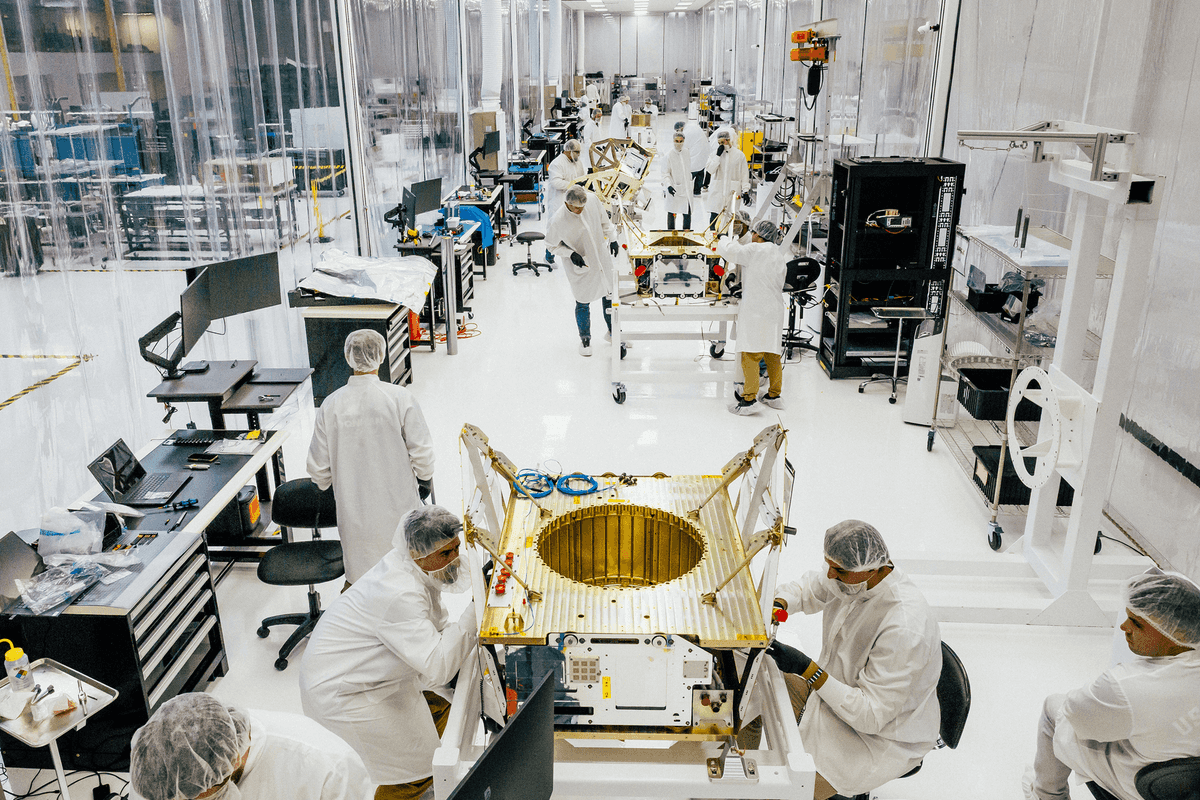
Image Source: Apex

Apex says its Factory One facility in Los Angeles can produce more than 200 satellites per year at peak production. The company is also expanding the campus with an additional 30,000 square feet of space and has grown to more than 350 employees, more than doubling its team over the past year.

The company is also moving deeper into defense. Apex recently announced a collaboration with Northrop Grumman tied to scalable space-based interceptor capabilities for the U.S. Space Force, and its Nova 1 platform is expected to host Project Shadow, a commercially led on-orbit demonstration for space-based interceptor technology.

That is the business Apex is trying to build: not custom spacecraft one mission at a time, but a repeatable satellite manufacturing operation that can keep pace with demand from commercial and government customers. If it works, Apex becomes less of a traditional aerospace contractor and more of a spacecraft production line for the proliferated constellation era.

Now onto this week’s LA venture deals, fund announcements and acquisitions.

🤝 Venture Deals

    LA Companies

    • Alfred, a Hawthorne-based stealth startup building software for robots, cars and other physical AI systems, is backed by investors including Chapter One, Khosla Ventures, SV Angel and Sam Altman’s Hydrazine Capital. Co-founded by former Tesla designer Ankit Ukil and former Meta engineer Dömötör Gulyas, the company is reportedly seeking funding at a $40M valuation as it develops tools to help robotics and automotive teams shorten R&D cycles and accelerate manufacturing. - learn more
    • California Naturals closed a Series B funding round led by Align Ventures to support continued growth across major retailers including Target, Ulta Beauty and CVS. The clean personal care brand also named Hayden Hiatt as CEO as it expands its hair, body and everyday essentials business. - learn more
    • Redondo Beach-based Impulse Space raised a $500M Series D co-led by 137 Ventures and BANNER VC, bringing the company’s total funding to more than $1B. Founded by SpaceX alum Tom Mueller, Impulse is building in-space mobility infrastructure, including spacecraft and propulsion systems that help satellites and payloads move after launch. The new funding will support hiring and manufacturing growth as the company scales to meet demand across commercial, civil and government space missions. - learn more
    • Just Women’s Sports closed a new seven-figure investment round led by Bolt Ventures, with returning investors including Starry Eyed Tomorrow, Rise of the Rest Seed Fund, Blue Pool Capital and OVO Fund. The women’s sports media company, founded by Haley Rosen, plans to use the capital to expand news and content operations, grow its team and invest in athlete-led programming. - learn more
    • GammaTime, a microdrama streaming app, received a minority investment from Versant Media Group as part of its Series A round. The company produces short-form, mobile-first scripted series and will work with Versant to develop original projects using select entertainment IP and creative resources from the media company. Financial terms were not disclosed. - learn more

    LA Venture Funds
    • Pinegrove Venture Partners participated in Ramp’s $750M Series F, which valued the fintech company at $44B. Ramp’s financial operations platform has expanded beyond corporate cards and expense management into payments, procurement, vendor management, accounting automation and AI-powered spend management. The company said its total purchase volume grew roughly 170% year-over-year in March 2026. - learn more
    • Alpha Edison participated in Oxford Quantum Circuits’ $350M Series C, which was led by Bullhound Capital and included backing from the British Business Bank, COFIDES, Fulcrum Asset Management, Pentland Ventures, Oxford Science Enterprises, Chevron Technology Ventures and others. The U.K.-based company builds and operates superconducting quantum computers for enterprise, government and research customers, with the funding going toward international expansion and continued development of its quantum computing roadmap. The round is described as Europe’s largest private funding round for a quantum computing company. - learn more
    • Patron participated in Board’s $20M Series A, which was led by Union Square Ventures, with additional backing from Raine Ventures, Lerer Hippeau, Expa, 25madison, Red & Blue Ventures, Day One Ventures and others. New York-based Board is building a face-to-face gaming console and AI-powered creator platform that lets people play and make tabletop-style games together, with the funding going toward its upcoming Board Studio creation tools and broader expansion beyond hardware. - learn more
    • Pinegrove Venture Partners participated in Layup Parts’ $42M Series A, which was led by Marlinspike, with backing from Cerberus Ventures and existing investors Founders Fund, Lux Capital and Haystack. Huntington Beach-based Layup Parts is building a software-driven manufacturing platform for custom composite parts, aiming to make carbon-fiber and fiberglass components faster, easier and cheaper to source. The company plans to use the funding to grow its team, expand capacity and move into a larger facility as demand grows across aerospace, defense and other advanced manufacturing markets. - learn more
    • Overture Ventures participated in Atana Elements’ $27.5M seed round, which was led by Lowercarbon Capital with backing from Borusan Ventures, Earthshot Ventures, Redwoods Climate Capital, Sunna Ventures, Verve Ventures, Volta Energy Technologies, WovenEarth and others. Atana uses AI, machine learning and oil-and-gas-style subsurface expertise to identify and develop flowing critical mineral systems, including lithium brines, hydrogen, helium and emerging copper and uranium extraction opportunities. The company says it has already secured positions estimated to contain more than 100M tonnes of Lithium Carbonate Equivalent across the EU and Americas. - learn more
    • Bedrock Capital participated in Mach Industries’ $300M Series C, which was led by Infinite Capital and Ribbit Capital and valued the Huntington Beach defense tech company at $1.8B. Mach builds advanced unmanned defense systems, including platforms for strike, surveillance and counter-drone use, and plans to use the funding to expand manufacturing, advance second-generation systems and grow its Forge manufacturing network. The round comes shortly after Mach acquired Exquadrum, now Mach Energetics, to strengthen its propulsion and vertically integrated production capabilities. - learn more
    • Strong Ventures participated in Unastella’s $24M Series B, which was led by Altos Ventures and also included Korea Development Bank, Hana Ventures and others. The Seoul-based rocket company is developing launch vehicles and engines for small satellite launch services, with a longer-term goal of crewed suborbital spaceflight. Unastella has now raised $44M total and plans to use its upcoming UNA EXPRESS-II launch to further validate its technology and commercial roadmap. - learn more
    • Connect Ventures co-led Sekai’s $20M Series A alongside Khosla Ventures, with participation from a16z Speedrun, Mayfield, A, MVP Ventures, 359 Capital, Parable VC* and 645 Ventures. Sekai is building an AI-powered platform that lets users create, remix and share mini apps through text prompts, with the new funding going toward expanding its engineering and product teams. The company has raised $26M across its seed and Series A rounds. - learn more
    • Shamrock Capital Advisors participated in a strategic growth investment in CardsHQ, alongside EnOne Ventures, bringing CardsHQ and Sports Card Investor together under one company. The combined platform will operate as CardsHQ and span sports cards, trading card games, retail, e-commerce, live breaking, content, data and technology, including Sports Card Investor’s media network and the Market Movers pricing and collection tracking platform. The funding will support new retail locations, expanded live events, broader inventory and further development of collector-facing tools. - learn more

    LA Exits

    • Catalina Capital Group, a fee-only RIA based in Torrance, was acquired by CW Advisors, giving the Boston-based wealth management firm its first Southern California office. Catalina brings about $655M in assets under management, and the deal expands CW Advisors’ national footprint to 24 offices and more than $16B in client assets. Financial terms were not disclosed. - learn more
    • adMixt, a performance marketing agency known for its proprietary technology and expertise across Meta, Google, TikTok and other digital platforms, was acquired by Interluxe Group. The deal expands Interluxe’s luxury marketing platform by adding paid search, paid social, performance creative, API integrations and advanced analytics capabilities for premium lifestyle and luxury brands. Financial terms were not disclosed. - learn more


      Download the dot.LA App

      Two LA Startups Raised $2.37B to Build What AI Needs

      🔦 Spotlight

      Happy Friday, LA.

      The largest checks in tech are increasingly going toward companies trying to build their way out of America’s biggest physical constraints.

      This week, two Los Angeles startups raised a combined $2.37 billion in equity to tackle two particularly urgent ones: how the country manufactures critical hardware and where it will find enough electricity to power the AI era.

      Torrance-based Hadrian is building highly automated factories for defense and aerospace. El Segundo’s Valar Atomics wants to manufacture nuclear reactors at scale. Different industries, same underlying bet: the next generation of technology will depend on our ability to produce physical infrastructure much faster than we do today.

      Hadrian raised $1.37 billion in Series D funding, bringing its valuation to $7.87 billion. The company plans to use the capital to open new factories, expand research and development, and increase its capacity to produce critical defense, aerospace and industrial systems.

      Hadrian’s pitch is straightforward, if wildly ambitious: America needs to relearn how to build things and build them quickly.

      Its factories combine skilled workers with AI, robotics and proprietary software to manufacture precision components and, increasingly, complete mission-critical systems. Its customers include defense giants such as Lockheed Martin and RTX, along with newer players like Anduril.

      The company has come a long way from simply making aerospace parts. Hadrian is positioning itself as a piece of America’s industrial infrastructure, offering manufacturers a way to rapidly scale domestic production at a time when wars abroad, strained supply chains and growing defense demands have made the country’s manufacturing gaps increasingly difficult to ignore.

      Investors are clearly buying the argument. The new round comes just over a year after Hadrian raised $260 million, suggesting that “reindustrialization” has officially graduated from venture capital buzzword to billion-dollar investment thesis.

      Meanwhile, roughly 15 miles away in El Segundo, Valar Atomics is moving even faster than its enormous ambitions suggested.

      When we last wrote about Valar, the company was reportedly raising $450 million at a $2 billion valuation and racing to prove that nuclear energy could move on AI’s timetable. Now, it has closed a $1 billion Series B led by Sequoia Capital, secured an additional $200 million credit facility and reportedly reached a $6 billion valuation.

      Valar is developing standardized, factory-built nuclear power plants designed to avoid the enormous costs and decades-long construction timelines associated with traditional nuclear projects. Its goal is not merely to build a working reactor, but to eventually manufacture fleets of them.

      That ambition also sounds considerably less theoretical than it did when we first covered the company. In June, Valar’s Ward 250 reactor achieved a self-sustaining nuclear reaction. Just one week later, the company demonstrated the reactor generating electricity to power an Nvidia Blackwell system. Valar now says the new funding will help it move from proving its technology works to producing reactors at scale.

      The timing is no coincidence. AI’s enormous appetite for electricity is forcing the tech industry to confront a basic reality: the cloud still has to plug into something. Training models and operating massive data centers will require far more reliable power, and nuclear energy is rapidly becoming one of Silicon Valley’s favorite answers.

      Hadrian and Valar may be solving different problems, but their unusually large rounds point to the same shift. AI can design, predict and automate, but it cannot manufacture a missile component or generate a megawatt of electricity on its own. That requires factories, energy systems, supply chains and a great deal of capital.

      For years, venture-backed companies competed to build the software layer. Now, some of the biggest bets are being placed on the infrastructure underneath it.

      The future may run on AI. But first, someone has to build what keeps it running.

      More from this week’s LA startup and venture scene below.

      🤝 Venture Deals

        LA Companies

        • Endeavor Optical Networks emerged from stealth with $10.75M in seed funding from General Catalyst and Andreessen Horowitz to develop a satellite network that uses lasers to move data between continents. The startup plans to use the capital to build an optics lab, hire engineers and conduct ground testing ahead of a demonstration satellite launch targeted for late 2027. - learn more
        • Actualyze AI emerged from stealth with a $7M seed round backed by Storm Ventures, Canaan Partners, Morado Ventures and AME Cloud Ventures. Its platform gives enterprises a central control layer for managing AI usage across teams and applications, helping them enforce security policies, track spending, route requests between models and maintain audit trails. - learn more
        • Blaze.tech raised $8.5M in pre-seed funding led by Friale, a healthcare-focused venture firm founded by the family behind HCA Healthcare. The company helps digital health startups, providers and payers turn AI-generated prototypes into HIPAA-compliant software for uses including e-prescribing, EHR integrations, telehealth and auditing. - learn more

        LA Venture Funds
        • Canon Capital participated in Oligo Security’s $60M funding round alongside Ballistic Ventures, Greenfield Partners, Lightspeed Venture Partners, Red Dot Capital Partners, TLV Partners and other investors, bringing the cybersecurity company’s total funding to $140M. Oligo will use the capital to accelerate product development and expand its global go-to-market operations as it helps organizations detect and block software exploits in real time. - learn more
        • Matter Venture Partners participated in Volta’s seed and Series A financing alongside Azora, Andreessen Horowitz, Altimeter, NVIDIA and Michael Dell’s family office, valuing the AI infrastructure startup at $2.4B. Emerging from stealth, Volta plans to use the backing to develop and operate large-scale AI data centers, supported by a $5B infrastructure financing program with Azora and a $10B European compute partnership. - learn more
        • Cedars-Sinai participated in Cirrus Therapeutics’ expanded seed financing through its Intellectual Property Company, bringing the ocular immunology biotech’s total funding to $14.7M. Cirrus will use the backing to advance its gene and cell therapy pipeline, including a lead treatment for geographic atrophy, while a new collaboration with Singapore Eye Research Institute and Duke-NUS will support research, clinical development and expansion across Asia-Pacific. - learn more
        • Strong Ventures made a follow-on investment in Ready Robust Machine’s ₩13.4B Series B, which was led by Quantum Ventures Korea and brought the heavy-equipment technology company’s total funding to ₩22.9B. The company develops energy-recovery systems for hydraulic machinery and will use the capital to build out mass production, expand its data services and enter the Japanese market. - learn more

        LA Exits

        • Artium has been acquired by global consulting firm AlixPartners, bringing its expertise in building enterprise-grade AI agents for clients including BNY Mellon, Mayo Clinic and eBay to a broader global platform. The company will continue operating as a distinct team under the name Artium by AlixPartners, retaining its founders, employees, methodology and research relationships. - learn more

          Download the dot.LA App

          How Replify Found Its Niche and an Acquirer

          🔦 Spotlight

          Hello LA,

          This week’s startup story began three years ago with an AI assistant built for almost any small business. It ended, or perhaps graduated, with an acquisition by one of the fitness industry’s largest technology providers.

          ABC Fitness has acquired Replify, an AI platform that manages customer communication for gyms and wellness businesses across phone, text, email and chat. Its virtual agents can answer questions, qualify leads, schedule tours and classes, follow up on missed calls and run outbound campaigns. Financial terms were not disclosed.

          Before Replify found its footing in fitness, it was HeyLibby, a general-purpose AI assistant founded in 2023 by former Zillow colleagues Spencer Rascoff, Tony Small and Anna Rodriguez. The company was incubated inside Rascoff’s 75 & Sunny Labs and initially set out to help small businesses turn incoming messages into qualified leads.

          That broad vision gave HeyLibby a large potential customer base, from real estate agents and contractors to hairstylists and event planners. But as the team searched for product-market fit, one industry’s problem stood out. Gym and wellness employees were often too busy helping customers in person to answer every call, text or email, leaving prospective members waiting and potential revenue on the table.

          That insight reshaped the company. HeyLibby narrowed its focus to fitness and wellness, raised a $4.5M seed round in 2025 and later rebranded as Replify. It went on to work with brands including Gold’s Gym and UFC Gym, proving that its AI agents could do more than answer routine questions. According to the company, customers have captured up to 10 times more leads and shortened sales cycles from roughly 30 days to as little as three to five days.

          ABC Fitness became a natural next step. The company provides software to more than 30,000 fitness businesses serving over 40 million members worldwide. By adding Replify to its platform, ABC can offer gyms an always-available AI front desk while bringing Replify’s technology to a much larger global customer base.

          Replify’s journey offers a useful lesson amid the rush to build AI products for everyone. The company began with a broad promise, identified a customer with a specific and expensive problem, and built deeply around that need. Gym owners did not need another flashy chatbot. They needed someone to answer the phone when the front desk could not.

          Sometimes the smartest AI strategy is simply picking up the call.

          More from this week’s LA startup and venture scene below.

          🤝 Venture Deals

            LA Companies

            • Dimension raised a $1.65M seed round backed by Science Inc., UpscaleX, OpenSky, Long Run Capital, 1864 Fund and others. The profitable social-commerce company will use the funding to launch Seller OS more broadly, an agentic AI platform that automates TikTok Shop operations for brands and agencies. - learn more
            • Procode raised a $10M Series A led by Health Velocity Capital, bringing its total funding to $14M. The AI-powered medical billing company will use the capital to acquire two additional billing businesses and expand its platform beyond plastic surgery and dermatology into all surgical specialties and ambulatory surgery centers. - learn more
            • Antares raised $470M in Series C financing, including $370M in equity and $100M in debt, in a round co-led by Paradigm and Caffeinated Capital. The nuclear energy company will use the capital to commercialize its autonomous microreactors, with an electricity-producing model planned for 2027 and initial deployments at U.S. military installations beginning in 2028. - learn more

            LA Venture Funds
            • Wilshire Lane Capital participated in Ellis’ more than $10M seed round, which was led by First Round Capital and included Kearny Jackson, 645 Ventures, Harlem Capital, Khosla Ventures and others. Founded by Cadre founder Ryan Williams, Ellis has emerged from stealth with an AI-native operations platform that helps private credit managers reconcile fragmented data and automate workflows such as portfolio monitoring, investor reporting and compliance; the funding will support team growth and further product development. - learn more
            • Rebel Fund participated in Dili’s $15M Series A, led by Khosla Ventures, bringing the AI compliance company’s total funding to $21.7M. Dili helps energy, construction, infrastructure and manufacturing companies identify compliance issues by reviewing project data in real time, and will use the funding to expand its team and broaden its platform into additional audit and waste-detection workflows. - learn more
            • B Capital led ChipAgents’ $60M Series A2, which brought the semiconductor AI startup’s expanded Series A financing to $134M. ChipAgents will use the funding to scale customer deployments, expand its engineering and go-to-market teams and further develop its AI platform, which automates complex chip design and verification workflows. - learn more
            • StoryHouse Ventures participated as a returning investor in Henry AI’s $16.5M Series A, led by FirstMark Capital with backing from Thomson Reuters Ventures, Y Combinator and others. The commercial real estate AI company will use the funding to expand its engineering and product teams and scale Henry Deal, a platform that automates underwriting, offering materials and other back-office work throughout a transaction. - learn more
            • Walkabout Ventures and Bungalow Capital co-led Discern’s $10M Series A, bringing the company’s total funding to $17.5M. Discern provides a software-based registered agent service that automates state filings and compliance tasks, and will use the capital to scale its platform following fourfold annual recurring revenue growth in 2025. - learn more
            • Starshot Capital participated in Quercus Biosolutions’ oversubscribed $5M seed round, which was led by Serra Ventures and included several climate, agriculture and grower-backed investors. The agtech startup will use the funding to expand its pipeline of AI-designed proteins for fighting herbicide-resistant weeds, begin regulatory work and explore applications targeting fungi, insects and other crop pests. - learn more
            • B Capital co-led Flourish Health’s $26M Series A alongside F-Prime and Cherryrock Capital, bringing the youth mental health provider’s total funding to $46M. Flourish will use the capital to expand its psychiatrist-led, in-home care model nationwide, hire and train clinicians and further develop its AI-enabled platform for coordinating care. - learn more
            • Powerhouse Capital participated in European Technology Network’s $1.6M seed round alongside Axel Springer, a LADbible co-founder and angel investors from OpenAI and DeepMind. The London-based tech media startup will use the funding to open a larger studio, expand its team, launch a newsletter and increase its livestreamed programming from two shows per week to five. - learn more

            LA Exits

            • Saltair, the Los Angeles body-care brand founded by model and entrepreneur Iskra Lawrence, is selling a majority stake to private equity firm TSG Consumer. Financial terms were not disclosed, but the deal will support Saltair’s expansion across e-commerce, retail and new products, while Lawrence transitions into the role of chief community advocate. - learn more
            • Digital marketing agency GR0 plans to acquire Ultimate AI’s enterprise deployment division and use the team’s technology to launch a new company called GR0 AI. The platform will deploy AI agents across brands’ customer data, commerce and marketing systems to personalize outreach, recover abandoned sales and generate measurable revenue; financial terms were not disclosed. - learn more

              Download the dot.LA App

              From Uber to Atoms: Travis Kalanick’s $1.7 Billion Return

              🔦 Spotlight

              Hello LA,

              Nine years after his turbulent exit from Uber, Travis Kalanick is back with a new company, an enormous war chest and, apparently, some unfinished business.

              Los Angeles-based Atoms announced this week that it has secured a $1.7 billion equity investment led by Andreessen Horowitz, with a16z cofounder Ben Horowitz joining its board. Bain Capital, Fifth Wall, Uber and several other investors participated, while a roster of major banks, including Goldman Sachs, JPMorgan and Bank of America, are listed as debt partners.

              Yes, Uber itself is now backing the comeback of its famously ousted cofounder. Silicon Valley may preach disruption, but it has always appreciated a good redemption arc.

              Atoms is the culmination of the company Kalanick has spent the past eight years building largely out of public view. Formerly known as City Storage Systems, the parent company behind CloudKitchens, it is now bringing its businesses together under one ambitious umbrella: Atoms Food, Atoms Mining and Atoms Transport.

              The premise is that AI’s next major frontier will not be confined to screens, chatbots or software. Atoms wants to build what Kalanick calls a “computer for the physical world,” using software, sensors, robotics and AI to automate how physical goods are produced, stored and moved.

              That means tackling decidedly unglamorous but enormous industries such as mining, construction, food production and heavy transportation. Rather than betting on humanoid robots that can theoretically do everything, Atoms is focused on specialized machines designed to perform specific, economically useful jobs.

              In other words, the robot does not need a face. It needs a business model.

              For a16z, the investment is as much a bet on Kalanick as it is on industrial AI. In an essay bluntly titled “Travis Is Back,” Horowitz argues that Kalanick possesses the rare mix of technical range, endurance and sheer force of will required to drag old-line industries into a new technological era. The firm’s broader thesis is that robotics will eventually handle much of the repetitive work involved in making, moving and storing physical goods, creating a market potentially as consequential as computing itself.

              There is also some history being settled. Kalanick, Horowitz and Marc Andreessen nearly partnered during Uber’s early days but never completed the deal. In a new conversation about Atoms, Kalanick and Horowitz revisit that missed opportunity and the long road that brought them back together. Sixteen years later, the check is considerably larger.

              The scale of the investment is remarkable, but so is its location. Atoms is headquartered in Los Angeles, giving the city a front-row seat to one of tech’s boldest industrial AI bets. It also reinforces something increasingly evident across LA’s startup ecosystem: the next era of AI will not only be written in code. It will be built in kitchens, warehouses, mines, vehicles and factories.

              Whether Atoms becomes the operating system for the physical world or simply proves that even $1.7 billion cannot make atoms behave like bits remains to be seen. But Kalanick is taking another enormous swing, and this time, Los Angeles is where the comeback story begins.

              More from this week’s LA startup and venture scene below.

              🤝 Venture Deals

                LA Companies

                • Hawthorne-based Andrenam raised an $18M Series A led by Upfront Ventures, with participation from Valor Equity Partners, Also Capital, First Round Capital and Long Journey Ventures, bringing its total funding to $30M. The maritime defense startup will use the capital to scale production of its sonar-equipped buoys and expand its AI-powered platform for detecting and tracking underwater activity. - learn more
                • Long Beach-based Bluecore Energy emerged from stealth with approximately $10M in oversubscribed financing led by Slauson & Co., with participation from Harlem Capital, Precursor Ventures, Hartbeat Ventures and others. The company is developing small modular nuclear reactors that can operate aboard floating barges and deliver zero-emission power to ports, data centers and other critical infrastructure. - learn more
                • Vikk AI raised $4.2M across a $700K pre-seed and $3.5M seed round, with backing from MagnaSci Ventures and several angel investors. The legal AI startup will use the funding to expand its consumer assistant, document tools and advertising platform that connects users with lawyers based on their needs and location. - learn more
                • Final Boss Sour raised $4M in strategic funding from Evolution VC Partners, The Angel Group, Mondelēz International’s SnackFutures Ventures and others, bringing its total funding to $12M. The gaming-inspired real-fruit snack brand will use the capital to expand into major retailers, including Walmart, Kroger, Target and 7-Eleven, while developing new products and collaborations. - learn more

                LA Venture Funds
                • Overture Ventures participated in Fluxco’s $26M seed round, led by 8VC and Congruent Ventures, alongside Trust Ventures, Koch Disruptive Technologies and others. The Austin startup uses AI to help companies source electrical transformers from more than 150 manufacturers, reducing a procurement process that can take months to just days. - learn more
                • Alexandria Venture Investments and Wedbush Healthcare Partners participated as returning investors in Crystalys Therapeutics’ oversubscribed $130M Series B, which was led by Frazier Life Sciences. The San Diego biotech will use the funding to advance Phase 3 trials and commercialization preparations for dotinurad, its once-daily oral treatment for gout. - learn more
                • Rebel Fund participated in Klaimee’s $5.5M seed round, led by FundersClub’s Alexander Mittal and backed by ex/ante, Pioneer Fund, Y Combinator and others. The San Francisco insurtech startup certifies and insures autonomous AI agents, helping businesses manage financial and liability risks that traditional cyber and technology policies may not cover. - learn more
                • M13 participated in Skyfall AI’s undisclosed funding round alongside Fidelity, Inovia Capital, Touring Capital, NextView Ventures and Garage Capital. Founded by former Microsoft researchers, the San Francisco startup is developing AI systems capable of making long-term decisions across finance, operations, marketing and other business functions, with the goal of building an autonomous enterprise. - learn more
                • Interlagos Capital led Beyond Reach Labs’ $10M seed round, with participation from TerraForge Capital, Off-Piste Capital, Y Combinator and Augur VC. The startup will use the funding to scale production of its deployable solar-array hardware for satellites at a new 16,000-square-foot facility in Brooklyn, with plans to achieve flight qualification by the end of 2026. - learn more

                  Download the dot.LA App

                  RELATEDEDITOR'S PICKS
                  Trending