
'I Don't Think Anybody Could Have Imagined What Actually Happened.' Former Consumer CEO Jeff Wilke on Building the Amazon Empire

Ben Bergman

Ben Bergman is the newsroom's senior finance reporter. Previously he was a senior business reporter and host at KPCC, a senior producer at Gimlet Media, a producer at NPR's Morning Edition, and produced two investigative documentaries for KCET. He has been a frequent on-air contributor to business coverage on NPR and Marketplace and has written for The New York Times and Columbia Journalism Review. Ben was a 2017-2018 Knight-Bagehot Fellow in Economic and Business Journalism at Columbia Business School. In his free time, he enjoys skiing, playing poker, and cheering on The Seattle Seahawks.
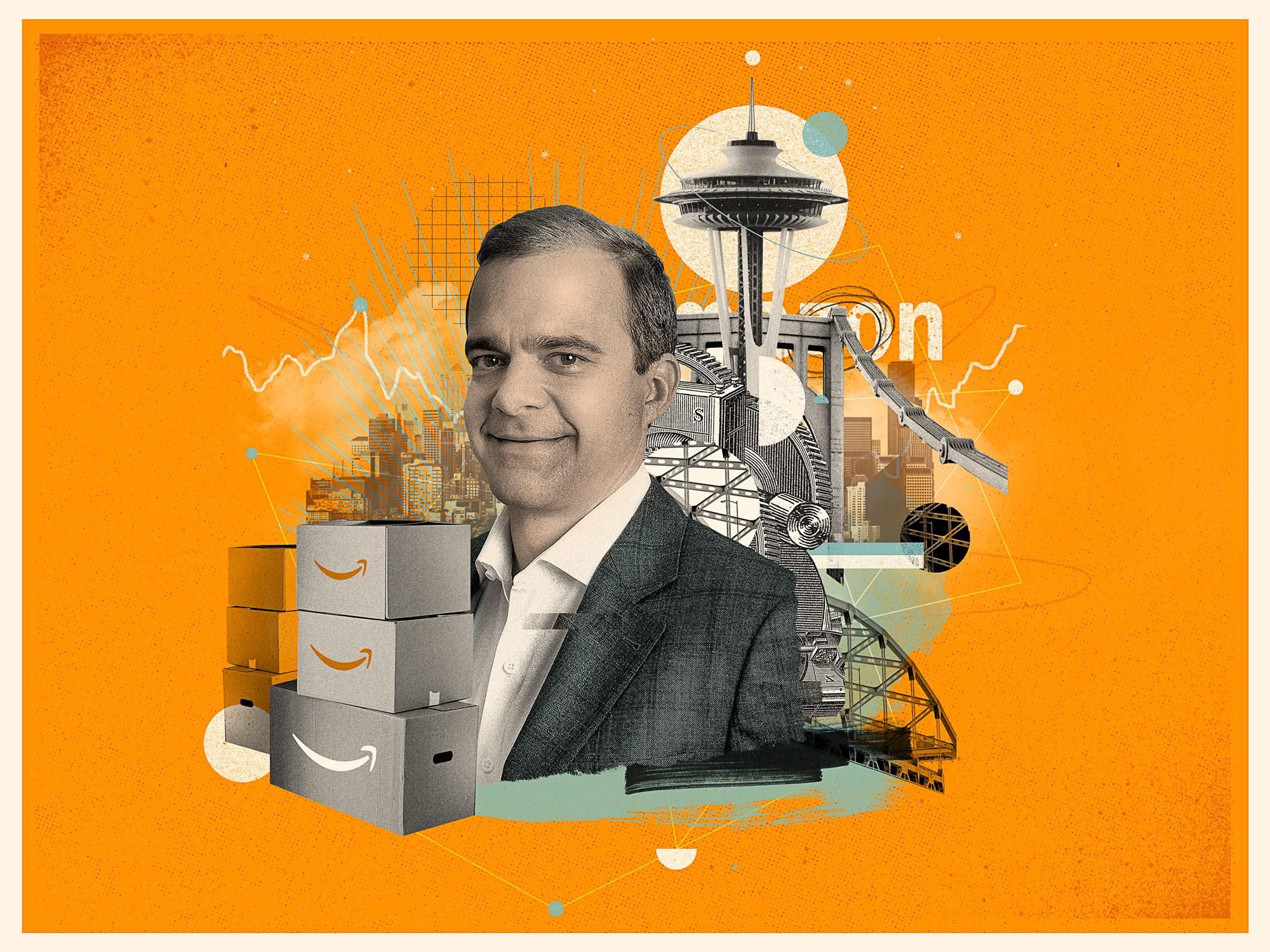

Jeff Wilke
illustration by Eduardo Ramón Trejo

In March, Jeff Wilke quietly stepped away from Amazon, the company he was instrumental in building from an online book retailer to one of the most valuable and influential corporations in the world.

As CEO of Amazon Worldwide Consumer since 2016, he oversaw the company's vast retail business, Prime, the Amazon marketplace, Amazon stores, marketing and Whole Foods.


When Wilke joined Amazon in 1999 to oversee operations the company was doing about $2 billion of revenue a year. Now it brings in about $1 billion every day and last week announced its sales grew by an astonishing 44% year-over-year.

Wilke was long considered the second most important person in the company behind Amazon CEO Jeff Bezos, who shocked the world by announcing his own departure in February.

Bezos called Wilke his tutor and he was seen as a likely successor, but that job instead went to Andy Jassy, the chief executive of Amazon Web Services.

In a wide ranging conversation with dot.LA – among his first since leaving – Wilke says he has no regrets and felt it simply time to do something else.

Wilke also talked about what it was like to work for Bezos and his reaction to last month's failed unionization vote at an Amazon warehouse in Alabama.

This interview has been edited for length and clarity.

You left Amazon only a few weeks ago. What's it been like these past couple of weeks, not being at the helm of that giant operation?

Jeff Wilke: It's certainly been an adjustment and I'm still adjusting. I was there over 21 years and it's a part of me in so many different ways. I have so many connections there still and friends who are there. I spent the first two weeks learning to code in Python, which I thought would be a really good way to stay connected to the engineers that build Amazon every day and upgrade my skills since I hadn't written code in modern languages.

So you're not on the golf course. You're learning Python?

Yeah, it was super fun. It was very immersive. It was a reminder to me of how coding compounds creativity and invention.

Why did you want to depart Amazon?

I just said it was time. I didn't spend any time through the years carefully charting some course. We were building what we hoped would be a lasting, important company and worrying about the customer experience and I got to a point where I felt like it was time to do other things.

Did the job become not as fun with all of the scrutiny from Washington and organized labor and just the giant pressure you were under with all that?

The job was just as fun when I started to think about leaving, which was well before the pandemic. And it was really meaningful last year in terms of all that was accomplished. But it just felt time for me to move on.

Did you want to be the next CEO?

I never really thought about it because I always imagined Jeff doing it forever. When I was making my decision that wasn't what I was thinking about.

But when you heard he was stepping down, were you like, "I should have just stuck around a little longer?"

No. I was super excited and I am super excited for [new Amazon Worldwide Consumer CEO] Dave Clark and for Andy Jassy.

Were you surprised when the other Jeff said he was leaving?

Yes

It's interesting that both of you who had been there over 20 years and in his case founded the company decided at this moment to leave. Do you think he took some inspiration from you?

(Laughs) That's hard to say but I think in many ways the last year or so has been quite a time of self-reflection for many people. It's not surprising to me that if people were maybe thinking in the back of their mind about making a change, the events of the last year would have caused them to think even harder about it. I don't know for sure why Jeff chose the particular time he chose, but he has so many things in his life that he wants to focus on, too. And I'm just really happy for him.

How do you think the company will be different under Andy Jassy?

Andy was a part of the S-team [Amazon's senior leadership group] for a long time and contributed materially to a bunch of the things that are part of the culture. He and I worked with a group of people on a couple of the revisions to the leadership principles that really have guided the company for nearly two decades. And of course the business and culture that he built with the team and AWS is a big part of Amazon and certainly a big part of the technical underpinnings of the way Amazon works. And that's not going to change at all. So I think it's a terrific team with a great mission and a lot of runway because of the businesses that they're in. I'm going to remain a fan.

What was Jeff Bezos like to work for?

You vote with your feet at work, and if I didn't think he was somebody that I enjoyed working for and that I could learn from, I wouldn't have had him as my boss for over 20 years. He and I have different strengths in different areas where we were able to help each other out by learning from each other and of course Amazon is more than just one or two or 10 people – it's thousands and now actually over a million people.

In those early days what did you see Amazon becoming? Did you just think it would be a big bookseller or could you have seen this global colossus?

I don't think anybody could have imagined what actually happened. Too many things had to fall into place. For instance, there was no iPhone or Android system in 1999 when I joined. People weren't carrying around what are basically supercomputers in their hands, which radically changed the way people interact with the World Wide Web. The delivery networks were not nearly as capable as they became over those 20 years. There's a ton of work to do to get costs to a point where you could afford to offer something like Prime. We didn't have a studio so the idea that we would be creating movies and TV shows as a complement to the delivery services as part of the subscription program called Prime – I think it would have been hard to envision all these things in detail.

What was your reaction to the union vote in Alabama failing by a pretty wide margin?

Jeff hit this well in the shareholder letter; the company can always be better at taking care of employees. If I were still there, I wouldn't have hung my hat on the outcome of that particular vote. I would have said there are some signals that we're receiving that say we have more work to do. We should be proud of what we've done – proud of our safety record and proud that we pay industry leading wages and proud that we have 20 weeks of family leave for people who started an unskilled hourly job on day one, which is really unheard of. So, we have all these things that we've done that are great and then there's a lot of things that we can do to get better.

What did you think of "Nomadland"?

The work camper thing was something that sort of naturally evolved. There were groups of people who had come to work only for the holiday at Amazon and they showed up in campers and they were making great money and then they left post-holiday. They started coming back every year. They really enjoyed it. They built email networks together and they coordinated their work. They asked Amazon to help with finding parking lots for the campers and we were happy to do that. But it was really an organic thing. It just sprouted up. I really enjoyed my trips to the fulfillment centers, hearing their stories and then seeing them come back year after year.

Is it hard when you order something now from Amazon and it doesn't arrive on time and you're like, "why did this happen?" Is it hard to get that out of your system after all these years?

Of course. I mean, the team knows any time there's a defect, I'm going to send an email and that's not going to change.

Part two: Jeff Wilke reveals his next chapter.

Lead illustration by Eduardo Ramón Trejo.

https://twitter.com/thebenbergman
ben@dot.la
Two LA Startups Raised $2.37B to Build What AI Needs

🔦 Spotlight

Happy Friday, LA.

The largest checks in tech are increasingly going toward companies trying to build their way out of America’s biggest physical constraints.

This week, two Los Angeles startups raised a combined $2.37 billion in equity to tackle two particularly urgent ones: how the country manufactures critical hardware and where it will find enough electricity to power the AI era.

Torrance-based Hadrian is building highly automated factories for defense and aerospace. El Segundo’s Valar Atomics wants to manufacture nuclear reactors at scale. Different industries, same underlying bet: the next generation of technology will depend on our ability to produce physical infrastructure much faster than we do today.

Hadrian raised $1.37 billion in Series D funding, bringing its valuation to $7.87 billion. The company plans to use the capital to open new factories, expand research and development, and increase its capacity to produce critical defense, aerospace and industrial systems.

Hadrian’s pitch is straightforward, if wildly ambitious: America needs to relearn how to build things and build them quickly.

Its factories combine skilled workers with AI, robotics and proprietary software to manufacture precision components and, increasingly, complete mission-critical systems. Its customers include defense giants such as Lockheed Martin and RTX, along with newer players like Anduril.

The company has come a long way from simply making aerospace parts. Hadrian is positioning itself as a piece of America’s industrial infrastructure, offering manufacturers a way to rapidly scale domestic production at a time when wars abroad, strained supply chains and growing defense demands have made the country’s manufacturing gaps increasingly difficult to ignore.

Investors are clearly buying the argument. The new round comes just over a year after Hadrian raised $260 million, suggesting that “reindustrialization” has officially graduated from venture capital buzzword to billion-dollar investment thesis.

Meanwhile, roughly 15 miles away in El Segundo, Valar Atomics is moving even faster than its enormous ambitions suggested.

When we last wrote about Valar, the company was reportedly raising $450 million at a $2 billion valuation and racing to prove that nuclear energy could move on AI’s timetable. Now, it has closed a $1 billion Series B led by Sequoia Capital, secured an additional $200 million credit facility and reportedly reached a $6 billion valuation.

Valar is developing standardized, factory-built nuclear power plants designed to avoid the enormous costs and decades-long construction timelines associated with traditional nuclear projects. Its goal is not merely to build a working reactor, but to eventually manufacture fleets of them.

That ambition also sounds considerably less theoretical than it did when we first covered the company. In June, Valar’s Ward 250 reactor achieved a self-sustaining nuclear reaction. Just one week later, the company demonstrated the reactor generating electricity to power an Nvidia Blackwell system. Valar now says the new funding will help it move from proving its technology works to producing reactors at scale.

The timing is no coincidence. AI’s enormous appetite for electricity is forcing the tech industry to confront a basic reality: the cloud still has to plug into something. Training models and operating massive data centers will require far more reliable power, and nuclear energy is rapidly becoming one of Silicon Valley’s favorite answers.

Hadrian and Valar may be solving different problems, but their unusually large rounds point to the same shift. AI can design, predict and automate, but it cannot manufacture a missile component or generate a megawatt of electricity on its own. That requires factories, energy systems, supply chains and a great deal of capital.

For years, venture-backed companies competed to build the software layer. Now, some of the biggest bets are being placed on the infrastructure underneath it.

The future may run on AI. But first, someone has to build what keeps it running.

More from this week’s LA startup and venture scene below.

🤝 Venture Deals

    LA Companies

    • Endeavor Optical Networks emerged from stealth with $10.75M in seed funding from General Catalyst and Andreessen Horowitz to develop a satellite network that uses lasers to move data between continents. The startup plans to use the capital to build an optics lab, hire engineers and conduct ground testing ahead of a demonstration satellite launch targeted for late 2027. - learn more
    • Actualyze AI emerged from stealth with a $7M seed round backed by Storm Ventures, Canaan Partners, Morado Ventures and AME Cloud Ventures. Its platform gives enterprises a central control layer for managing AI usage across teams and applications, helping them enforce security policies, track spending, route requests between models and maintain audit trails. - learn more
    • Blaze.tech raised $8.5M in pre-seed funding led by Friale, a healthcare-focused venture firm founded by the family behind HCA Healthcare. The company helps digital health startups, providers and payers turn AI-generated prototypes into HIPAA-compliant software for uses including e-prescribing, EHR integrations, telehealth and auditing. - learn more

    LA Venture Funds
    • Canon Capital participated in Oligo Security’s $60M funding round alongside Ballistic Ventures, Greenfield Partners, Lightspeed Venture Partners, Red Dot Capital Partners, TLV Partners and other investors, bringing the cybersecurity company’s total funding to $140M. Oligo will use the capital to accelerate product development and expand its global go-to-market operations as it helps organizations detect and block software exploits in real time. - learn more
    • Matter Venture Partners participated in Volta’s seed and Series A financing alongside Azora, Andreessen Horowitz, Altimeter, NVIDIA and Michael Dell’s family office, valuing the AI infrastructure startup at $2.4B. Emerging from stealth, Volta plans to use the backing to develop and operate large-scale AI data centers, supported by a $5B infrastructure financing program with Azora and a $10B European compute partnership. - learn more
    • Cedars-Sinai participated in Cirrus Therapeutics’ expanded seed financing through its Intellectual Property Company, bringing the ocular immunology biotech’s total funding to $14.7M. Cirrus will use the backing to advance its gene and cell therapy pipeline, including a lead treatment for geographic atrophy, while a new collaboration with Singapore Eye Research Institute and Duke-NUS will support research, clinical development and expansion across Asia-Pacific. - learn more
    • Strong Ventures made a follow-on investment in Ready Robust Machine’s ₩13.4B Series B, which was led by Quantum Ventures Korea and brought the heavy-equipment technology company’s total funding to ₩22.9B. The company develops energy-recovery systems for hydraulic machinery and will use the capital to build out mass production, expand its data services and enter the Japanese market. - learn more

    LA Exits

    • Artium has been acquired by global consulting firm AlixPartners, bringing its expertise in building enterprise-grade AI agents for clients including BNY Mellon, Mayo Clinic and eBay to a broader global platform. The company will continue operating as a distinct team under the name Artium by AlixPartners, retaining its founders, employees, methodology and research relationships. - learn more

      Download the dot.LA App

      How Replify Found Its Niche and an Acquirer

      🔦 Spotlight

      Hello LA,

      This week’s startup story began three years ago with an AI assistant built for almost any small business. It ended, or perhaps graduated, with an acquisition by one of the fitness industry’s largest technology providers.

      ABC Fitness has acquired Replify, an AI platform that manages customer communication for gyms and wellness businesses across phone, text, email and chat. Its virtual agents can answer questions, qualify leads, schedule tours and classes, follow up on missed calls and run outbound campaigns. Financial terms were not disclosed.

      Before Replify found its footing in fitness, it was HeyLibby, a general-purpose AI assistant founded in 2023 by former Zillow colleagues Spencer Rascoff, Tony Small and Anna Rodriguez. The company was incubated inside Rascoff’s 75 & Sunny Labs and initially set out to help small businesses turn incoming messages into qualified leads.

      That broad vision gave HeyLibby a large potential customer base, from real estate agents and contractors to hairstylists and event planners. But as the team searched for product-market fit, one industry’s problem stood out. Gym and wellness employees were often too busy helping customers in person to answer every call, text or email, leaving prospective members waiting and potential revenue on the table.

      That insight reshaped the company. HeyLibby narrowed its focus to fitness and wellness, raised a $4.5M seed round in 2025 and later rebranded as Replify. It went on to work with brands including Gold’s Gym and UFC Gym, proving that its AI agents could do more than answer routine questions. According to the company, customers have captured up to 10 times more leads and shortened sales cycles from roughly 30 days to as little as three to five days.

      ABC Fitness became a natural next step. The company provides software to more than 30,000 fitness businesses serving over 40 million members worldwide. By adding Replify to its platform, ABC can offer gyms an always-available AI front desk while bringing Replify’s technology to a much larger global customer base.

      Replify’s journey offers a useful lesson amid the rush to build AI products for everyone. The company began with a broad promise, identified a customer with a specific and expensive problem, and built deeply around that need. Gym owners did not need another flashy chatbot. They needed someone to answer the phone when the front desk could not.

      Sometimes the smartest AI strategy is simply picking up the call.

      More from this week’s LA startup and venture scene below.

      🤝 Venture Deals

        LA Companies

        • Dimension raised a $1.65M seed round backed by Science Inc., UpscaleX, OpenSky, Long Run Capital, 1864 Fund and others. The profitable social-commerce company will use the funding to launch Seller OS more broadly, an agentic AI platform that automates TikTok Shop operations for brands and agencies. - learn more
        • Procode raised a $10M Series A led by Health Velocity Capital, bringing its total funding to $14M. The AI-powered medical billing company will use the capital to acquire two additional billing businesses and expand its platform beyond plastic surgery and dermatology into all surgical specialties and ambulatory surgery centers. - learn more
        • Antares raised $470M in Series C financing, including $370M in equity and $100M in debt, in a round co-led by Paradigm and Caffeinated Capital. The nuclear energy company will use the capital to commercialize its autonomous microreactors, with an electricity-producing model planned for 2027 and initial deployments at U.S. military installations beginning in 2028. - learn more

        LA Venture Funds
        • Wilshire Lane Capital participated in Ellis’ more than $10M seed round, which was led by First Round Capital and included Kearny Jackson, 645 Ventures, Harlem Capital, Khosla Ventures and others. Founded by Cadre founder Ryan Williams, Ellis has emerged from stealth with an AI-native operations platform that helps private credit managers reconcile fragmented data and automate workflows such as portfolio monitoring, investor reporting and compliance; the funding will support team growth and further product development. - learn more
        • Rebel Fund participated in Dili’s $15M Series A, led by Khosla Ventures, bringing the AI compliance company’s total funding to $21.7M. Dili helps energy, construction, infrastructure and manufacturing companies identify compliance issues by reviewing project data in real time, and will use the funding to expand its team and broaden its platform into additional audit and waste-detection workflows. - learn more
        • B Capital led ChipAgents’ $60M Series A2, which brought the semiconductor AI startup’s expanded Series A financing to $134M. ChipAgents will use the funding to scale customer deployments, expand its engineering and go-to-market teams and further develop its AI platform, which automates complex chip design and verification workflows. - learn more
        • StoryHouse Ventures participated as a returning investor in Henry AI’s $16.5M Series A, led by FirstMark Capital with backing from Thomson Reuters Ventures, Y Combinator and others. The commercial real estate AI company will use the funding to expand its engineering and product teams and scale Henry Deal, a platform that automates underwriting, offering materials and other back-office work throughout a transaction. - learn more
        • Walkabout Ventures and Bungalow Capital co-led Discern’s $10M Series A, bringing the company’s total funding to $17.5M. Discern provides a software-based registered agent service that automates state filings and compliance tasks, and will use the capital to scale its platform following fourfold annual recurring revenue growth in 2025. - learn more
        • Starshot Capital participated in Quercus Biosolutions’ oversubscribed $5M seed round, which was led by Serra Ventures and included several climate, agriculture and grower-backed investors. The agtech startup will use the funding to expand its pipeline of AI-designed proteins for fighting herbicide-resistant weeds, begin regulatory work and explore applications targeting fungi, insects and other crop pests. - learn more
        • B Capital co-led Flourish Health’s $26M Series A alongside F-Prime and Cherryrock Capital, bringing the youth mental health provider’s total funding to $46M. Flourish will use the capital to expand its psychiatrist-led, in-home care model nationwide, hire and train clinicians and further develop its AI-enabled platform for coordinating care. - learn more
        • Powerhouse Capital participated in European Technology Network’s $1.6M seed round alongside Axel Springer, a LADbible co-founder and angel investors from OpenAI and DeepMind. The London-based tech media startup will use the funding to open a larger studio, expand its team, launch a newsletter and increase its livestreamed programming from two shows per week to five. - learn more

        LA Exits

        • Saltair, the Los Angeles body-care brand founded by model and entrepreneur Iskra Lawrence, is selling a majority stake to private equity firm TSG Consumer. Financial terms were not disclosed, but the deal will support Saltair’s expansion across e-commerce, retail and new products, while Lawrence transitions into the role of chief community advocate. - learn more
        • Digital marketing agency GR0 plans to acquire Ultimate AI’s enterprise deployment division and use the team’s technology to launch a new company called GR0 AI. The platform will deploy AI agents across brands’ customer data, commerce and marketing systems to personalize outreach, recover abandoned sales and generate measurable revenue; financial terms were not disclosed. - learn more

          Download the dot.LA App

          From Uber to Atoms: Travis Kalanick’s $1.7 Billion Return

          🔦 Spotlight

          Hello LA,

          Nine years after his turbulent exit from Uber, Travis Kalanick is back with a new company, an enormous war chest and, apparently, some unfinished business.

          Los Angeles-based Atoms announced this week that it has secured a $1.7 billion equity investment led by Andreessen Horowitz, with a16z cofounder Ben Horowitz joining its board. Bain Capital, Fifth Wall, Uber and several other investors participated, while a roster of major banks, including Goldman Sachs, JPMorgan and Bank of America, are listed as debt partners.

          Yes, Uber itself is now backing the comeback of its famously ousted cofounder. Silicon Valley may preach disruption, but it has always appreciated a good redemption arc.

          Atoms is the culmination of the company Kalanick has spent the past eight years building largely out of public view. Formerly known as City Storage Systems, the parent company behind CloudKitchens, it is now bringing its businesses together under one ambitious umbrella: Atoms Food, Atoms Mining and Atoms Transport.

          The premise is that AI’s next major frontier will not be confined to screens, chatbots or software. Atoms wants to build what Kalanick calls a “computer for the physical world,” using software, sensors, robotics and AI to automate how physical goods are produced, stored and moved.

          That means tackling decidedly unglamorous but enormous industries such as mining, construction, food production and heavy transportation. Rather than betting on humanoid robots that can theoretically do everything, Atoms is focused on specialized machines designed to perform specific, economically useful jobs.

          In other words, the robot does not need a face. It needs a business model.

          For a16z, the investment is as much a bet on Kalanick as it is on industrial AI. In an essay bluntly titled “Travis Is Back,” Horowitz argues that Kalanick possesses the rare mix of technical range, endurance and sheer force of will required to drag old-line industries into a new technological era. The firm’s broader thesis is that robotics will eventually handle much of the repetitive work involved in making, moving and storing physical goods, creating a market potentially as consequential as computing itself.

          There is also some history being settled. Kalanick, Horowitz and Marc Andreessen nearly partnered during Uber’s early days but never completed the deal. In a new conversation about Atoms, Kalanick and Horowitz revisit that missed opportunity and the long road that brought them back together. Sixteen years later, the check is considerably larger.

          The scale of the investment is remarkable, but so is its location. Atoms is headquartered in Los Angeles, giving the city a front-row seat to one of tech’s boldest industrial AI bets. It also reinforces something increasingly evident across LA’s startup ecosystem: the next era of AI will not only be written in code. It will be built in kitchens, warehouses, mines, vehicles and factories.

          Whether Atoms becomes the operating system for the physical world or simply proves that even $1.7 billion cannot make atoms behave like bits remains to be seen. But Kalanick is taking another enormous swing, and this time, Los Angeles is where the comeback story begins.

          More from this week’s LA startup and venture scene below.

          🤝 Venture Deals

            LA Companies

            • Hawthorne-based Andrenam raised an $18M Series A led by Upfront Ventures, with participation from Valor Equity Partners, Also Capital, First Round Capital and Long Journey Ventures, bringing its total funding to $30M. The maritime defense startup will use the capital to scale production of its sonar-equipped buoys and expand its AI-powered platform for detecting and tracking underwater activity. - learn more
            • Long Beach-based Bluecore Energy emerged from stealth with approximately $10M in oversubscribed financing led by Slauson & Co., with participation from Harlem Capital, Precursor Ventures, Hartbeat Ventures and others. The company is developing small modular nuclear reactors that can operate aboard floating barges and deliver zero-emission power to ports, data centers and other critical infrastructure. - learn more
            • Vikk AI raised $4.2M across a $700K pre-seed and $3.5M seed round, with backing from MagnaSci Ventures and several angel investors. The legal AI startup will use the funding to expand its consumer assistant, document tools and advertising platform that connects users with lawyers based on their needs and location. - learn more
            • Final Boss Sour raised $4M in strategic funding from Evolution VC Partners, The Angel Group, Mondelēz International’s SnackFutures Ventures and others, bringing its total funding to $12M. The gaming-inspired real-fruit snack brand will use the capital to expand into major retailers, including Walmart, Kroger, Target and 7-Eleven, while developing new products and collaborations. - learn more

            LA Venture Funds
            • Overture Ventures participated in Fluxco’s $26M seed round, led by 8VC and Congruent Ventures, alongside Trust Ventures, Koch Disruptive Technologies and others. The Austin startup uses AI to help companies source electrical transformers from more than 150 manufacturers, reducing a procurement process that can take months to just days. - learn more
            • Alexandria Venture Investments and Wedbush Healthcare Partners participated as returning investors in Crystalys Therapeutics’ oversubscribed $130M Series B, which was led by Frazier Life Sciences. The San Diego biotech will use the funding to advance Phase 3 trials and commercialization preparations for dotinurad, its once-daily oral treatment for gout. - learn more
            • Rebel Fund participated in Klaimee’s $5.5M seed round, led by FundersClub’s Alexander Mittal and backed by ex/ante, Pioneer Fund, Y Combinator and others. The San Francisco insurtech startup certifies and insures autonomous AI agents, helping businesses manage financial and liability risks that traditional cyber and technology policies may not cover. - learn more
            • M13 participated in Skyfall AI’s undisclosed funding round alongside Fidelity, Inovia Capital, Touring Capital, NextView Ventures and Garage Capital. Founded by former Microsoft researchers, the San Francisco startup is developing AI systems capable of making long-term decisions across finance, operations, marketing and other business functions, with the goal of building an autonomous enterprise. - learn more
            • Interlagos Capital led Beyond Reach Labs’ $10M seed round, with participation from TerraForge Capital, Off-Piste Capital, Y Combinator and Augur VC. The startup will use the funding to scale production of its deployable solar-array hardware for satellites at a new 16,000-square-foot facility in Brooklyn, with plans to achieve flight qualification by the end of 2026. - learn more

              Download the dot.LA App

              RELATEDEDITOR'S PICKS
              Trending