

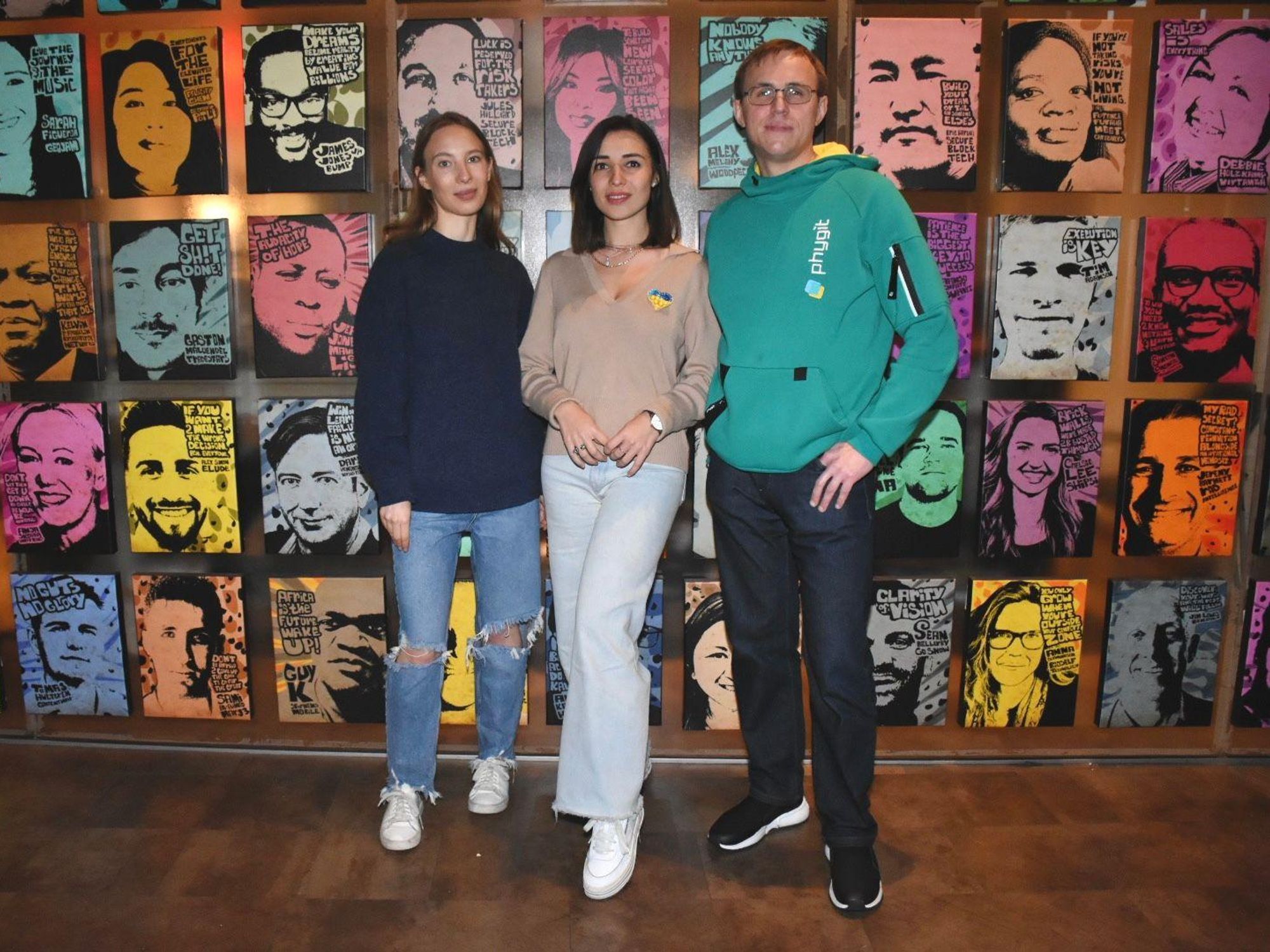
Why These Ukrainian Entrepreneurs Are Making LA Their Home

Aisha Counts
Aisha Counts is a business reporter covering the technology industry. She has written extensively about tech giants, emerging technologies, startups and venture capital. Before becoming a journalist she spent several years as a management consultant at Ernst & Young.
Why These Ukrainian Entrepreneurs Are Making LA Their Home
Joey Mota

Fleeing war and chasing new opportunities, more than a dozen Ukrainian entrepreneurs have landed in Los Angeles, finding an unexpected community in the city of dreams. These entrepreneurs have started companies that are collectively worth more than $300 million, in industries ranging from electric vehicle charging stations to audience monetization platforms to social networks.

Dot.LA spent an evening with this group of Ukrainian citizens, learning what it was like to build startups in Ukraine, to cope with the unimaginable fear of fleeing war, and to garner the resilience to rebuild.


Andrew Skrypnyk, CEO of learning platform Promova, decided to enter tech after being awed by 3D graphics on a computer. He went on to spend time in a variety of software development roles, learning more than 20 programming languages in the process. Artem Kudymovskyy, co-founder and CCO of software development firm ITRex Group, similarly became inspired when he saw his first personal computer and met a former programmer who taught him to code.

Others took more winding paths. Vlad Klimchuk studied biomedical engineering and then became one of Ukraine’s highest-grossing filmmaker before switching into tech and co-founding image-based social network TLPRT. Dana Sydorenko spent time as a military paramedic and created Ukraine’s best army supply company before co-founding GameTree with John Uke.

Despite taking different paths, what these founders share is a passion and ingenuity for solving their own problems and developing creative solutions.

For instance, when Oleksiy Malytskyy first moved to Los Angeles, had a difficult time finding an apartment which led him to co-found co-living startup Sota. When Alexey Menshikov, a former sound designer, became frustrated that the gaming company he worked for wouldn’t accept his ideas, he decided to start Beatshapers, his own company in immersive gaming.
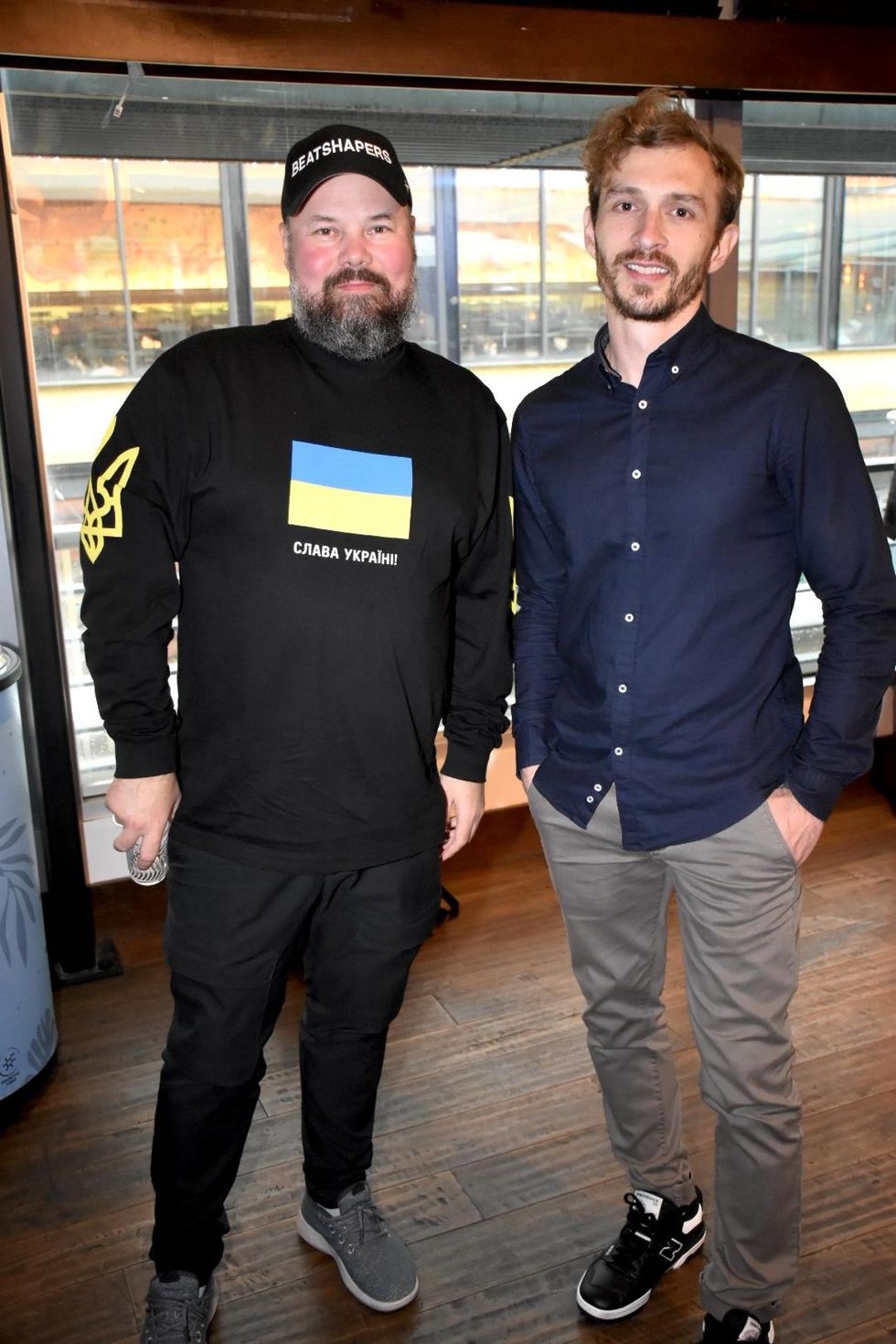
Alexey Menshikov -Beatshapers, Oleksandr Gamaniuk -tarta.aiJoey Mota

The sense of resilience and adaptability these entrepreneurs share is exactly what investors look for in startup founders.

“Startup life is really hard. And it's a grind to go from a zero to a one and to have something that's just a concept, or an idea and bootstrap that and build it and get to a place where you're actually making money,” said Brandon Gerson, a former entrepreneur turned venture partner at Expert Dojo and angel investor in Primeclass.

Starting a tech company isn’t easy being with, but in Ukraine it’s especially hard. Ukraine’s challenging history includes the collapse of the Soviet Union in 1991, the Russian invasion of Crimea in 2014, numerous financial crises, and of course the recent Russian invasion of Ukraine amongst other events.

Each of these events caused the economy to sink, businesses to collapse and access to capital to dry up. Over the years Ukraine’s annual GDP has swung wildly as result, from highs of 10%+ annual GDP growth to lows of -20% growth. Ukrainian founders not only face the normal challenges of managing a startup, but have the added pressures of navigating rapidly shifting economic conditions.

The limited number of venture capital firms in the country also means access to capital is hard to come by, and thus harder to scale.

This wasn’t always the case: Ukraine was broadly known for having a thriving tech scene before the war. Between 2015 and 2016 for instance, investors pumped more than $200 million into startups and Ukraine’s IT outsourcing sector was worth billions.
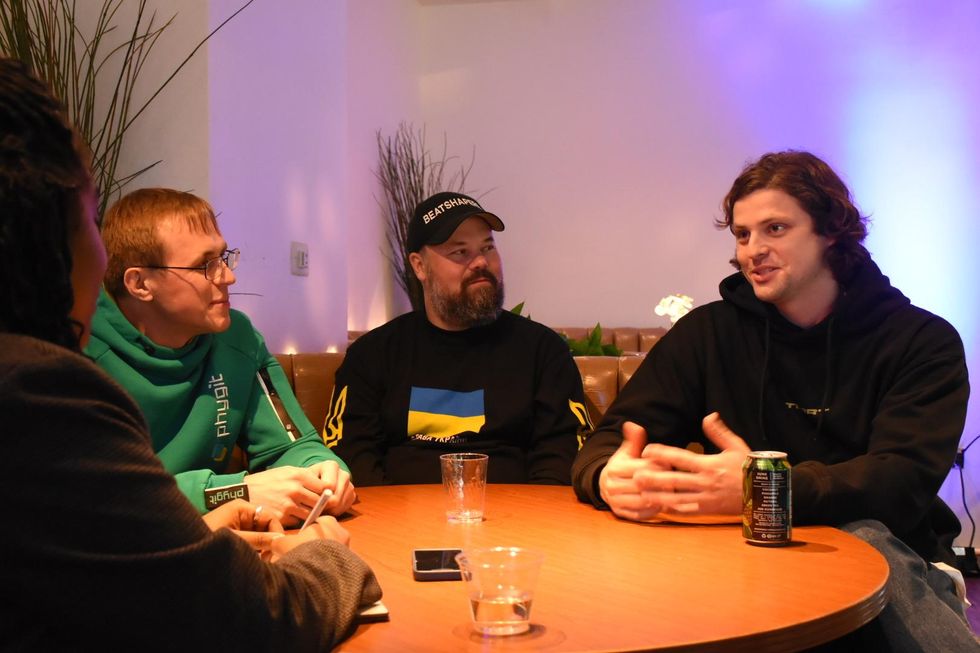
Pavlo Shlapak - Phygit, Alexey Menshikov -Beatshapers, Vlad Klimchuk-TLPRT Pavlo Shlapak - Phygit, Alexey Menshikov -Beatshapers, Vlad Klimchuk TLPRT Joey Mota

But as Sydorenko, the paramedic turned GameTree co-founder, put it, “at some point Ukraine has limits.” Not only is it difficult to raise money in Ukraine, but “you will never be able to build a publicly traded company over there because this market does not exist,” she said.

Although Sydorenko and her team were able to build a social network in Ukraine that now has over 500,000 users, fundraising was difficult. It wasn’t until moving to Los Angeles that they were able to raise a significant amount of money: $650,000 in their most recent round.

By virtue of being from Ukraine then, these entrepreneurs naturally have resilience and adaptability in spades. “Someone who comes from Ukraine and having gone through what those folks have gone through, I don't even mean just in the war, just in history, they're prepared in a way that most of the folks are not,” said Brian MacMahon, whose accelerator Expert Dojo has invested in more than 200 startups across Africa, Latin America, and India among other regions.

Now the Russia-Ukraine war has threatened to dismantle the country’s tech industry as infrastructure is destroyed, internet access and electricity are cut off, and tech companies and their workers flee.

Even still, Ukrainian tech workers are carrying on in astounding fashion.

One Ukranian man, who was locked in his dimly lit basement for weeks, carried on programming and coding even while bombs were going off overhead, said Kudymovskyy, as an illustration of Ukrainian resolve.

By some estimates nearly 90 to 95% of all startups fail, but in the experience of Pavlo Shlapak, founder of Phygit, which creates digital experiences for physical products, the survival rate for Ukrainian startups is significantly higher. “And that's because we can adapt, we have a positive mind, great sense of humor, and it's a super valuable source actually in crisis situations,” he said.

For Ukrainian founders then, relocating and building a startup in sunny Los Angeles, is almost easy by comparison. Access to capital is plentiful, networking opportunities abound and the Los Angeles tech community is thriving.

Despite being separated by more than six thousand miles across the Atlantic Ocean, several Ukrainians saw parallels between Odessa, Ukraine and Los Angeles for example.

“Odessa is the most diverse city in Ukraine,” said Primeclass founder Ivan Kovpak, who noted the connection between his hometown and Los Angeles. Kovpak, Skrypnyk and Kudymovskyy agreed that both cities possess comparable climates, proximity to water and similar levels of openness and diversity.
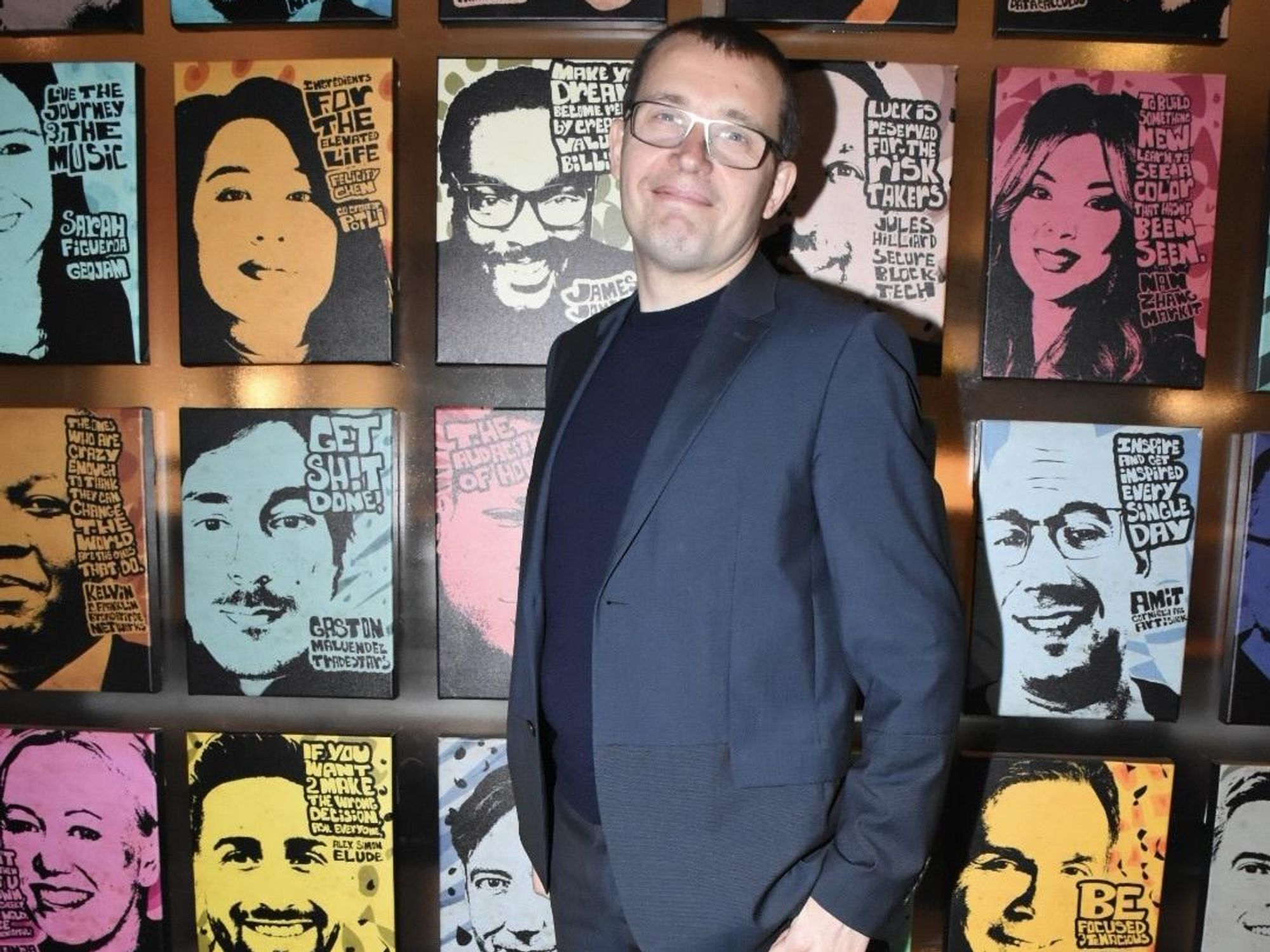
Ivan Kovpak, Primeclass founderJoey Mota

“In California, everybody kind of likes Silicon Valley, but there's something very special about this place,” said Kudymovskyy, a former consultant who moved to Los Angeles in 2012 before starting his own firm ITRex Group. Kudymovskyy also said that diversity and access to different ideas can actually make startups more successful.

The culture of creativity and storytelling was one of the main appeals of relocating to Los Angeles, according to several founders. More than one joked that Ukrainians are not the best salesmen or marketing gurus. But living in the filmmaking and content creation capital of the world, they now had the perfect combination of storytelling and tech.

The combination of a U.S. founder with sales experience and “a founder from Ukraine who will develop a product is the killer combination,” said Malytskyy, co-founder of Sota.

Other founders agreed. “I think the combination of Ukraine and LA is our key of success,” said Sydorenko. “If you take almost any company, you have developers in Ukraine, you test your product in Ukraine, and you have people who create networking and promote your product in LA, any sort of company will be successful,” she said.

Although it may seem more obvious to build a startup in Silicon Valley rather than Los Angeles, several founders thought otherwise.

“It makes perfect sense that if you want to build a startup, you think that San Francisco is the spot,” Sydorenko added. “But actually it's the worst place to build because the cost per developer is extremely high [and] you need to compete with the biggest companies in the market,” she said.
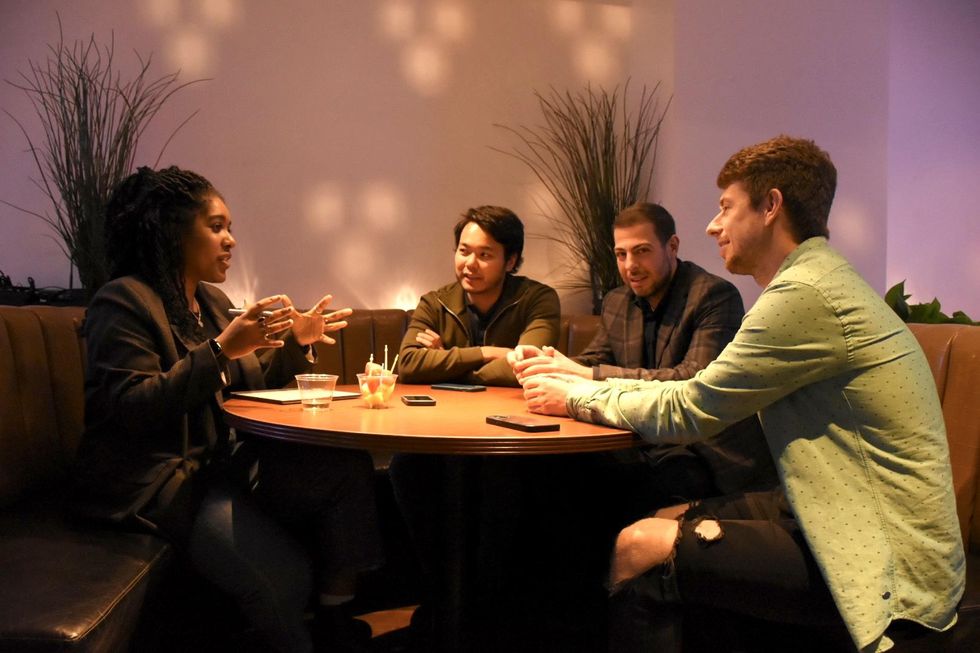
Omar Zhandarbekuly, Yevgen Arutyunyan - AEV charging, Oleksyy Malytskyy - Go SotaJoey Mota

Plus as more Silicon Valley investors open offices in the city and startups relocate their headquarters, Los Angeles is quickly becoming a new tech capital in its own right, said Menshikov.

In many ways Los Angeles was the perfect landing spot for this group of entrepreneurs. But as the Russia-Ukraine war rages on, many of the founders can’t help but feel the tug of home.

They each grappled with the dual responsibility and tension of building successful startups in the U.S., while still supporting their country and taking care of friends, family and employees back home.

Founders often find themselves helping colleagues find shelter and safe places to work back in Ukraine or working to relocate family members. At times this can mean ceasing startup operations to assist with the war.

“Every Ukrainian is in one way or the other contributing to the war,” whether they are on the front lines or not, said Malytskyy, who organized a resistance group inside of Russia at the start of the war.

For the founders, this often means using money as a form of resistance.

“We also fight on the economical front,” said Skrypnyk. In his mind they are financial soldiers, helping to wage war by beefing up the Ukrainian economy, sending monetary support to the military and propping up families and businesses.

Although these founders have physically left Ukraine, they brought with them their country’s sense of resilience, humor, purpose and passion. For now, Los Angeles is home, but the spirit of Ukraine lives on.

Inside Tinder’s Biggest Product Shift in Years

🔦 Spotlight

Hello Los Angeles,

Despite headlines about swipe fatigue and dating app burnout, Tinder believes the problem isn’t that people are tired of dating. They’re tired of bad dating experiences.

So it felt fitting that Tinder chose the El Rey Theatre in Los Angeles, a venue known for reinvention, to make its case that the category is far from over.

Walking into the El Rey, it was clear Tinder wanted this to feel less like a tech launch and more like a cultural moment. Music was bumping, the room buzzed with chatter and excited energy, red light beams cut through the room, and chandeliers glowed overhead.

At Tinder Sparks 2026: Start Something New, Match Group and Tinder CEO Spencer Rascoff took the stage to outline what the company calls the biggest evolution of the app in years. Tinder remains the largest dating app in the world, used by tens of millions of people across more than 185 countries and responsible for billions of matches every year.

Match Group and Tinder CEO Spencer Rascoff

Rascoff framed the shift around a broader cultural reality. In a world where people increasingly interact with machines, technology and AI, the need for real human connection has not gone away. If anything, Tinder believes it has only grown stronger.

To respond to that shift, Tinder says it’s focusing on what it calls “sparks,” the moments when a match actually turns into a real conversation.

As Rascoff put it on stage:

“We are not optimizing for swipes or likes. We are optimizing for sparks.”

That philosophy is shaping a wave of new features discussed throughout the keynote by Tinder’s leadership team, including Mark Kantor, SVP and Head of Product, Yoel Roth, SVP of Trust & Safety, and product leaders Claire Watanabe and Hillary Paine.

Image Source: Tinder

Among the updates are Music Mode, which lets users connect through shared songs and artists, and a new Astrology Mode that highlights compatibility between zodiac signs. Tinder is also leaning further into social dating with Double Date, a feature that lets friends match with other pairs together. The feature is already gaining traction with Gen Z users, reflecting a broader shift toward more social and lower-pressure ways to meet people.

Image Source: Tinder

Tinder is also redesigning profiles to help users express more personality. New tools can surface stronger photos from a user’s camera roll, improve lighting, and highlight interests more visually, while integrations with platforms like Spotify, Duolingo and the restaurant app Belly bring more of a person’s real life into their profile.

Image Source: Tinder

But the most interesting experiment might be happening right here in LA. Tinder is launching IRL Events in the city, letting users browse and RSVP to real-world meetups directly through the app. Think coffee shop raves, trivia nights and pickleball tournaments. The idea is simple. Dating works better when it feels like a social activity instead of an interview.

Image Source: Tinder

Under the hood, Tinder is also leaning more heavily on AI to improve recommendations. New tools like Learning Mode and Chemistry aim to better understand what users are actually looking for and surface stronger matches faster. At the same time, the company is investing heavily in safety, expanding Face Check, a facial verification system designed to reduce bots and impersonation accounts.

Closing out the presentation, Melissa Hobley, Tinder’s Chief Marketing Officer, zoomed out from the product roadmap to the brand’s cultural footprint, noting that Tinder is mentioned in billions of TikTok videos and has become shorthand for how younger generations talk about dating.

Taken together, the updates represent Tinder’s most significant evolution in years. And judging by the energy inside the El Rey this week, the company believes the next chapter of dating will be more social, more expressive and more intentional. It’s a shift being shaped right here in Los Angeles, and one that could redefine how the next generation meets.

Now onto this week’s LA venture deals, fund announcements and acquisitions.


🤝 Venture Deals

      LA Companies

      • Hurray’s GIRL BEER raised a $5M seed round led by Lakehouse Ventures, with participation from Spice Capital plus CPG insiders and entertainment executives, as it accelerates national expansion. The LA-based flavored light beer brand says it has already landed retail placements at Walmart, Kroger, Albertsons, and Whole Foods, and plans to use the new capital to deepen distribution, enter new markets, and ramp up marketing, alongside a rollout of seven new flavors. - learn more
      • Freestyle closed a $10M Series A led by Silas Capital, with significant participation from ECP Growth. The company also noted continued backing from existing investors including Mucker Capital, Adapt Ventures, and Superangel, as it scales its premium diapers and wipes business following nationwide launches at Walmart and Target. - learn more
      • MAX BioPharma announced a new investment and partnership with Technomark Life Sciences to advance Oxy210, its oxysterol-based, orally available drug candidate for MASH. Technomark is joining as a strategic lead investor by participating in MAX BioPharma’s $13M Series A to fund a Phase 1a/1b first-in-human study, and the companies say the collaboration will pair MAX’s therapeutic platform with Technomark’s drug development experience. - learn more

                      LA Venture Funds

                      • B Capital participated in ORO Labs’ $100M Series C, which was led by Brighton Park Capital and Growth Equity at Goldman Sachs Alternatives, as the company pushes deeper into what it calls agentic procurement orchestration. ORO said the new funding follows 300% revenue growth over the past year and will be used to speed up product development, expand go-to-market and customer teams globally, and broaden enterprise use cases across procurement, finance, legal, and supply chain workflows. - learn more
                      • Aliment Capital participated in Tropic’s oversubscribed $105M Series C, which was co-led by Forbion’s Bioeconomy Fund and Corteva as the company scales the commercial rollout of its gene-edited tropical crops. Tropic said the funding will help expand production of its banana portfolio, accelerate its banana and rice pipelines, and support entry into additional climate-resilient crops, following the 2025 launch of its first new banana varieties in more than 75 years and demand that is already outpacing supply. - learn more
                      • B Capital doubled down in Axiom’s $200M Series A, which valued the company at more than $1.6 billion and was led by Menlo Ventures. Axiom said the new funding will help it extend its lead from formal mathematics into what it calls “Verified AI,” with plans to apply its technology beyond mathematical discovery into software and hardware verification. - learn more
                      • WndrCo participated in Quince’s $500M Series E, a round led by ICONIQ that values the manufacturer-to-consumer retail platform at $10.1B post-money. Quince says it will use the fresh capital to accelerate growth and global expansion of its proprietary M2C operating system, which uses AI-driven demand forecasting and direct factory partnerships to cut traditional retail markups. Other investors in the round included Basis Set Ventures, Wellington Management, MarcyPen Capital Partners, Baillie Gifford, Notable Capital, and DST Global. - learn more
                      • Matter Venture Partners co-led Eridu’s oversubscribed Series A, part of $200M+ raised as the AI networking startup emerges from stealth to tackle what it calls the “network wall” bottleneck in AI data centers. - learn more
                      • Matter Venture Partners participated in Rhoda AI’s $450M Series A, backing the startup as it comes out of 18 months in stealth with FutureVision, a video-predictive control platform aimed at helping robots operate reliably in messy, real-world industrial environments. The round included a large syndicate of investors, including Capricorn Investment Group, Khosla Ventures, Leitmotif, Mayfield, Premji Invest, Prelude Ventures, Temasek, Xora, and John Doerr, and the company says the funding will accelerate development and industrial deployments. - learn more
                      • Halogen Ventures participated in Rasa Legal’s $5M late-seed round, backing the company’s push to scale its tech-enabled criminal record sealing and expungement service nationwide. The round was led by Rethink Education with participation from Social Finance and the Richard King Mellon Foundation, and Rasa says the funding will help it expand leadership, speed product development, and grow beyond its current footprint (Utah, Arizona, and Pennsylvania). - learn more
                      • Halogen Ventures participated in Nyad’s $1.3M oversubscribed pre-seed round, backing the Birmingham-based startup as it launches an AI decision-support tool for wastewater treatment operators. The round was led by Boost VC with participation from Draper Associates, Ollin Ventures, Apprentis, First Avenue Ventures, and strategic angel Troy Wallwork, and Nyad says it will use the funding to hire, grow customers, and keep building the product as retirements thin the wastewater workforce. - learn more
                      • MANTIS VC participated in Scanner’s $22M Series A, which was led by Sequoia Capital and also included CRV, as the company builds a high-speed security data layer for AI-driven threat investigation. Scanner said the funding comes as security teams at companies like Notion, Ramp, and BeyondTrust use its platform to search years of log data quickly and power agentic workflows that help hunt threats, triage alerts, and investigate incidents more efficiently. - learn more
                      • Chapter One participated in Zcash Open Development Lab’s $25M+ seed round, joining a syndicate that included Paradigm, a16z crypto, Winklevoss Capital, Coinbase Ventures, Cypherpunk Technologies, and Maelstrom. The new company, formed by former Electric Coin Company team members, said the funding will support continued development of privacy-focused infrastructure for the Zcash ecosystem, including its self-custodial wallet and broader shielded payments tooling. - learn more
                      • CIV participated in Isembard’s $50M Series A, which was led by Union Square Ventures and also included Tamarack Global, IQ Capital, and existing backer Notion Capital. Isembard said the new funding will help it open 25 AI-powered factories by the end of 2026, expand its engineering team, and enter Germany, France, and Ukraine as it scales software-driven component manufacturing for aerospace and defense customers. - learn more
                      • WndrCo participated in Crafting’s $5.5M seed round, which was led by Mischief as the startup launched general availability for Crafting for Agents. The company said the new capital will support its push to become core infrastructure for AI-driven engineering teams, giving agents secure access to production-like environments so they can validate, test, and ship code inside complex enterprise systems used by customers including Brex, Faire, and Webflow. - learn more

                                        LA Exits

                                        • Hireguide has been acquired by HireVue, which is buying Hireguide’s underlying technology and bringing the Hireguide team into HireVue’s product org. HireVue says the deal accelerates its agentic AI roadmap, starting with a voice-based AI interviewer designed to help employers qualify candidates earlier and run smarter, more conversational hiring workflows. - learn more
                                        • Ultracor has been acquired by Applied Aerospace & Defense, bringing the California-based maker of specialized honeycomb core materials into Applied’s advanced composites platform. Applied says the deal supports its selective vertical integration strategy by strengthening supply chain control and boosting speed and capacity for space and defense programs, from satellites and missiles to antennas, radomes, and next-gen aircraft. - learn more

                                                                  Download the dot.LA App

                                                                  Montgomery Summit Is Back at the Fairmont Miramar

                                                                  🔦 Spotlight

                                                                  Hey Los Angeles,

                                                                  If you’re looking to stack your March with the right rooms and the right people, The Montgomery Summit, presented by March Capital, is coming back to Santa Monica (March 10–11, 2026) at the Fairmont Miramar. It’s been running since 2004, founded by March Capital co-founder Jamie Montgomery, and it consistently draws a tight mix of founders, investors, and execs who show up to have real conversations, not just do the conference lap.

                                                                  This year’s program is shaping up to be a big one: 1,200+ attendees, 180+ speakers, and CEOs from 120+ carefully selected private tech companies. In other words, if you want early looks at breakout companies and the context you can’t get from a headline scroll, this is one of LA’s most high-signal two-day events.

                                                                  What I like about Montgomery is the vibe. It’s less “conference chaos” and more “high-signal collisions,” with structured ways to connect, including 1:1 meeting scheduling through the Summit app for eligible attendees. The agenda doesn’t stop when the panels do, there’s a Getty Villa reception and a closing reception, so the Summit keeps moving well past the main stage hours.

                                                                  It’s invitation-only, but you can request an invitation here.

                                                                  Keep scrolling for the latest LA venture rounds, fund news and acquisitions.


                                                                  🤝 Venture Deals

                                                                      LA Companies

                                                                      • Vast secured $500M in new financing, made up of $300M in Series A equity and $200M in debt, to accelerate production of its Haven commercial space stations and expand its facilities and team. The round was led by Balerion Space Ventures with participation from IQT, Qatar Investment Authority, Mitsui & Co., MUFG, Nikon, Stellar Ventures, Space Capital, Earthrise Ventures, and founder/first investor Jed McCaleb, as Vast pushes toward Haven-1 and its longer-term successor vision. - learn more
                                                                      • PartsPulse has raised $3M from UP.Partners and used the momentum to officially launch its unified AI platform at CONEXPO in Las Vegas. The startup says its “command center” combines inventory planning, pricing optimization, and sales intelligence into one system for OEMs, dealers, and fleet managers, and it was built with UP.Labs and co-developed with Wabash to help parts businesses spot revenue opportunities and stock the right parts at the right time. - learn more
                                                                      • Procode AI launched out of stealth with $4M in venture funding and acquired The Auctus Group, a major revenue cycle management (RCM) firm that bills for 300+ plastic surgery and dermatology providers. The company says the combination will bring AI into private-practice surgical billing, using its “Coding Copilot” to translate operative reports into billing codes faster and reduce denials, while Auctus continues operating under CEO John Gwin. - learn more
                                                                      • Smack has raised $32M across Seed and Series A to scale what it calls the first “frontier AI lab” built specifically for national security, after landing contracts with multiple branches of the U.S. military in 2025. The Series A was led by Geodesic Capital and Costanoa Ventures, with participation from Point72 Ventures, Felicis, First In, Scribble Ventures, Bloomberg Beta, Washington Harbour Partners, Palumni VC, Fulcrum Venture Group, Anomaly Fund, and Fortitude Ventures. - learn more

                                                                                      LA Venture Funds

                                                                                      • BOLD Capital Partners participated in KeyCare’s $27.4M financing round, backing the Epic-native virtual care company as it scales an AI-enabled model designed to extend health systems’ capacity with 24/7 virtual urgent, preventive, chronic, and virtual-first primary care. The round was led by HealthX Ventures and also included 8VC, LRVHealth, and Ikigai Venture Partners, plus strategic investors such as WellSpan Health, Allina Health, University of Chicago Ventures, Edge Ventures, and Exact Sciences, bringing KeyCare’s total funding to $55M+. - learn more
                                                                                      • Fifth Wall led RenoFi’s $22M Series B, backing the Philadelphia startup’s push to make renovation financing simpler through an AI-enabled platform that underwrites loans based on a home’s after-renovation value. The round also included meaningful participation from Progressive Insurance and additional support from investors such as HighSage Ventures, Alumni Ventures, Flintlock Capital, and Gaingels, plus continued backing from Canaan, First Round Capital, Curql, TruStage Ventures, and several credit union partners. - learn more
                                                                                      • B Capital co-led Bounce’s $5M internal round alongside existing backers Accel and Qualcomm Ventures, extending fresh capital without bringing in new investors. Bounce founder Vivekananda Hallekere told The Economic Times the round underscores continued support from its current investors as the electric mobility startup pushes forward in the EV space. - learn more

                                                                                                      LA Exits

                                                                                                      • Silent House Group has been acquired by concert staging and live-experiences giant TAIT, formalizing a long-running partnership between the two companies. The deal pairs Silent House’s LA-born creative and production chops, behind major tours and live experiences including Taylor Swift’s The Eras Tour and Kendrick Lamar’s Grand National Tour, with TAIT’s engineering, staging, and global delivery capabilities to build touring, experiential, and broadcast productions at any scale. - learn more

                                                                                                                                Download the dot.LA App

                                                                                                                                Revel’s Afterburner Round: $150M for Hard Tech Infrastructure

                                                                                                                                🔦 Spotlight

                                                                                                                                Hello Los Angeles,

                                                                                                                                This week’s biggest hard tech funding headline belongs to Revel, which just raised a $150M Series B to modernize the software layer behind hardware test and control. The round was led by Index Ventures, with major participation from Redpoint Ventures and returning investors Thrive Capital, Felicis, and Abstract Ventures, plus angel participation including Figma CEO Dylan Field.

                                                                                                                                Image Source: Revel

                                                                                                                                Revel’s pitch is simple: rockets, advanced energy, robotics, and defense systems have evolved fast, but the tooling that tests and commands them is still stuck in the past. The company says its platform can cut test stand setup time from 14 days to about 8 hours, and that teams go from testing every other day to multiple tests per day. One customer, Impulse Space, reportedly runs 80+ instances of RevelTest, and Revel claims every pilot it has run has converted into a paying customer.

                                                                                                                                What makes this more than “just another big round” is where Revel is aiming next: expanding from test stands into industrial control across critical infrastructure, including nuclear facilities, power stations, refineries, water treatment, data centers, and biomedical manufacturing. Their platform includes live telemetry and safe command execution, and even a purpose built language, RevelCode, designed for deterministic, debuggable control in high consequence environments. In other words, if LA is becoming a capital of hard tech, Revel is trying to become the control room software those companies standardize on.Keep scrolling for the latest LA venture rounds, fund news and acquisitions.

                                                                                                                                🤝 Venture Deals

                                                                                                                                    LA Companies

                                                                                                                                    • Third Way Health raised an oversubscribed $15M Series A led by Health Velocity Capital to scale its AI-enabled hybrid human and automation front-office operations for medical practices. The company says it will use the funding to accelerate customer growth, expand operations, and deepen its AI and automation roadmap, building on its claim of supporting practices serving 5M+ patients annually. - learn more
                                                                                                                                    • Inhouse raised $5M in seed funding to grow its AI legal platform that helps small and midsize businesses generate contracts, get answers to complex legal questions, and bring in attorneys when needed. The round included backing from Run Ventures, Royal Street Ventures, Switch, and LegalZoom cofounder and former CEO Brian Liu, and the company says it will use the new capital to expand its AI agent capabilities and increase automation across contract lifecycle management, compliance, and proactive risk management. - learn more
                                                                                                                                    • Subject raised a $28M growth investment led by Vistara Growth, with participation from new backers NextEquity Partners, Green Street Impact Partners, and Outcomes Collective, plus existing investors including Kleiner Perkins and others. The company says it will use the funding to accelerate development of its AI-powered K–12 curriculum and online learning platform, expand accredited course offerings, and scale adoption with more districts and educators worldwide. - learn more
                                                                                                                                    • Mogul raised $5M in a round led by the Yamaha Music Innovations Fund, with participation from Urban Innovation Fund, Mindset Ventures, Fairway Capital Partners, and renewed support from Amplify LA and Wonder Ventures. The royalty management platform says it will use the funding to expand services for artists and their teams, building on traction like processing over $1.5B in royalties and launching its new Catalog Valuation Center to help creators understand the value of their catalogs. - learn more
                                                                                                                                    • Handl Health raised a $14.2M Series A led by Arthur Ventures, with follow-on investment from Syndra Capital Partners, an additional strategic investor, and increased participation from existing backers Mucker Capital, Riverfront Ventures, Digital Health Venture Partners, and Boutique Venture Partners. The company says it will use the new capital to expand its platform and deliver deeper analytics that help employers and benefits decision-makers design lower-cost health plans with more predictable pricing and better care outcomes. - learn more
                                                                                                                                    • Skorppio launched a self-serve, on-premise high-performance computer rental platform that lets AI teams, VFX studios, researchers, and schools rent enterprise-grade systems without buying hardware or locking into the cloud. The company says its fleet includes everything from performance laptops to DGX-class AI systems and GPU servers, supported through a PNY Pro partnership that makes NVIDIA Blackwell GPUs available, plus curated “KIT” bundles designed for specific workflows. - learn more

                                                                                                                                                  LA Venture Funds

                                                                                                                                                  • B Capital participated in Gushwork’s $9M seed round, backing the startup’s bet that “AI search” will become a major new channel for B2B lead generation. The round was co-led by Susquehanna International Group and Lightspeed, and Gushwork says it’s helping businesses show up in answers from tools like ChatGPT, Gemini, and Perplexity using automated marketing agents that generate search optimized content and backlinks. - learn more
                                                                                                                                                  • UP.Partners participated in BeyondMath’s $18.5M seed round, backing the company as it scales its “generative physics” approach to faster engineering-grade simulation. The raise included a $10M seed extension led by Cambridge Innovation Capital, with additional participation from Insight Partners and InMotion Ventures. - learn more
                                                                                                                                                  • MANTIS Venture Capital participated in SolveAI’s $50M funding round, backing the company as it launches a platform that lets employees build enterprise applications using natural language instead of code. The raise included a $45M Series A led by GV plus a previously undisclosed $5M pre-seed led by Accel, with additional participation from Northzone, NeverLift, and angels including Mike LoSapio, Pushmeet Kohli, and Olivier Godement. - learn more
                                                                                                                                                  • Fabric VC participated in Kash’s $2M pre-seed round, backing the startup as it embeds prediction markets directly into social media starting with X. Kash says users can turn posts into live, tradable markets through its @kash_bot, letting people express conviction on real-world outcomes inside the feed rather than in separate apps. The round also included investors such as Big Brain Holdings, Spartan Group, Coinbase Ventures, Kosmos Ventures, Halo Capital, MoonRock Capital, and Polaris Fund. - learn more
                                                                                                                                                  • M13 led LuminosAI’s latest funding round as the company launched Lighthouse, a new feature it says can automatically test generative and agentic AI systems for concrete legal liability. LuminosAI says the new capital will help it accelerate growth and expand its team to support a growing customer base, with participation from investors including Bloomberg Beta, Hawktail, AME Cloud Ventures, Crosscourt, Octave, Great Oaks, Fundrise, and others. - learn more

                                                                                                                                                                LA Exits

                                                                                                                                                                • Niagen Bioscience has sold its ChromaDex Reference Standards business to LGC in an all-cash transaction that closed on Feb. 24, 2026, as the company sharpens its focus on its core longevity strategy. Niagen says the divestiture helps it fully exit non-core operations and concentrate resources on NAD+ science, intellectual property, and commercial growth around its Niagen solutions, while LGC adds the standards portfolio to deepen its reference materials offering for pharma and lab customers. - learn more
                                                                                                                                                                • Mutiny has been acquired by LA-based investment firm Shamrock Capital, which says the deal will help Mutiny accelerate growth and strengthen its position as a leading gaming-focused creative agency. Founded in 2021 and previously incubated within Trailer Park Group, Mutiny works with publishers and brands on research-driven, player-first creative, social, and community campaigns. Shamrock says Mutiny will continue scaling as a standalone business, with support that could include strategic acquisitions. - learn more
                                                                                                                                                                • Vestigo Aerospace has been acquired by Applied Aerospace & Defense, bringing Vestigo’s Spinnaker deorbit drag-sail product line into Applied’s portfolio. Applied says Spinnaker helps satellite and launch-vehicle operators meet tightening orbital debris rules by providing a lightweight, cost-effective way to deorbit objects in low Earth orbit, and Vestigo founder and CEO Dr. David Spencer will join Applied as VP of Deployable Systems. - learn more

                                                                                                                                                                                        Download the dot.LA App

                                                                                                                                                                                        RELATEDEDITOR'S PICKS
                                                                                                                                                                                        Trending