
What’s Behind the ‘Architectural Digest’ Decor at LA’s Ketamine Clinics?
Andrew Fiouzi
Andrew Fiouzi is an editor at dot.LA. He was previously a features writer at MEL Magazine where he covered masculinity, tech and true crime. His work has been featured in the Los Angeles Times, Long Reads and Vice, among other publications.
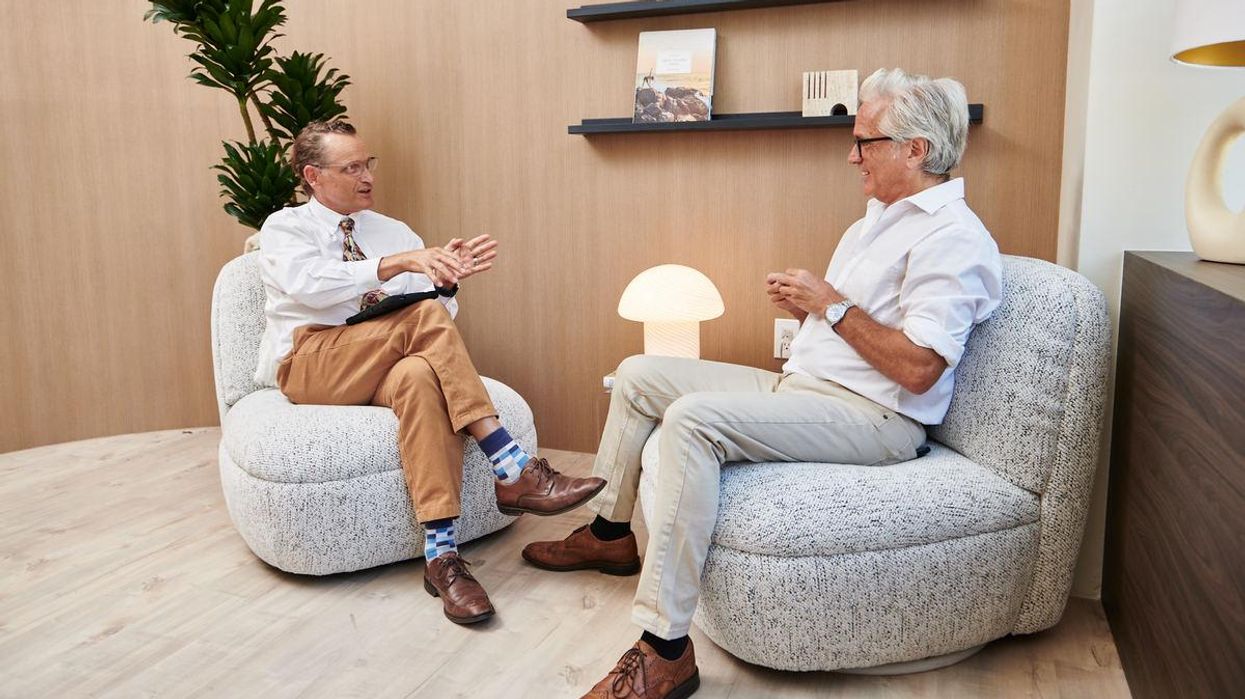
Antonio Ocana (left) sitting down with another person in the Pasithea clinic.
Courtesy of Pasithea

On the stretch of Sunset Boulevard, where the line between West Hollywood and Beverly Hills becomes faint, inside an eight-story, low-rise medical building, wrapped with a 60-foot poster of J.Lo’s pixel-perfect naked body, the ketamine clinic of the near future is preparing for the clinically depressed.

Pasithea is the latest ketamine center to grace Los Angeles. Inside their state-of-the-art, 1,235 square-foot facility, light oak wood walls, the likes of Scandinavian-themed architecture proliferating throughout the city, welcomes patients with the prospect of chic possibilities.


“Tall doors and tall windows are hardwired to your brain to give you bigger thinking,” says Antonio Ocana, the clinical director of Pasithea’s L.A. office.

The tiny window in the waiting room—a feature typical of the other offices in the Sunset Medical Tower, or so I’m told—has been scrapped in favor of a cascading frosted glass.

“It’s to bring in more natural light,” says Daniela Amador, the 20-something interior designer of the clinic. And the removal of sharp corners in the waiting room in favor of curves, she says, “was a representation of the cycle of life.”

In that sense, the Pasithea clinic feels less like a psychiatric office where they administer intravenous dissociative anesthetics and more like a desert sanctuary.

“There are two types of [ketamine] clinics or two types of vibes so to speak,” says Manuel Hoyer, Pasithea’s VP of Growth and Marketing. “One is a very hippy-esque, mom-and-pop shop that to a degree feels very aligned with the movement around psychedelics that’s not quite super credible for folks seeking out something medically backed. And on the other side of the spectrum you have more dentist-office-like spaces that are not giving away the sense that this is an innovative treatment.”

This distinction is important considering Pasithea is hardly the first ketamine clinic to open brick and mortar in L.A. In fact, it’s not even the fifteenth. Since 2014, when anesthesiologist Steven Mandel, who co-founded Ketamine Clinics Los Angeles, began using ketamine for off-label purposes to treat depression and other mental health disorders, Los Angeles has seen more than 1,000% increase in the number of clinics, based on the current number of ketamine clinics listed on Yelp. The current market size of this industry is estimated at $900 million. It helps too that in 2019, the FDA approved a version of ketamine called esketamine for mental health treatment. Under the brand name Spravato, the antidepressant is administered via nasal spray.

At Pasithea, the price per session for IV ketamine treatment is $700.

“Spravato will be offered as well starting next month,” says Hoyer. They recommend starting with six sessions of IV ketamine that are typically undergone anywhere between one to three weeks. Other ketamine clinics in Los Angeles have a similar protocol but range in price between $400 and $700 per infusion. Which is to say, Pasithea, if anything, is on the higher end of the spectrum.

But such is the price of healing inside a facility that looks less like a medical office and more like a cream-hued fantasy dream. Similar in sensibility, as Hoyer says, to “Santa Monica’s Proper Hotel,” with its sandy palette that alludes to a beach setting.

In recent years or, at least since 2020, much of the reporting on ketamine clinics has, inadvertently, drawn attention to the “vibe” of the facilities. Last year, when reporting on Field Trip, a ketamine clinic in Santa Monica that opened in September 2020, dot LA’s Keerthi Vedantam noted that, “the clinic is outfitted with mid-century furniture, fluffed-up cushions and shaggy rugs, almost like an Architectural Digest spread came to life.”

In her story from 2020 on the mainstreamification of ketamine therapy, the New Yorker’s Emily Witt wrote that the “decorative touches'' of Field Trip’s New York office, “are spa-like: white rugs, fiddle-leaf figs, electric candles inside glass-paned lanterns.” Adding that, “The aesthetic seems based on the assumption that, when a company hopes to take a formerly taboo practice mainstream, a West Elm interior can go a long way.”

Additionally, Field Trip has been described as, “not your average doctor’s office.” The waiting room, writes Sara Spruch-Feiner for Coveteur, “looks more like your chicest friend’s living room, with plenty of natural sunlight, a tactile moss wall, and aesthetically minded furniture.”

All of which is a far cry from the ketamine clinics of yore, which one Redditor described as being “in the back of a [P]olish pharmacy next to a kebab shop,” or “full of incense and pretty psychedelic.”

According to Ocana, to be eligible for ketamine therapy inside Pasithea’s lush, contemporary facility, a patient has to have already tried at least two different SSRIs. Which is important considering IV administered ketamine is not currently FDA approved for any psychiatric indication.

“There are a number of FDA-approved medications and evidence-based treatments for depression, including medications, TMS [transcranial magnetic stimulation], ECT [electroconvulsive therapy] and evidence based psychotherapy,” says Charles Nemeroff, the chair of Department of Psychiatry and Behavioral Sciences at the University of Texas in Austin. “Where ketamine should fall in the treatment algorithm is unclear at this time. I see many patients with treatment-resistant depression who are immediately sent to a ketamine clinic before other well-established treatments have been tried.”

To that end, Nemeroff says, only a small minority of the clinics you are referring to adhere to these recommendations.

“Unfortunately, if you have the funds to pay for a treatment, you can easily receive it,” he adds.

Which is exactly the sort of clientele Pasithea hopes to attract with its palatial motif. According to VP of Operations Chirstian Pedrini, their primary demographic is “people between the age of 25 and 45, successful, either corporate or execs, probably tech and working in the entertainment business, basically people working in high stress environments.” Adding that for these types of people, “the thing you always need to take into account with these psychedelic treatments, is setting is really important.” Hence the floor-to-ceiling wall installation in the waiting room, backlit and ornamented with white vases and beach dried palm spears. Or the white leather phlebotomy chairs. Or the vases and wall art sprinkled throughout the facility, that look as though they’ve been picked out of a CB2 catalog.

Such is the inevitable result of ketamine going mainstream and backed by venture capital. In fact, these days, you don’t even have to go looking for ketamine therapy to find it. Per Rolling Stone’s recent report on the telemedicine company Peak, they’re pushing ketamine therapy via TikTok. Pasithea, at least, who does offer at-home ketamine therapy, does require that a medical professional administer the IV.

Ultimately, says Amador, her goal when designing the Pasithea clinic was to redefine what a doctor’s office could be — to demolish that feeling most people get when they arrive inside the typically aseptic waiting area replete with old gossip rags.

“We want the opposite,” she says. “We want the patient to feel at home.”

An LA AI Company Just Won Entertainment’s Backing

🔦 Spotlight

Hello LA.

The entertainment industry has spent the past several years debating what generative AI could take from creators.

This week, some of its biggest companies put money behind an AI startup promising to build something for them instead.

Los Angeles-based Stability AI raised $76M in Series B funding from an investor group that includes Electronic Arts, Sony Music Group, Universal Music Group and Warner Music Group. AMD Ventures and Pacific Alliance Ventures also joined the round, while LA-based MANTIS Capital and Sound Ventures are among the company’s existing backers.

The financing brings Stability AI’s total funding under CEO Prem Akkaraju to $232M, including two equity rounds and convertible notes. The company plans to use the new capital to expand its creative production tools, applied research and professional services across music, gaming and entertainment.

The amount is notable. The names attached to it are the bigger story.

Generative AI’s arrival in entertainment has been anything but quiet. Artists have questioned whether their work was used to train models without permission. Studios have faced pressure over how the technology could affect jobs. Record labels have pursued AI companies in court while simultaneously exploring how the same technology might fit into their businesses.

Now, several of the world’s largest entertainment companies are investing directly in one.

That does not mean the industry has resolved its concerns about AI. It means some of its biggest players would rather help shape the technology than wait to see what it becomes.

Stability AI is positioning itself for that opening. Rather than focusing solely on general-purpose models, the company is building tools specifically for professional creatives. Its recently launched Stable Audio 3.0 was trained on fully licensed music and lets artists generate, edit and arrange audio through a web platform or directly inside digital audio workstations.

Image Source: Stability AI

That licensed-data approach is central to the pitch. The next phase of creative AI will not be decided only by which company produces the most impressive model. It will also depend on which companies can earn the trust of the artists, studios and rights holders whose work gives those models value.

For its new strategic investors, the round offers more than financial upside. It creates a closer view into how generative AI may change production, a voice in how the tools develop and an opportunity to establish rules before those rules are established for them.

For Stability AI, the backing provides something equally important: credibility inside industries that have every reason to scrutinize what it is building.

The company now has capital and access to some of the largest catalogs, franchises and creative workforces in entertainment. What it does with that access will determine whether this becomes a meaningful alliance or simply an impressive collection of logos.

Either way, the industry is no longer watching from a safe distance.

It has entered the room.

LA’s Air-Taxi Plans Are Coming Downtown

While Stability AI is trying to change how entertainment gets made, Archer Aviation wants to change how people get to it.

AEG and Archer announced plans to develop downtown Los Angeles’ first vertiport at L.A. LIVE, creating a potential new stop in Archer’s proposed electric air-taxi network ahead of the 2028 Olympic and Paralympic Games.

Image Source: Archer

The planned site would sit beside Crypto.com Arena and allow passengers to travel to and from the entertainment district aboard Archer’s Midnight aircraft. The company says its network could turn drives that take an hour or longer into electric flights lasting approximately 10 to 20 minutes.

Archer has already identified SoFi Stadium, USC and Hollywood Burbank Airport as possible locations, with its recently acquired Hawthorne Airport expected to serve as the network’s central operating hub. As the official air-taxi provider of LA28 and Team USA, Archer has an unusually visible deadline for turning those plans into something tangible.

AEG and Archer have completed an initial feasibility study of the L.A. LIVE site, including reviews of land use, airspace, power availability and community impact. The next phase will examine operations and the passenger experience.

There is still a substantial distance between a proposed vertiport and a functioning air-taxi network. The infrastructure must be built, regulatory approvals must be secured and passengers must be persuaded that flying across the city is safer and more practical than staying on the ground.

Still, few locations could make that future feel more real than L.A. LIVE. Millions of people already pass through the district for concerts, games and major events. Placing a vertiport there would bring urban air mobility out of the concept stage and directly into public view.

Together, this week’s announcements show Los Angeles becoming a testing ground for two technologies still moving from promise toward everyday use.

One could reshape how entertainment is created. The other could reshape how Angelenos reach it.

In a city famous for both its creative industries and its traffic, that feels appropriately on brand.

More from this week’s LA startup and venture scene below.

🤝 Venture Deals

    LA Companies

    • Atorie raised a $9.5M seed round from investors including a16z speedrun, Night Capital and Lightspeed Venture Partners’ Jeremy Liew. The AI-powered fashion startup connects consumers directly with luxury manufacturers to offer high-quality goods without traditional designer markups, and will use the funding to expand logistics, production and its AI shopping tools. - learn more
    • Long Beach-based Maglut Heavy Industries emerged from stealth with $3.1M in pre-seed funding from Wave Function, Nova Threshold and Julian Capital. The startup is developing a chromatography-based system to process and refine rare earth elements domestically, with pilot tests producing materials at more than 99.9% purity. - learn more

    LA Venture Funds
    • MANTIS Venture Capital participated in Voya Energy’s $35M Series A, led by Energy Impact Partners and joined by John Doerr, StepStone, Founders Fund, Overmatch and Seven Stars. The Hayward-based startup will use the funding to commercialize its aluminum-fueled generators, which provide clean, off-grid power for data centers and other energy-intensive operations without combustion or local air emissions. - learn more
    • Regeneration.VC participated in eComID’s $17M seed round, led by Systemiq Capital and joined by Course Corrected, Stadium and returning investor CapitalT. The Stockholm-based startup will use the funding to expand internationally and scale its AI-powered Shopping Passport, which helps retailers personalize sizing and product discovery while reducing returns. - learn more
    • Clocktower Technology Ventures participated in Helcim’s $53M Series C, led by BDC Capital’s Growth Venture Fund and joined by new investors Curql Collective and LA-based Gold House Ventures. The Calgary payments company will use the funding to expand its platform, develop additional financial services and serve more small and midsize businesses across North America. - learn more

    LA Exits

    • Altruist agreed to be acquired by Vanguard, giving the Los Angeles-based wealth technology and custody platform greater resources to expand its tools for independent financial advisors. Altruist will continue operating as a standalone business under its existing leadership and brand after the deal closes, which is expected later this year pending regulatory approval; financial terms were not disclosed. - learn more
    • Personality AI has been acquired by WildBrain for approximately $11M in cash and 1M WildBrain shares upfront, with additional payments tied to future performance. The startup develops kid-safe conversational AI experiences for entertainment characters, including “Hey Peppa Pig,” and will help WildBrain expand its franchises into interactive products across toys, apps and digital platforms. - learn more

      Download the dot.LA App

      This Torrance Startup Just Raised $1B to Mass-Produce Hypersonic Missiles

      🔦 Spotlight

      Happy Friday, Los Angeles.

      Castelion has spent the past four years trying to prove that hypersonic missiles do not need to take decades to develop or cost so much that the military can only afford a limited supply.

      Now comes the harder part: producing them at scale.

      The Torrance-based defense startup raised a $1B Series C at a $13B valuation. The financing includes $800M in equity and a $250M revolving credit facility, making it one of the largest recent raises for an LA defense technology company.

      JPMorganChase’s Strategic Investment Group, Andreessen Horowitz and Carlyle co-led the round. Lightspeed Venture Partners, Lavrock Ventures, Altimeter, General Catalyst, T. Rowe Price and LA-based Interlagos Capital also participated.

      Castelion will use the capital to ramp production of Blackbeard, its low-cost hypersonic strike missile, while developing a longer-range precision weapon and new defensive systems. Hundreds of millions of dollars will go toward expanding manufacturing at Project Ranger, the company’s 1,000-acre production campus in New Mexico.

      Image Source: Castelion

      Blackbeard was designed in California, will be built in New Mexico and is expected to enter service in 2027. Castelion says it has already secured more than $500M in U.S. military contracts over the past 18 months and moved the missile from a clean-sheet concept to an official program in fewer than four years.

      That timeline is central to Castelion’s pitch. Traditional defense programs are often associated with long development cycles, limited production runs and eye-watering costs. Castelion is applying the rapid testing and vertically integrated manufacturing approach popularized by commercial space companies to weapons production.

      But a $13B valuation changes the standard. Castelion is no longer being judged as a promising startup with an impressive prototype. It is being funded like a company expected to become a major part of the American defense industrial base.

      The question is no longer whether a startup can build a hypersonic missile. It is whether one can manufacture thousands of them without losing the speed, discipline and cost advantages that made it disruptive in the first place.

      For LA’s defense ecosystem, that shift matters. The region has become home to a growing number of companies promising to modernize how America builds critical hardware. Castelion now has the capital, contracts and facilities to show what happens when that promise reaches the factory floor.

      The next test will not be in a pitch deck. It will be in production.

      More from this week’s LA startup and venture scene below.

      🤝 Venture Deals

        LA Companies

        • Long Beach based Ampaire raised a $19M Series B led by DiamondStream Partners, with strategic participation from Alaska Star Ventures and IAGi Ventures, bringing its total funding to $68M. The hybrid-electric aviation company will use the capital to expand flight operations, produce additional Eco Caravan aircraft, advance regulatory certification and scale its manufacturing capabilities. - learn more

        LA Venture Funds
        • SUM Ventures participated in AssistMe’s €6.5M funding round, which was led by CRB Health Tech and Vorwerk Ventures and included several returning investors. The German care technology company will use the capital to expand across Europe, prepare for a U.S. launch and further develop alea, its digital platform for supporting caregivers and improving nursing-home operations. - learn more
        • CIV led Hypercubic’s $5.3M seed round, with participation from Y Combinator, Afore Capital, Pioneer Fund, Multimodal Ventures and several angel investors. The San Francisco startup will use the capital to develop AI agents that can analyze, document and rewrite decades-old COBOL systems, helping enterprises modernize critical mainframe software faster and with less risk. - learn more
        • Plus Capital participated in Wispr Flow’s $280M Series B, led by Menlo Ventures and joined by existing and new investors, valuing the AI voice company at $2B. The funding brings Wispr’s total capital raised to $361M and will support its expansion beyond dictation into meeting tools and proprietary speech technology, including its new Canto model. - learn more
        • Alexandria Venture Investments participated in Leal Therapeutics’ $30M Series A extension alongside new investor Eli Lilly and returning backers including OrbiMed, Newpath Partners and SV Health Investors’ Dementia Discovery Fund. The biotech company will use the funding to advance clinical trials of LTX-001 for schizophrenia and LTX-002 for ALS, with initial schizophrenia trial data expected by year-end. - learn more
        • BroadLight Capital participated in Higgsfield’s $400M Series B, led by DST Global and joined by investors including Goldman Sachs Alternatives, Smash Capital, Fifth Wall and Intel Capital. The AI video and image platform, now valued at $5.4B with $700M in annualized revenue, will use the funding for R&D, global infrastructure, AI hiring and international expansion. - learn more

          Download the dot.LA App

          Why Samsonite Just Paid $178.5M for BÉIS

          🔦 Spotlight

          Hello, Hello.

          This week, one of LA’s most recognizable consumer brands packed its biggest bag yet.

          Samsonite Group has agreed to acquire an 85% stake in BÉIS for $178.5M, valuing the Los Angeles-based travel and lifestyle brand at approximately $210M. The deal is expected to close in Q4, pending regulatory approval.

          Founded by actress and entrepreneur Shay Mitchell and incubated by LA-based Beach House Group in 2018, BÉIS has grown from a digitally native luggage startup into a profitable business that generated approximately $210M in sales last year. Along the way, it built the kind of fiercely loyal online following that legacy brands spend years and considerable marketing budgets trying to manufacture.

          Image Source: BÉIS

          That may be the most interesting part of this deal. Samsonite is not simply acquiring another luggage line. It is buying access to a younger, predominantly female customer base, a sophisticated direct-to-consumer operation and a brand that knows how to turn social media attention into actual sales. The suitcases are useful; the cultural relevance is the real carry-on.

          BÉIS will continue operating as a standalone brand under CEO Adeela Hussain Johnson and its existing management team. Mitchell will retain a 15% ownership stake and continue guiding the company’s creative and product vision, while Samsonite brings the global distribution, sourcing and logistics infrastructure needed to take the brand further.

          For LA’s startup community, the acquisition is another reminder that valuable technology companies do not always look like software companies. BÉIS built its advantage through digital distribution, community and an unusually sharp understanding of its customer. Now, one of the world’s largest luggage companies wants what it created.

          Sometimes the strongest exit starts with knowing exactly what people want to pack.

          More from this week’s LA startup and venture scene below.

          🤝 Venture Deals

            LA Companies

            • Heaviside Industries raised a $60M Series B to accelerate the development and production of its autonomous precision munitions for U.S. and allied forces. The company also announced a strategic partnership with defense manufacturer Nammo, combining Heaviside’s autonomous weapons technology with Nammo’s expertise in propulsion, warheads and large-scale munitions production. - learn more
            • Alex Cooper and Matt Kaplan’s media company Unwell received its first outside investment from WTSL, giving the profitable business a $500M pre-money valuation. Unwell, which reaches a reported 70M women each month through podcasts, film and television, live events, consumer products and a creative agency, will use the capital to pursue acquisitions, make investments and expand into new business lines. - learn more
            • Neros raised a $250M Series C at a $2.5B valuation, with participation from LA-based Interlagos, MANTIS Venture Capital and Thiel Capital. The El Segundo defense startup will use the funding to scale its autonomous strike and interceptor drone programs, expand production and strengthen its domestic supply chain as demand grows from the U.S. military and allied forces. - learn more
            • FriskAI raised $3.6M from MaC Venture Capital to expand its observability and security platform for AI agents. The startup helps companies monitor what autonomous agents do in real time, giving teams greater visibility into agent behavior and helping them identify errors, risks and unexpected actions. - learn more
            • Diald raised $1M in follow-on funding led by Feedback Ventures, bringing its total funding to $4.75M. The company also launched a rebuilt conversational AI platform that lets commercial real estate investors create pro formas and evaluate zoning, permits, neighborhood sentiment and other property risks through plain-language prompts. - learn more

            LA Venture Funds
            • Alexandria Venture Investments participated in Khartis Therapeutics’ $50M Series B, led by Forge Life Science Partners, bringing the San Diego biotech’s total funding to $95M. Khartis will use the capital to advance its lead oral treatment for thyroid eye disease and expand its pipeline of small-molecule immunology drugs. - learn more
            • Finality Capital Partners co-led Entravel Group’s $7.5M funding round alongside Ethereal Ventures, with participation from GSR, Varrock, G1 Ventures, Seier Capital, Veris Ventures, Funfair Ventures and WTG Ventures. The traveltech company will use the capital to expand its white-label hotel-booking infrastructure beyond crypto platforms and develop a stablecoin-powered system for settlement, treasury and working-capital financing. - learn more
            • Regeneration.VC participated in Clarity Systems’ $4.4M seed round, led by LMnT Ventures and joined by Humba Ventures and Massive Technology Ventures. Clarity uses X-ray imaging, computer vision and AI to detect counterfeits, product swaps and other forms of returns fraud in seconds without opening the package. - learn more
            • CIV participated in AGent Energy’s $11M Series Seed round alongside existing investor Zero Infinity Partners, with Spero Ventures and MassMutual Ventures co-leading and Intrepid Investment Management also joining. The Houston startup uses AI-powered hardware and software to turn largely idle backup generators into on-demand grid capacity during emergencies, and the new funding brings its total raised to $17M. - learn more
            • Smash Capital co-led CodeRabbit’s $143M Series C alongside Atomico, valuing the AI code-review company at $1.5B. CodeRabbit will use the funding to expand internationally and develop its new Agentic Change Management platform, which helps companies review, govern and monitor software created by both humans and AI agents. - learn more
            • Multiball Capital backed Soctera’s $4M seed round alongside Anorak Ventures, with additional participation from 9Yards Capital, Mana Ventures and Red Bear Ventures. The Cornell spinout will use the funding to develop heat-efficient power amplifiers designed to improve the range, signal quality and reliability of radar, electronic warfare, satellite and telecommunications systems. - learn more
            • WndrCo participated in Genera’s $10M seed round, which was led by First Round Capital and also included BoxGroup, Carpenter Capital and Success Venture Partners. Genera will use the funding to scale its AI platform, which automates the often labor-intensive process of deploying enterprise software, including customer discovery, data migration and system configuration. - learn more
            • M13 co-led Baselayer’s $20M Series A alongside Koro Capital, bringing the fintech startup’s total funding to approximately $47M. Baselayer will use the capital to enhance its AI-powered platform, which helps banks, fintech companies and government agencies automate business verification, risk assessment and fraud monitoring. - learn more

              Download the dot.LA App

              RELATEDEDITOR'S PICKS
              Trending