

But others in the local esports market have pulled back on their plans for stadiums, focusing instead on the lucrative merchandising and sponsorship income that ballooned during the pandemic.
After a whirlwind few years when interest in esports skyrocketed, the industry is grappling with what the future of competitive play looks like.
In particular, teams and tournament organizers are facing a critical question: Is an in-person presence necessary to their operations?
‘Fans Need a Home’
Glytch is one esports outfit gunning for more arenas, betting that ambitious, state-of-the-art facilities could draw in even larger crowds by providing a centralized infrastructure for esports.
The company is currently working on the first of its stadiums in Los Angeles, home to a slew of top-talent esports teams and gaming companies, including TSM, Immortals, Cloud 9, Team Liquid and FaZe Clan. All have bases or training facilities in L.A.; none own stadium space, although gaming organization 100 Thieves operates its own broadcast center at its Culver City headquarters.
Glytch co-founder and chief financial officer Michael Williams wouldn’t disclose the exact location for his planned stadium, but he’s already inked a partnership with events company Legends that would see the New York-based firm – which has deals with Inglewood’s SoFi stadium and the LAFC’s Banc of California Stadium Downtown – operating all Glytch’s completed venues.
“There’s a lot of different stadiums [esports teams] can play at, but ultimately [fans] need a home,” Glytch’s CEO, Gerome Seeney told dot.LA.
The company’s custom-built arenas will each cost between $54 million and $75 million to construct and encompass 1,500 to 3,000 seats across a total 120,000 square feet, combined with a mixed-use stage and broadcasting capabilities.
Glytch is looking to subsidize some of that development cost with municipal funds. While it is not seeking city funding in LA, the company is “exploring” bond agreements with the cities of Chicago and Atlanta, Williams said.
Glytch, which counts Joe Montana and Twitch co-founder Kevin Lin among its investors, plans to host at least 16 events each month. While it won't say precisely how much esports event tickets will cost, non-esports event tickets average around $80 in Los Angeles per Pollstar data, Williams said, adding that he was optimistic that price will continue to rise.
Williams wouldn’t disclose how much Glytch has raised since its 2020 launch but said, “the vast majority of our funding is from sports industry people, not venture people.”
Williams’ prior ventures include esports tournament organizer Oomba and video arcade chain GameWorks, which shut down in December 2021.
Glytch plans to generate revenue by hosting other events at its venues, along with esports.
“Today, we might have an esports event, tomorrow, there might be a TED talk,” Seeney said.
There currently aren’t any sponsors lined up to slap their name on Glytch’s forthcoming arena, and it’s too early for teams to be signed up to play there. Williams said Legends is responsible for courting naming rights deals roughly a year prior to opening.
To cater to a more casual crowd, Glytch’s stadium will contain a place for people to rent equipment to play live games on a local area network (also called a LAN center).
“We plan to charge very little for our LAN center because that will not be our primary source of income,” Williams said. “Having great gaming machines at a reasonable rental rate is not sufficient to pay the high rents charged in the L.A. basin. Instead, the company must have a complete solution that includes multiple revenue sources.”
And the venue would be part of a “broader, master-planned… entertainment, sports and wellness district” with a number of tenants and upcoming projects, according to Brian Mirakian, who works for Populous, the architecture firm tasked with designing the complex. The firm has helped build 1,300 sports stadiums globally, and is now working on a redesign of the L.A. Convention Center.
Mirakian compared Glytch to Topgolf, the driving range chain that recently opened a facility in El Segundo, adding that “there's a tremendous amount of excitement around returning to the live events.”
He said the arena is in the “early stages of design” and hasn’t yet broken ground – its estimated opening is first quarter of 2025.
Glytch isn’t alone in its ambitions to build an in-person esports center in the city.
Dr. Patrick Soon-Shiong, owner of the LA Times, announced plans to build “the Staples Center of esports” adjacent to the Times’ El Segundo headquarters in 2019, but construction never got underway, though his company did build a seven-acre lot near the El Segundo campus that hosts Epic Games’ L.A. production lab.
Hillary Manning, a spokeswoman for Soon-Shiong, told dot.LA the billionaire hasn’t totally abandoned plans for a stadium.
“The Soon-Shiongs remain interested and invested in esports and are still considering building an esports arena,” she said.
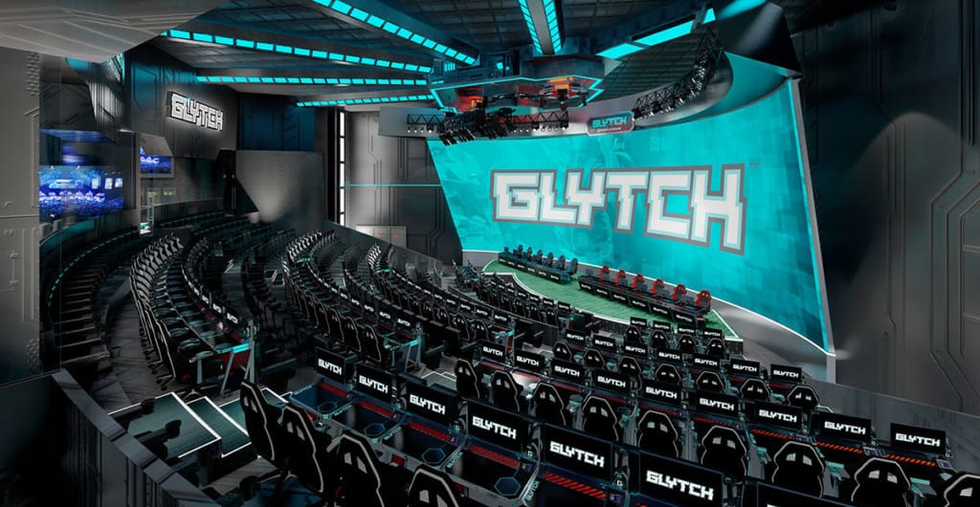 A rendering of the design of Glytch's esports arena, which it says will seat thousands.Credit: Glytch
Competition, Live and At Home
Paying for premium stadium real estate could be difficult if people fail to show up, and many in the esports world see venues as an unnecessary money suck, given that fans have become used to not watching in-person.
“The beauty of the sport is it clearly doesn't matter” where fans are, said Bruce Stein, former co-founder of esports organization Team Liquid. “It's a different kind of affinity and connection, and it works really best online… that means you have to adapt your business to it.”
The pandemic prompted a renewed interest in watching esports – the global fan base is set to grow nearly 9% annually to 532 million people by the end of this year, according to analysts at Newzoo.
The esports industry, which is on pace to rake in nearly $1.4 billion by the end of 2022, has been doing just fine without a concentrated network of in-person venues, especially because many tune in strictly online. Its unprecedented rise during the pandemic has been thanks mainly to lucrative sponsorship deals, which made up an estimated 60% of the entire market.
“A typical day for us would be like 4,000 people at our facility and 100,000 people online,” Williams speculated.
Reaching a broad audience is key to not going bankrupt when you’re a facility owner. One cautionary tale: OGN’s now defunct 35,000-square-foot esports arena.
The South Korean broadcast company moved into a Manhattan Beach arena in 2018 but couldn’t fill the seats.
“They couldn't book it enough and it didn't drive enough revenue and we shut it down,” said Greg Lovett, executive managing director of Cushman Wakefield’s L.A. realty office, who oversaw the deal while working at Cresa Partners.
“We had to sublease it to a production company,” he said, adding that OGN ultimately found that, unlike South Korea, U.S. gamers just weren’t used to going out to see live esports events.
Another example: Irvine’s now defunct Esports Arena. According to an insider, the property was built by a mall operator unfamiliar with the specifics of building a venue for hundreds or thousands of spectators. The arena quickly shut down because it couldn’t get enough fans through the doors each month to keep the lights on.
“An audience-rated facility is very expensive, and very difficult for permitting because of fire safety,” Lovett said. “If you go to the city today and say, ‘I want to build something like [an esports arena], that’s a mega-project,” he said, adding that retrofitting a building to be a stadium instead of custom construction is “almost impossible."
Glytch’s plans for an esports stadium differ from OGN’s and the Esports Arena’s in terms of scale: Glytch wants its first L.A. outpost to be part of a network of nationwide arenas that all feed into the esports fandom and prop up company revenue.
Williams said he thinks esports can succeed if it mirrors traditional sports, partly because that’s an ecosystem that regional fans – but perhaps more crucially, big-box advertisers with sponsorship cash to flex – are familiar with.
“We had the idea of, ‘Let's build these sports stadiums across America. If esports is the next NFL, then there ought to be stadiums,’” Williams said.
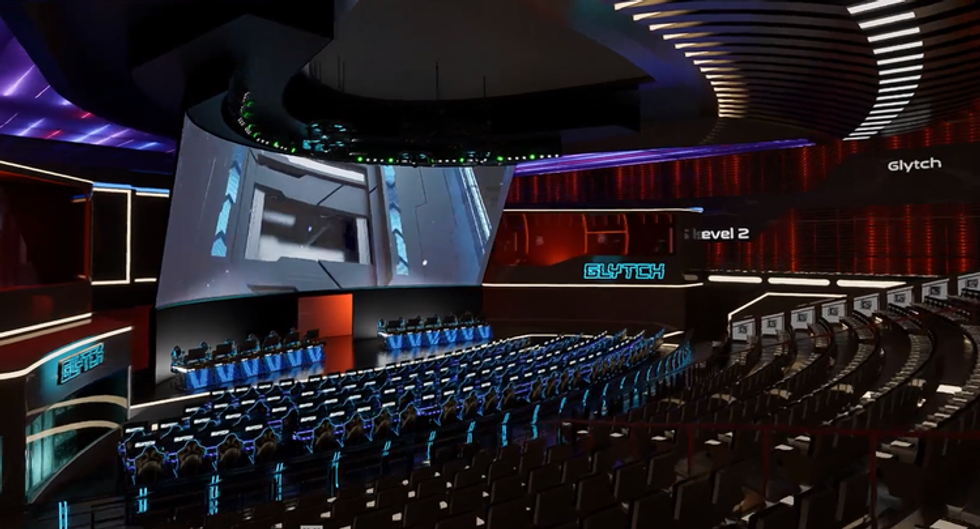 A rendering of the design of Glytch's esports arena, which it says will seat thousands.Credit: Glytch
If You Build It, Will They Come?
Still others in the industry see an opportunity for a forward-thinking company backed by investors with deep pockets and vision to build esports into an in-person event in the U.S. But much will depend on whether fans prove interested and venue operators are able to find sponsorship.
“Most esports organizations don’t own a stadium,” said Dominic Kallas, vice president of esports company TSM, which operates 12 teams from its base in Playa Vista.
Kallas said TSM’s focus is on sponsor deals, but he noted that it recently inked a $210 million naming rights deal with cryptocurrency exchange FTX in early June.
“You can stay profitable off of doing large deals like that” to offset pricier franchise or venue costs, Kallas said.
Williams told dot.LA that Glytch’s arenas will have to rake in at least $8 million across box office, merchandising and concessions in order to break even, but is targeting $10 million annually.
Others agreed that the potential is there, but say the model still hasn’t been created, in the U.S., at least.
“I think that there is a bigger demand, if people can figure out the programming side of it,” said Erik Anderson, head of esports for gaming group FaZe Clan.
“On our side, it's something that we find super interesting at a certain size, [but] when it goes over a certain size, it's no longer interesting and starts to become a burden… There's a certain size when experimenting is no longer an option, because it's too expensive,” Anderson said, adding that “1,000 seats might be too much in the current marketplace.”
Riot Games’ Esports Event Producer Daniel Lee said he thinks locality plays a role in esports, but isn’t convinced that means stadiums would play the same role as they do for other types of sports.
“I believe a city-based [team] will create fandom,” he said. “But traditional sports and esports are completely different beings,” he said, added.
Stein agreed.
“If you try to make it look the same, you're investing for the wrong reason. You may get much more out of it than traditional sports, but don't try to make it the same just because there's competition.”
For his part, Williams said he isn’t daunted by the prospect of building the stadiums along with the market for them.
“We hope that we can be the home team [stadium]” for all local esports teams, he said, adding “I hope the numbers in esports continue to grow, the way football has.”
As the industry transitions back into blockbuster events and in-person championship, will esports follow a trajectory that mirrors the NFL’s rise to its place as an intrinsic part of American sports culture? The answer may simply depend on who shows up.
Editor's note: This story has been updated to reflect the make-up of Glytch's founding team.
- Esports One Provides 'Fantasy Sports' for Competitive Gaming - dot.LA ›
- 'LA Hasn't Built a Stadium of This Size in 100 Years': SoFi Stadium Is ... ›
- Infinite Reality's $470 Million Bet on Metaverse Gaming - dot.LA ›
- The Future of NRG Esports Is in Madison Square Garden - dot.LA ›
- LA Tech Week: Normalizing Esports Investment Downturns - dot.LA ›
- Mastery Esports (@mastery_esports) on Instagram • 1 photos and ... ›
- Glytch | Founder Michael Williams on the future of esports | blooloop ›
- Esports Arena - Wikipedia ›
- About — Glytch ›
- Glytch Announces Populous as Design Architect for its Esports ... ›
- Glytch announces major esports and gaming arenas | Esportz Network ›