

🔦 Spotlight
Hello, LA.
Most companies built around solar energy are trying to capture more sunlight.
Reflect Orbital wants to move it.
The Hawthorne-based startup is developing satellites equipped with large reflectors that could redirect sunlight from orbit to specific locations on Earth after sunset. The idea sounds borrowed from science fiction, but Reflect Orbital is getting closer to testing whether it can work at commercial scale.
This week, the company announced $73.5M in new funding, bringing its total raised to more than $100M. Existing investors Sequoia Capital, Lux Capital and Starship Ventures participated alongside new backers including Buckley Ventures, Convective Capital, The Uncommon Group and Salesforce Ventures.
The funding will support Reflect Orbital’s first satellite launches, continued development of its reflector technology and new commercial partnerships across the energy and lighting industries.
The company’s premise begins with a familiar limitation: Solar panels stop producing energy when the sun disappears below the horizon, often just as electricity demand is rising.
Reflect Orbital wants to extend that window.
Its planned satellites would remain in sunlight while orbiting Earth, then angle their reflectors toward selected areas on the ground. Solar farms could potentially generate electricity beyond daylight hours without acquiring more land or replacing their existing infrastructure.
The same technology could eventually illuminate disaster zones for search-and-rescue teams, help construction crews work more safely at night and provide light in places without reliable electrical infrastructure.
That is a considerable expansion from where the company stood two years ago.
Reflect Orbital raised a $6.5M seed round in 2024 to develop its production vehicles and grow its Hawthorne team. It followed that with a $20M Series A led by Lux Capital in May 2025.
Now, the company is preparing to leave the warehouse and test its technology where it was designed to operate.
Reflect Orbital has received Federal Communications Commission approval for its first demonstration mission, Eärendil-1, which is expected to launch in the second quarter of 2027. The satellite will allow the company to study how its reflector deploys and performs in low Earth orbit while gathering data that could shape future versions of the system. Reflect Orbital has also secured additional launch opportunities for 2027, including two dedicated missions with Skyroot Aerospace.
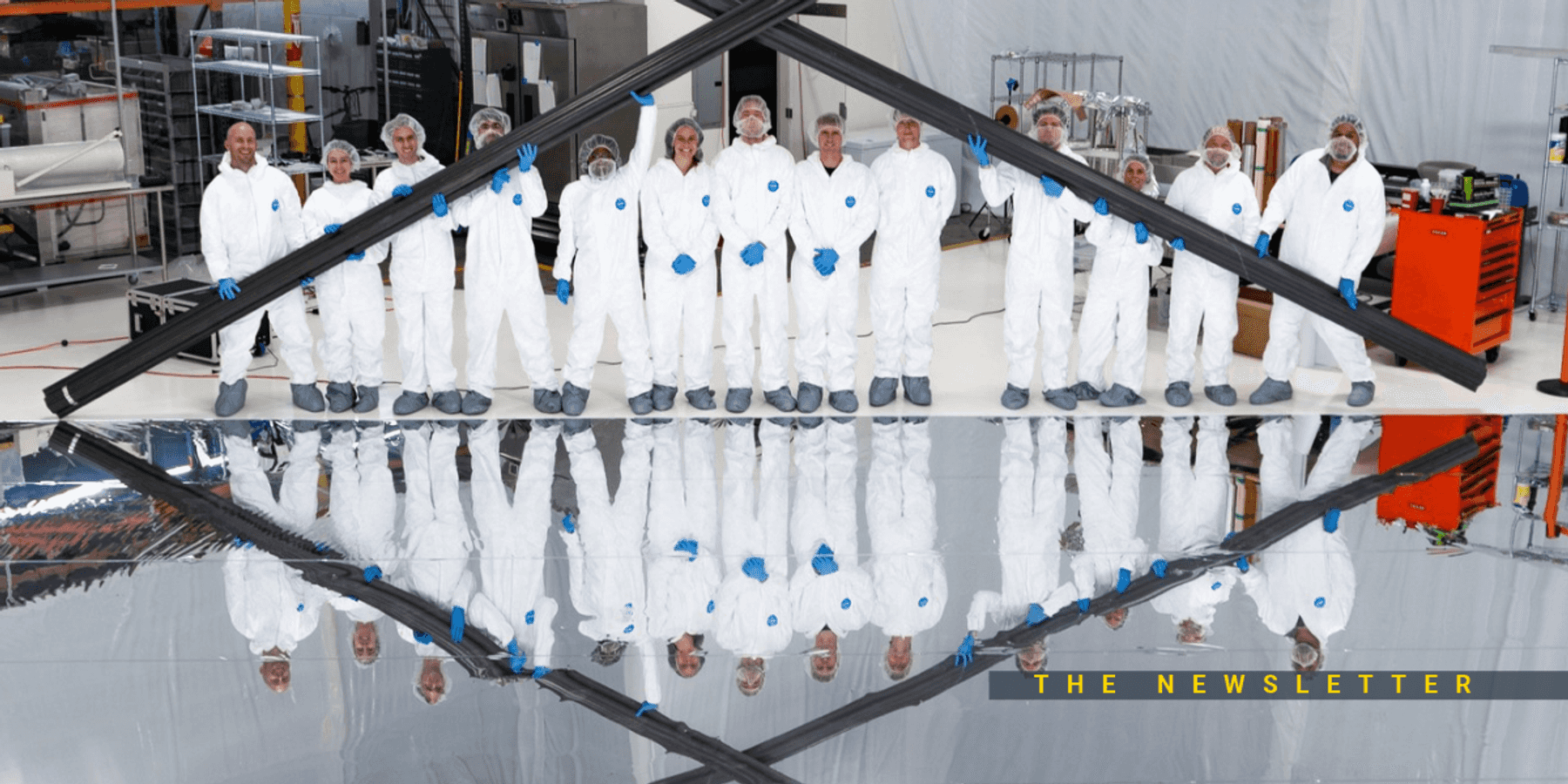
Building the satellites presents its own unusual manufacturing challenge. According to the company, its team produces reflector material 28 times thinner than a human hair, folds individual sections into packages roughly the size of a shoebox and assembles satellites containing approximately 12,000 parts.
In other words, delivering sunlight after dark requires some very careful folding.
The concept has naturally prompted questions from astronomers and dark-sky advocates about light pollution and potential interference with scientific observations. Reflect Orbital says it is designing the service around predictability, transparency and control, including limiting reflections to defined locations and short periods, publishing satellite positions in advance and avoiding observatories and other protected sites.
The demonstration mission is expected to produce illumination comparable to a full moon for no more than five minutes during the two hours following local sunset. Reflect Orbital has also said it will collect data, invite outside evaluation and use the results to refine both its technology and safeguards before attempting to scale.
That process will matter because Reflect Orbital is not simply building another satellite. It is proposing a new kind of infrastructure, one that could change when and where sunlight becomes available.
The company still has significant technical and regulatory work ahead. But it has already moved from an unconventional idea to more than $100M in funding, an approved demonstration mission and multiple launch opportunities.
The next step is proving that its technology can deliver light precisely, reliably and responsibly from hundreds of miles above Earth.
If it succeeds, the sun may no longer disappear from the energy grid when it drops below the horizon.
More from this week’s LA startup and venture scene below.
🤝 Venture Deals
LA Companies
- Helix raised $6.2M in a round led by Chicago Ventures, with participation from BAM Ventures, Aglaé Ventures, Corazon Capital and others. The startup is developing on-device voice technology that verifies whether users are human and estimates their age without collecting traditional identity documents, offering a privacy-focused alternative to CAPTCHA and photo verification. - learn more
- Opdo raised a $2.3M pre-seed round led by Angular Ventures, with participation from Inflection and Tiny.vc. The company uses AI agents alongside established optical-design software to help engineers develop and manufacture complex components faster, and will use the funding to expand its engineering capabilities, improve its AI tools and support more customer projects. - learn more
- Athlete To Athlete raised an $8M Series A led by Rally Ventures, with participation from Newbound VC, Scrum Ventures and UpHonest Capital. The platform pairs young athletes with college-athlete mentors for virtual one-on-one guidance and will use the funding to expand youth sports partnerships, strengthen participant safeguards and reach more families nationwide. - learn more
- Kindo raised $30M in a round co-led by Crosspoint Capital and Forgepoint Capital, bringing its total funding to $57.6M. The company provides a centralized platform for enterprises to monitor and control AI agents, including their data access, activity and costs, and will use the capital to expand sales and further develop its AI management and security products. - learn more
- Trousdale Ventures made a follow-on investment in Databento’s $100M Series C, which was led by Fifth Down Capital and valued the market-data company at $1.1B. Databento plans to accelerate its global infrastructure expansion and build a larger historical market-data archive as demand grows from financial institutions and AI companies. - learn more
- Upfront Ventures led General Translation’s seed round, while Andreessen Horowitz led its Series A, bringing the AI localization startup’s combined funding across the two rounds to $27M. The company is building full-stack infrastructure that helps businesses translate and continuously update apps, websites, documents and videos across languages. - learn more
- Alpha Edison participated in Q-CTRL’s $290M Series C, which was led by Salesforce Ventures. The quantum infrastructure company will use the funding to expand its AI-powered software for improving the performance and reliability of quantum computers and sensors while accelerating commercial adoption. - learn more
- KittyHawk Frontier participated in Twin1 AI’s $5M seed extension, which was led by Curql and brought the company’s total seed financing to $25M. Twin1 develops privacy-focused AI “digital twins” that preserve professionals’ knowledge and working context, and will use the capital to expand across credit unions, law firms and financial institutions while growing its teams and enterprise governance tools. - learn more
- Bonfire Ventures co-led Axle’s $9M funding round alongside Eniac, with participation from Teamworthy Ventures. Axle provides investment banks with a unified platform for managing conferences, corporate access, roadshows and expert engagements, and will use the capital to expand its AI capabilities and bring the product to more financial institutions. - learn more
- TenOneTen Ventures participated in Tristar AI’s $12.4M Series A, which was led by Isogon Ventures. The Cambridge-based company uses AI-powered visual inspection to identify manufacturing defects in real time and will use the funding to improve its vision and edge-computing platform, enter additional industries and support larger deployments across customer facilities. - learn more
- Clearlake Capital Group co-led Mirendil’s $1B Series A alongside Kleiner Perkins, with M13 participating among the company’s other new and existing investors. Mirendil is developing AI agents and tools that allow smaller teams to conduct advanced AI research and will use the funding to make frontier-level R&D more accessible to scientists and engineers. - learn more
- CommonKind VC participated in Akara’s $5.5M funding round, which was led by Locke Health and brought the healthcare technology company’s total funding to $12.3M. Akara combines privacy-preserving sensors, AI agents and robotics to give hospitals real-time visibility into clinical operations, and will use the capital to expand its teams, grow adoption across U.S. hospitals and further develop its physical AI platform. - learn more
- March Capital co-led Rox’s $100M Series B alongside General Catalyst, valuing the AI sales startup at $1.3B. Rox helps large enterprises automate pipeline generation, deal execution and upselling, and will use the funding to advance its AI models and expand across industries including healthcare, energy, financial services and manufacturing. - learn more
- Clocktower Technology Ventures participated in Palomma’s $10M Series A, which was led by Cometa and brought the Colombian fintech’s total funding to $14M. Palomma combines AI leasing software, rent payments and financial products for landlords and tenants, and will use the capital to expand in Colombia, develop additional services and prepare for entry into new markets. - learn more
- Alpha Edison led Agent F’s $4M pre-seed round, with participation from United Founders, Tiny Supercomputer Investment Company and several technology executives and founders. The Berlin startup is building AI-powered enterprise software that automates accounting, financial planning and compliance tasks for fast-growing companies while keeping finance professionals responsible for final approval. - learn more
- Bail Capital participated in Delix Therapeutics’ oversubscribed $100M Series C, which was co-led by Johnson & Johnson Innovation and SV Health Investors’ Dementia Discovery Fund. The neuroscience company will use the funding to advance its non-hallucinogenic depression treatment Zalsupindole into Phase II development and expand its broader pipeline of therapies for psychiatric and neurodegenerative conditions. - learn more
- M13 participated in Nominal’s $240M Series C, which was led by Lightspeed Venture Partners and co-led by Insight Partners at a $3B valuation. The hardware intelligence company will use the funding to expand its AI-powered engineering platform, develop new tools across the hardware lifecycle and enter additional industries and markets. - learn more
- MANTIS Venture Capital participated in Project Omega’s $80M Series A, which was led by B Capital. The nuclear technology company will use the funding to begin building a domestic fuel-recycling facility and advance long-duration power systems that transform materials recovered from used nuclear fuel into energy, reactor feedstock and strategic isotopes. - learn more
- Critical Frontier participated in Mavria’s latest funding round, which was led by Paradigm and valued the infrastructure startup at $1B. Mavria has raised $130M across its pre-seed and seed rounds to scale manufacturing, secure supply chains and build factory-produced data centers designed to bring AI computing capacity online faster and at lower cost. - learn more